
The following letter was written by Lydia (McAllister) McKeen (1838-1933), the wife of James H. McKeen of Patten [post office], Aroostook county, Maine.
Lydia write the letter to Hiram Keay (1828-1907), the son of Thomas Keay and Rebecca Grant of Bowdoin, Maine. Hiram was 34 years old and residing in Island Falls, Maine, when he enlisted as a private in Co. H, 20th Maine Infantry on 29 August 1862. He was transferred to the 2nd Battalion, Veteran Reserve Corps in September 1863 due to the wound he received in his left hand. How of when Hiram was wounded is not stated in the letter but a Return of Casualties in Maine Regiments at the Battle of Fredericksburg shows that he was “wounded and missing.” Most likely Hiram was still hospitalized from that battle seven months earlier as the regiment did not participate in the Battle of Chancellorsville due to an outbreak of smallpox in the regiment.
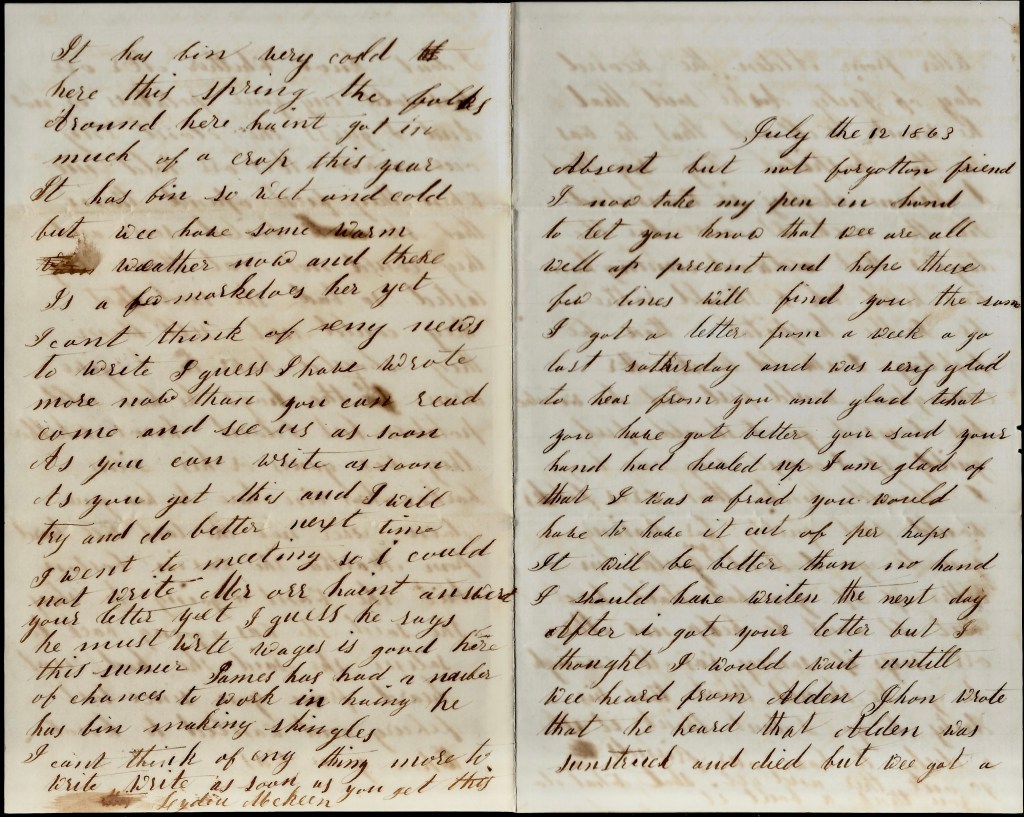
Transcription

July the 12th 1863
Absent but not forgotten friend,
I now take my pen in hand to let you know that we are all well at present and hope these few lines will find you the same. I got a letter from a week ago last Saturday and was very glad to hear from you and glad that you have got better. You said your hand had healed up. I am glad of that. I was afraid you would have to have it cut off. Perhaps it will be better than no hand.
I should have written the next day after I got your letter but I thought I would wait until we heard from Alden [Cunningham]. I have wrote that we heard that Alden was sun struck and died but we got a letter from Alden the second day of July and he said that he wasn’t well and that he was in the hospital. They say that Hiram Chesley 1 is wounded in the neck. It come in the dailies that Edward Cunningham was killed. 2 Oh, I should rather be in the hospital than be fighting. I should think Mr. Cunningham would feel bad. He wanted his boys to go. I should feel guilty if I coaxed anyone to go. I should think that Orr’s folks would feel guilty for teasing you to go. I think you would [have] been better off if you had stayed here. But it can’t be helped now. Mr. Orr says if Sammy [b. 1845] was old enough to go, he should think t’was his duty to go. I don’t think it is a duty to have our friends go out there and get shot. What do you think about it?
I don’t know whether Mr. [William D.] Orr has sold any of your potatoes or not and I guess they don’t anyone know. Mrs. Orr told me when they first opened them that she boiled some and they could not eat them—they tasted so bad. She said that they could not sell them. They should have to give them to the hogs. He has sold potatoes but I don’t know whether they was yours or his.
Silas Barker has been here. He has gone down river now. The last we heard from Martha she was in Boston but she wasn’t going to stay. She said she a going back to Salem. She said she had not heard from you since last February and wanted to know where you was.
It has been very cold here this spring. The folks around here haint got in much of a crop this year, it has been so wet and cold, but we have some warm weather now and there is a few mosquitoes here yet.
I can’t think of any news to write. I guess I have wrote more now than you can read. Come and see us as soon as you can. Write as soon as you get this and I will try and do better next time. I went to meeting so I could not write. Mr. Orr haint answered your letter yet, I guess. He says he must write. Wages is good here this summer. James has had a number of chances to work in haying. He has been making shingles.
I can’t think of anything more to write. Write as soon as you get this. — Lydia McKeen
1 Hiram H. Chesley, attorney, Louisville, was born in Aroostook County, Maine, September 8, 1844, and is a son of Bela H. Chesley, of Anoka, Minn., a native of Oxford County, Maine. Mr. Chesley served in the late war in Co. H, 20th Maine Volunteer Infantry, and participated in the battles of Antietam, Fredericksburg, the Wilderness, Gettysburg and others. He received a gunshot wound through the neck at Gettysburg, which crippled him for life. He lay paralyzed for eighteen months, entirely helpless, and has suffered untold misery ; not an hour passes until the present time that does not bring its pains. He came to Marion County, Ill., in September, 1865. He there read law, and was admitted to the bar in 1867. In April, 1870, he located in Louisville, where he still remains, engaged in the practice of his profession. He was married, January 23, 1868, to Mary E. Tubbs, daughter of Alva Tubbs (deceased). She was born in Jennings County, Ind.” Excerpt from “History of Wayne and Clay Counties, Illinois 1884
2 Private Edward Cunningham, orderly to Major General Abner Doubleday. A member of Company I, 1st Maine Cavalry, he was a resident of Patten, Maine. Cunningham was killed on July 3 and was buried in the Maine plot in Gettysburg’s National Cemetery. On his body was found a postage stamp, a comb, and $3.95 in cash. (Union Casualties at Gettysburg, by Travis W. Busey and John W. Busey, 1:20)

 Spared & Shared 23