
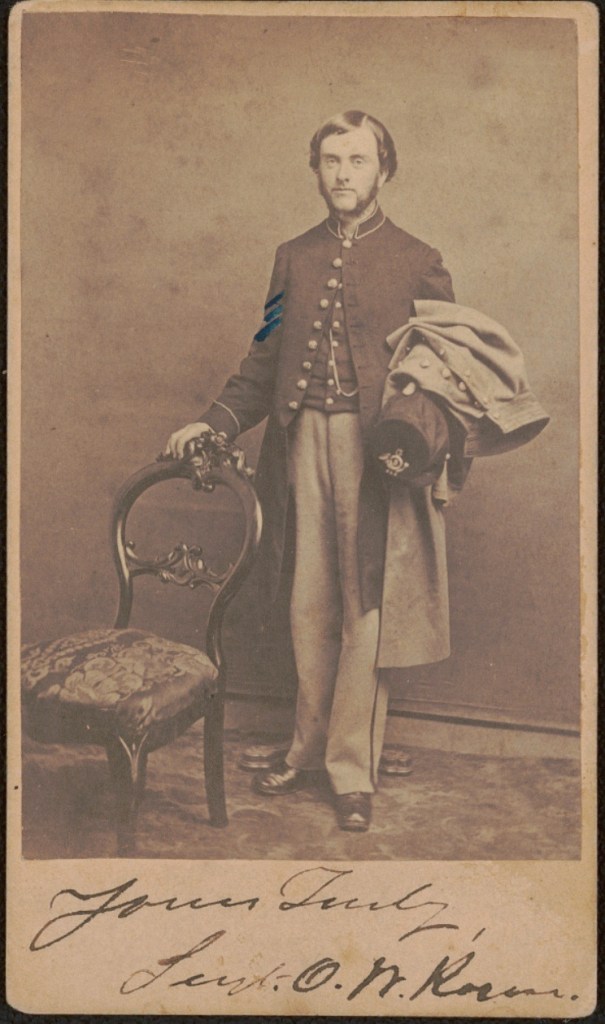
This letter was written by 25 year-old Samuel Lee Holt (1837-1905), the son of Samuel Holt (b. 1803) and Elvira Estes (b. 1809) of Bethel, Oxford county, Maine. Samuel was working as an engineer in Marlborough, Middlesex county, Massachusetts, in 1862 when he enlisted on 20 August 1862 and mustered into Co. I, 5th Massachusetts Infantry for 9 month’s service on 16 September 1862. He mustered out of the regiment on 2 July 1863. A year later he entered the service again, this time in the US Navy, serving as Acting 3rd Assistant Engineer aboard the USS Honduras in the East Gulf Squadron.
Samuel wrote this letter not long after his arrival in New Bern, North Carolina, where the 5th Massachusetts participated in Foster’s Expedition to Williamston, and later to Goldsboro. They were then on duty at New Berne till June, 1863, when they embarked for Boston and mustered out 2 July 1863.

Transcription
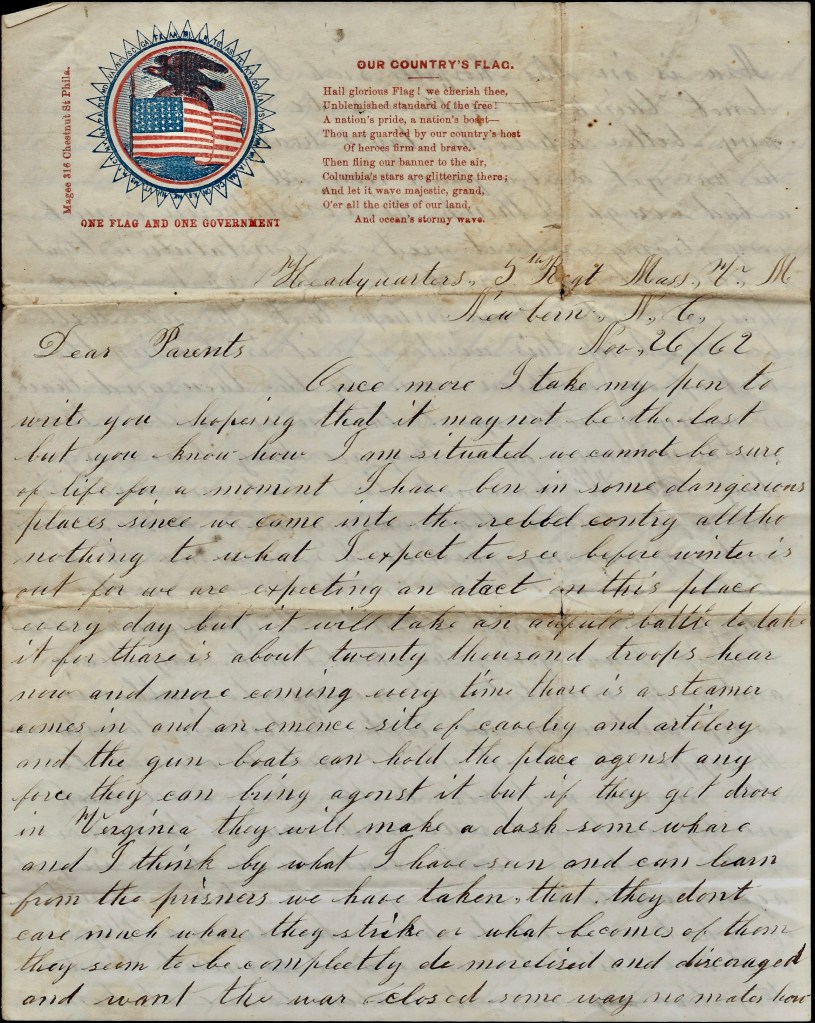
Headquarters 5th Regt. Mass V. M.
Newbern, North Carolina
November 26, 1862
Dear Parents,
Once more I take my pen to write you, hoping that it may not be the last, but you know how I am situated. We cannot be sure of life for a moment. I have been in some dangerous places since we came into the rebel country although nothing to what I expect to see before winter is out for we are expecting an attack on this place every day. But it will take an awful battle to take it for there is about twenty thousand troops here now and more coming every time there is a steamer comes in, and an immense sight of cavalry and artillery. And the gunboats can hold the place against any force they can bring against it. But if they get drove in Virginia, they will make a dash somewhere and I think by what I have seen and can learn from the prisoners we have taken that they don’t care much where they strike or what becomes of them. They seem to be completely demoralized and discouraged and want the war closed some way no matter how.
Asa is in the hospital sick. I do not think he will ever be any better while he stays here. He has got a slow fever now and a bad cough. I think his constitution is not very strong and it needs a constitution that is fire and water proof to endure what soldiers have to endure. I am in hopes that the war will be closed up this winter for it is killing the best of our northern men by the thousands. There is many a noble spirits that never will see their northern homes again. They are dying here every day.
We have not lost but one man since we left Boston. That was one from our company and was my favorite. His name was [Claude] Grenache. 1 He has worked with me two years in the shop and he said when our company was called that if I was going, he should not stay there. And so he enlisted and we were together in camp and when we left Boston in the steamer Mississippi the first night out, he climbed to the rigging and fell to the deck and broke one leg back, and scull and some of the fibers of his neck. He lived about twelve hours in great agony although he never spoke nor took any notice of what we said to him. He leaves a wife and one child to mourn and lament his loss. They live nearest neighbor to me at home.
I have been out on a brigade drill since I commenced this letter. My duty in camp is very light. I have to go out on brigade drills one afternoon in two days, two hours an afternoon, so I have plenty of time to read and write. But you know I never was much of a hand to write, but I don’t have anything else to busy myself about—only to look round among the rest of the men of the regiment who I find to be made up of good citizens of the Old Bay State—men of good morals and good principles and will do their duty in every respects. And if they are ever called into action, I trust you will hear a good report from them—not that I am bragging because I belong to this regiment, for I did not come here to gain fame or honor or to make money, for I could earn as much at home and save a good deal more. I come because I thought it my duty to come, for I had a good deal of sympathy for those brave men who have come before me. The men who have done the fighting and have stood the brunt of the battle—those are the men who deserve the sympathy of the North. The hospitals are full of them. They are broke down for life, their health are ruined for life, a priceless gem—that which money cannot buy. I know how to appreciate health. Mine is good and I find but few men that can endure more hardship than myself. But I am afraid I shall loose it before my time is out if I should be so fortunate as to dodge all the bullets.
And if I ever get home again, you shall have a long visit from me. I presume things have changed so much that it would not seem like home. Only think, it is seven years since I left the land of my birth. I am surprised when I think of it although as I look back upon this long years, it seems like a pleasant dream. And as I look back upon the scenes of my child[hood], they are as fresh in my memory as though it was but yesterday that I left them. But if I am spared for severn years more, I hope to mend my mistakes that I have made in the past.
I presume you have got your new home all complete by this time and I presume you need it for it is time now that you have plenty snow whistling round your ears. But we have not had but two frosty nights yet. One of them was about a week ago and the other last night.
Please write when you get this for it does me a great deal of good to hear from home and I believe I have written two or three times since I received an answer. Give my love and best wishes to all inquiring friends, if any such there be. Please excuse all mistakes and accept this from your son. — S. L. Holt
Direct to Sergt. S. L. Holt, Co. I, 5th Regiment Mass Vol. Militia, Newbern N. C.
1 Grenache, Claude (1827-1862) — Priv. — Res. Marlboro ; blacksmith ; 32 ; enl. Aug. 20, 1862 ; must. Sept. 16, 1862; died Oct. 23, 1862, on board U. S. transport “Mississippi,” by falling from yard arm. Claude’s wife was Elizabeth d’Aubreville (b. 1840); married in 1856.


 Spared & Shared 23