
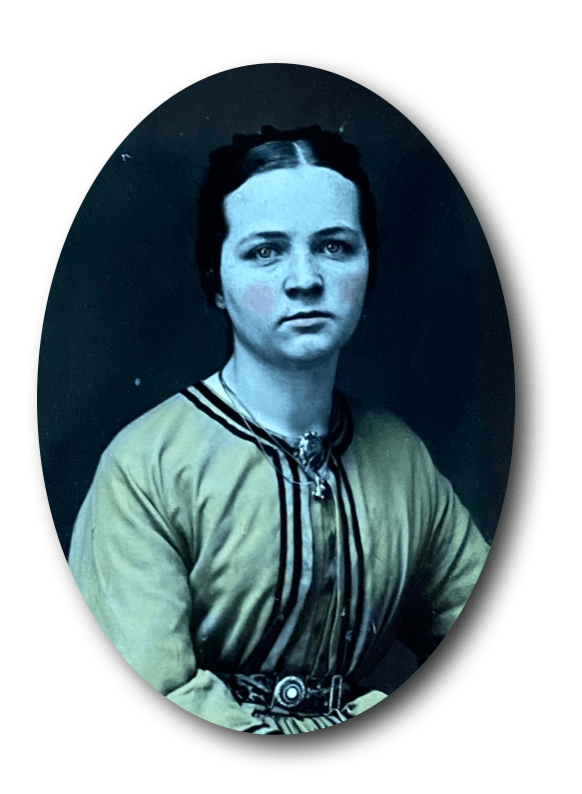
The following letter was written, I believe, by 16 year-old Nannie Margaret Bolton (b. 1847), the daughter of John Bolton (1817-1887) and Elizabeth Preston Smith (1821-1904). It was only signed “Nannie” but she is the only Nancy living in the vicinity of the neighbors mentioned in her letter; she was also referred to as “Nannie” or “Maggie.” In 1880, Nannie was still single and enumerated in her parents’ residence in Washington County, Tennessee. Sometime after 1880, the Bolton family moved to Randolph County, Missouri.
Nannie’s letter speaks of the 8 September 1863 fight at Telford’s Depot and Limestone Station near the family’s residence near Limestone, Washington county, Tennessee. [See Brisk Fight with the Johnnies: The 100th Ohio at Limestone Station by my friend Dan Masters, published on 16 August 2020.]
It should be noted the letter was certainly written in early 1864 but the dates are not correct.
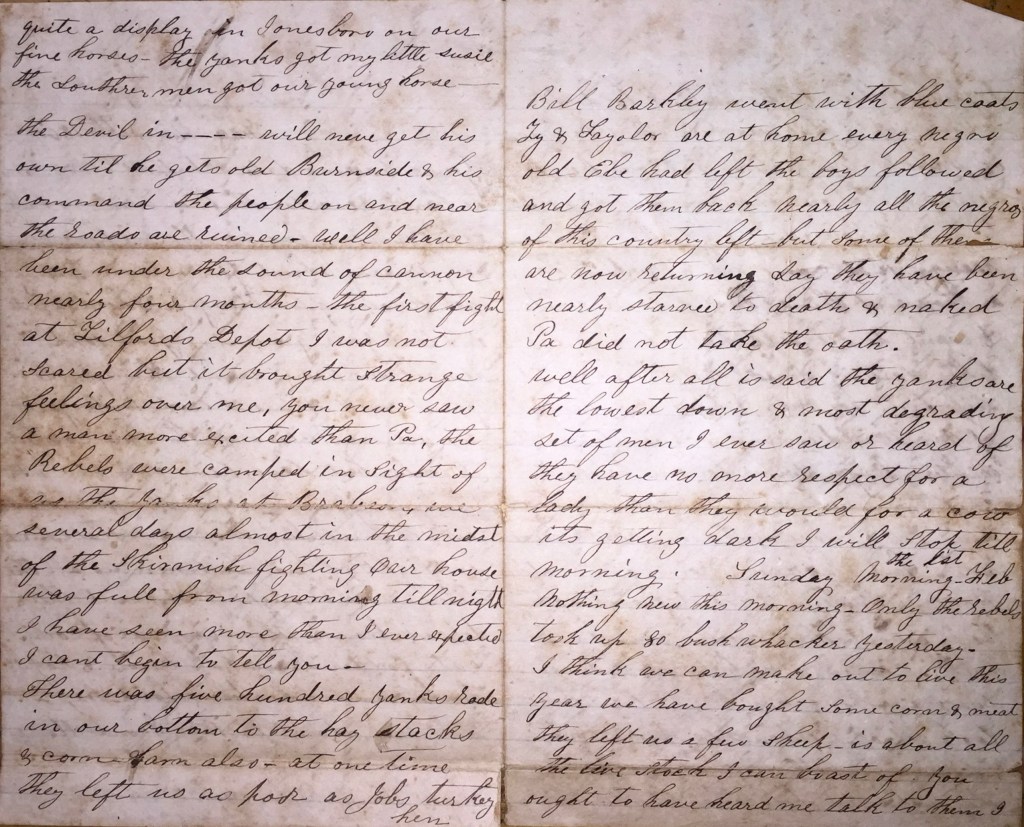
[This letter is from the private collection of Steve Blume and was transcribed and published on Spared & Shared by express consent.]
Transcription
Limestone, [Washington county] Tennessee
February 30th 1864
Yours bearing date October the 10th 1863 came to hand yesterday—the first mail we have had for near five months. We have been very uneasy about you and Uncle Jimmy, not knowing whether you skedaddled or stood your ground. Good Lord, Uncle, we have went through the flint mill since I last wrote you.
“The Devil in [Hell] will never get his own til he gets old Burnside & his command. The people on or near the roads are ruined.”
—Nannie M. Bolton, citizen, Limestone, Tenn., 30 February 1864
We are now clear of the blue coated Devils but have been over run with them for four long months. They treat us shamefully. They were stationed in sight of us and near us all the time—near enough to commit their depredations. They [took] every ear of corn, oats, fodder, bran, hay, bacon & hogs, turkey and chickens, lard soap, and even down to Pa’s grind stone. Our horses also. We have two old broke down rips. Aunt Alses, if you was here, I think we could make quite a display in Jonesboro on our fine horses. The Yanks got my little Susie. The Southern men got our young horse. The Devil in [Hell] will never get his own til he gets old Burnside & his command. The people on or near the roads are ruined.
Well, I have been under the sound of cannon nearly four months. The first fight at Telford’s Depot 1 I was not scared but it brought strange feelings over me. You never saw a man more excited than Pa. The Rebels were camped in sight of us; the Yanks at Brabson’s & we several days almost in the midst of the skirmish fighting. Our house was full from morning till night. I have seen more than I ever expected. I can’t begin to tell you. There was five hundred Yanks rode in our bottom to the hay stacks and corn [ ] also—at one time they left us as poor as Job’s turkey hen.
Bill Barkley went with blue coats. Ty & Taylor are at home. Every negro old Ebe had left the boys, followed and got them back. Nearly all the negroes of this country left but some of them are now returning. Say they have been nearly starved to death & naked. Pa did not take the oath.
Well, after all I said, the Yanks are the lowest down & most degrading set of men I ever saw or heard of. They have no more respect for a lady than they would for a cow. It’s getting dark. I will stop till morning.
Sunday morning, February 1st. Nothing new this morning—only the rebels took up 80 bushwhacker yesterday. I think we can make out to live this year. We have bought some corn & meat. They left us a few sheep is about all the livestock I can boast of. You ought to have heard me talk to them. I jawed them to the last. I told a Lieutenant that was here that he was of much less notice than our free negroes & that our free negroes was a credit to him. I poured it on to them pretty heavy. Just come up & I will tell you a thousand things that I can’t write.
I want to see Jeff so bad. Bless his little darling soul. I know he is sweet. Kiss him for me.
I have seen several of my Middle Tennessee acquaintances this winter. Major [John] Minor 2 for one. He spent a couple of weeks with us. I had like to have fell in love with him. He is a nice man.
Gen. [Alfred Eugene] Jackson’s 3 command is at Rogersville, Tenn. I heard from Capt. Berry about three weeks ago. He was well. Cousin Josiah Conley did not lose anything much but his horses. Took all of Ellison Thompson’s grain & horses and then ribbed his house. They just used Loflands up. They left & went to Virginia. Jennie [Lofland] is married to Jim [Horace] Baldwin. They used our good old Union friend Uncle Jerry Gibson about up. They was camped at the old place about ten days on the knob hill. The place is ruined, rail burned up, and timber cut down. Scarcely a tree left standing on the knobs.
Seven of Mr. Morrow’s negroes gone, his fencing nearly all burned up, and some of ours all next the road. Dr. [Alexander] Brabson 4 ruined. They day our folks retreated from Blue Springs, I never heard such shooting in my life. Our folks made a master retreat, crossed the long bridge just at dark. I never want to hear the like again. I got so used to cannons and guns that I did not mind it much. Five southern men run a thousand Yanks. They owned themselves that the rebs were the best fighters. I could write you a week of our troubles here but have not got space and paper is scarce in these diggings.
Mr. Miller says tell you he wants all the damned Yankees killed. We are all well and doing the best we can. William Henry Russell & his cousin has been spending the winter among the kin. Leesburg is dried up. Old Mrs. Sweet is still kicking. Old Jennie Cowan is dead. Bob Cowan out bushwhacking. Manuel Klepper gone with the Yanks.
I have not heard from my old spark since the middle of September. I hope he is still able for duty. You & Aunt Alses write to us soon and often. Pa says you must consider this letter [from] him and me both. It is such a task for him to write. As ever, your nice, — Nannie

1 Tilford [Telford] is a small station on the railroad between Limestone and Jonesboro. The community was first called Brabsontown, later Millwood, and continued so for many years. It was not until 1855, when Colonel George Whitfield Telford, a state senator who operated the Telford Manufacturing Company, donated about four acres of land to support local operations of the East Tennessee and Virginia Railroad, that the name Millwood was changed to Telford Depot. During the Civil War, citizens of this part of Washington County voted to secede from the Confederacy, but they were unsuccessful in persuading others to do so. The independent nation called “Bricker’s Republic” soon fell into relative obscurity. A Civil War battle took place in Telford on September 8, 1863, when the 100th Ohio Infantry clashed with the Confederate-aligned Thomas’ Legion just east of the depot. The Confederate force was supported by 4-Howitzer artillery unit commanded by General Alfred “Mudwall” Jackson. In the fight at Telford Station and Limestone, the 100th Ohio Infantry was overwhelmed by a much large force while guarding the railroad there and after a couple of hours of fighting, the Captain of Co. B, told his boys to make a break for it, but 240 men were captured.
2 Probably Major John Minor of Co. E, 10th Tennessee Cavalry (DeMoss’).
3 “Unlike most generals of the conflict, Brig. Gen. Alfred E. Jackson lacked any formal military training and had never donned a uniform, but was a farmer who owned 20 slaves prior to the Civil War. Jackson received his disparaging nom de guerre, the moniker “Old Mudwall,” by troops under his authority. Some men under the Tennessean’s leadership routinely complained to headquarters with statements accusing Jackson of being unfit for command to pointing out how the farmer turned brigadier had only commanded 20 slaves prior to the war. For much of the war, Alfred Jackson did little to gain the confidence of his men. He was known to discipline officers in the presence of enlisted men — chastening actions that a slaveholder would openly practice — but such harmful conduct toward military personnel was crippling to morale and esprit de corps of the entire unit, and it was shunned by veteran soldiers and grads of West Point and VMI.” [Civil War Talk]
4 Dr. Alexander Brabson (1805-1888) lived in the Limestone area of Washington County, Tennessee. After attending medical school in Kentucky, he returned to his home to open a general practice. In addition to his duties as a physician, Brabson owned and operated a flour mill. He was married to Emily Maria Stephens (1817-1885). The 1860 Slave Schedule shows he owned 6 slaves.

 Spared & Shared 23
Thanks for sharing this post! Much appreciated as I am researching about the history of Telford for my Master’s thesis. I have never heard of Brabsontown. Can you please share your data source for that information?
I would greatly appreciate it.
Jeff Banks
LikeLike
May have been from this page or some other source that I should have cited when I added that footnote. https://freepages.rootsweb.com/~walker/genealogy/brabson.html
LikeLike
Thanks! I can’t find any other info about the existence of a “Brabsontown” … I’ll keep looking though. There were a lot of folks here in Telford as early as 1772 who didn’t want to be bothered at all with documentation. They were just focused on staying alive.
LikeLike