

Early in the summer of 1863, there were constant rumors circulating about a potential Confederate invasion of border states. In response, the war department established two new departments in June: the Department of the Monongahela and the Department of the Susquehanna, aimed at protecting the state from any such enemy movement. Governor Curtin called for volunteers to serve for the duration of the war or the pleasure of the president. Despite the looming threat, the reduced number of men available for military service hesitated to respond, slow to believe that their homes were truly in danger. On June 12, the governor announced that the requested troops could be mustered into the service of the United States for six months or for the duration of the existing emergency, as they themselves chose. Ultimately, eight regiments were mustered in for the “emergency” and became the 20th, 26th, 27th, 28th, 30th, 31st, and 33rd emergency regiments. Additional companies and organizations volunteered their services, and their need was soon recognized. [Source: Fold 3]
Among those volunteering for service to meet the threat of invasion was 26 year-old James “Clarence” Cresson of Whitemarsh, Montgomery county, Pennsylvania. Clarence was mustered into Co. D, 32nd Pennsylvania Volunteer Militia on 26 June 1863 and served until 1 August 1863—approximately five weeks during the “Emergency of 1863.” The following letter was penned by Clarence to his uncle describing his experience during the Gettysburg Campaign. The 32nd and 33rd Pennsylvania Volunteer Militia were sent to Carlisle along with Landis’s Philadelphia militia artillery battery, and a company of the 1st New York Cavalry under the command of William F. “Baldy” Smith, dispatched there by Darius Couch of the Department of the Susquehanna. Much of the letter recounts the Battle of Carlisle which was fought on 1 July 1863 between Stuart’s Confederate Cavalry and Smith force of militia volunteers.
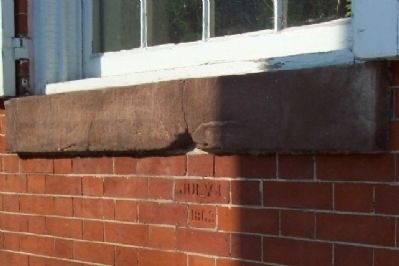
Realizing that the town was only lightly defended by volunteer militia, Stuart ordered Maj. Gen. Fitzhugh Lee to bombard and capture the town if they did not surrender but Smith refused and the city was pounded for several hours by artillery. It was during this attack that Stuart learned of the fighting going on in Gettysburg which eventually caused him to disengage and join Lee’s main army but not before setting fire to the Carlisle Barracks and destroying a lumbar yard and gas works [see header image]. Casualties for both sides were minimal, with eight Confederate casualties, and one Federal killed and a dozen wounded.
[Note: This letter is from the private collection of Greg Herr and was transcribed and published on Spared & Shared by express consent.]
Transcription
Hagerstown, [Maryland]
7 Mo. 19th [19 June] 1863
Dear Uncle,
I thought thee might like to know what I am about, so I concluded to send thee a few lines. I suppose thee has heard before this of my enlistment. I left home three weeks ago last seventh day [Saturday] and joined Company D, 1st Regiment Gray Reserves. Our company is composed of some of the finest young men from the City and I have stood the service very well so far. Today, three weeks ago, we were drawn up in line of battle this side of the Susquehanna [river], expecting an attack every moment. We laid on our arms all night but in the morning the Rebs had retreated so we were allowed to return to camp where we remained until the following fourth day [Wednesday], when our Brigade (consisting of three thousand men under Gen. Brisbain) started for Carlisle. We had a very hard march of it, being loaded down with about sixty or seventy pounds of luggage per man. I stood the march very well with the exception of badly blistered feet. Many of our men gave out.
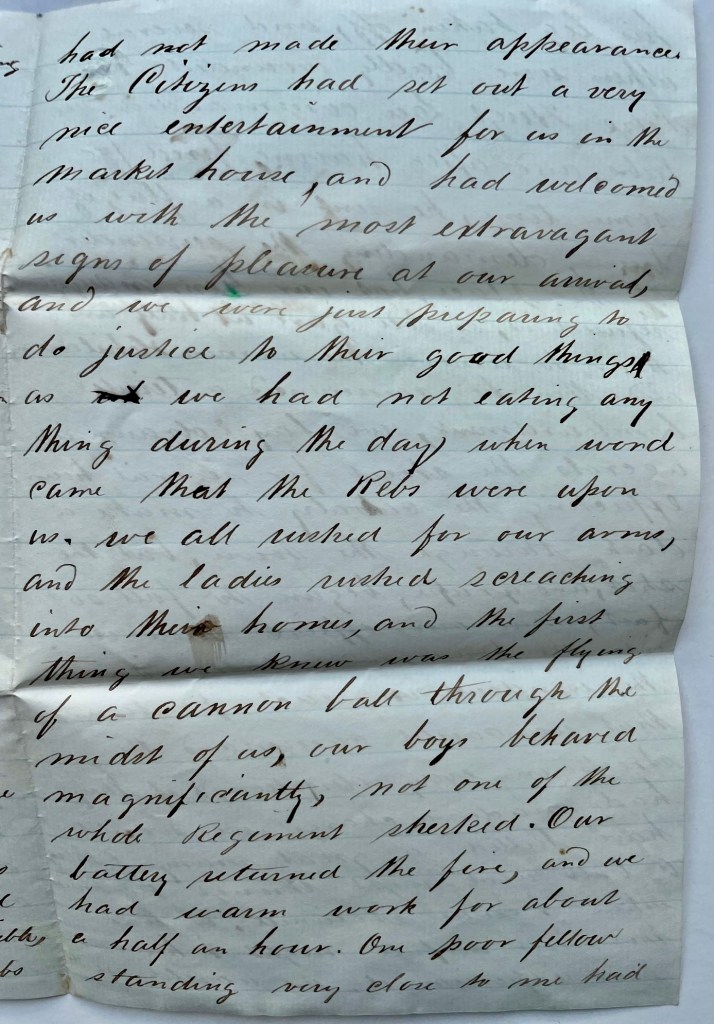
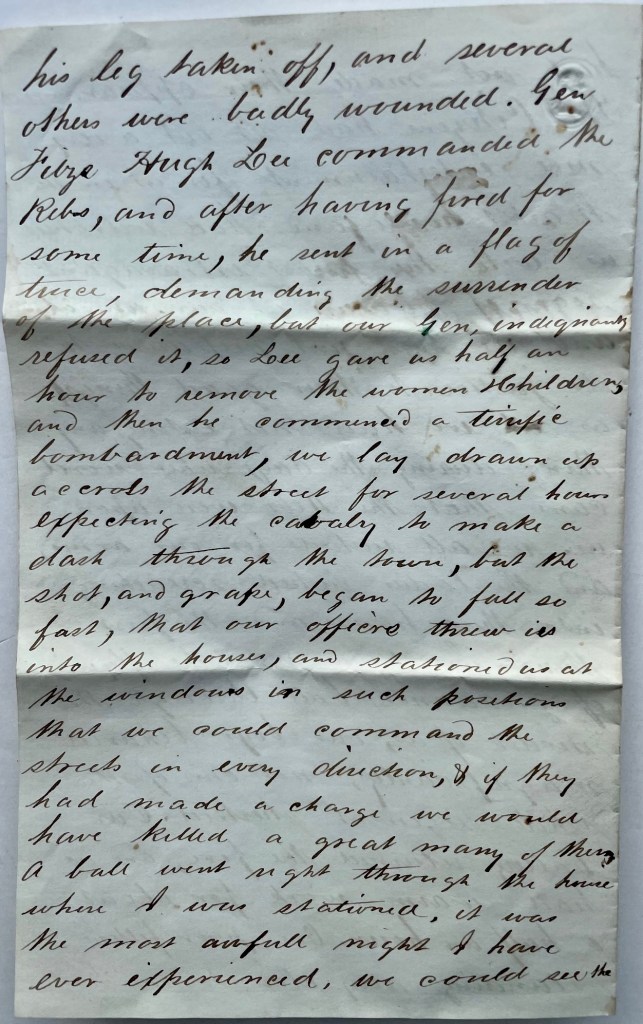
When we had arrived with five miles of Carlisle, and whilst we were just preparing for a few hours rest, a scout came dashing up to the Brigade with orders to move on immediately, at a double quick, as the enemy were supposed to be advancing on the town in a large force. So off we started and we traveled into the town as fast as possible. But when we got there, the Rebs had not made their appearance. The citizens had set out a very nice entertainment for us in the market house and had welcomed us with the most extravagant signs of pleasure at our arrival, and we were just preparing to do justice to their good things as we had not eaten anything during the day, when word came that the Rebs were upon us. We all rushed for our arms and the ladies rushed, screaching into their homes, and the first thing we knew was the flying of a cannon ball through the midst of us. Our boys behaved magnificently. Not one of the whole regiment shirked. Our battery returned the fire and we had warm work for about an hour. One poor fellow standing very close to me had his leg taken off and several others were badly wounded.

Gen. Fitzhugh Lee commanded the Rebs and after having fired for some time, he sent in a flag of truce demanding the surrender of the place. But our general indignantly refused it so Lee gave us have an hour to remove the women & children, and then he commenced a terrific bombardment. We lay drawn up across the street for several hours expecting the cavalry to make a dash through the town, but the shot and grape began to fall so fast that our officers threw us into the houses and stationed us at the windows in such positions that we could command the streets in every direction, and if they had made a charge, we would have killed a great many of them.
A ball went right through the house where I was stationed. It was the most awful night I have ever experienced. We could see the enemy very plainly but they were too far off for musket range. They ceased firing about twelve o’clock and sent word that if we did not surrender before ten o’clock the next morning, they would blow us to the infernal regions.
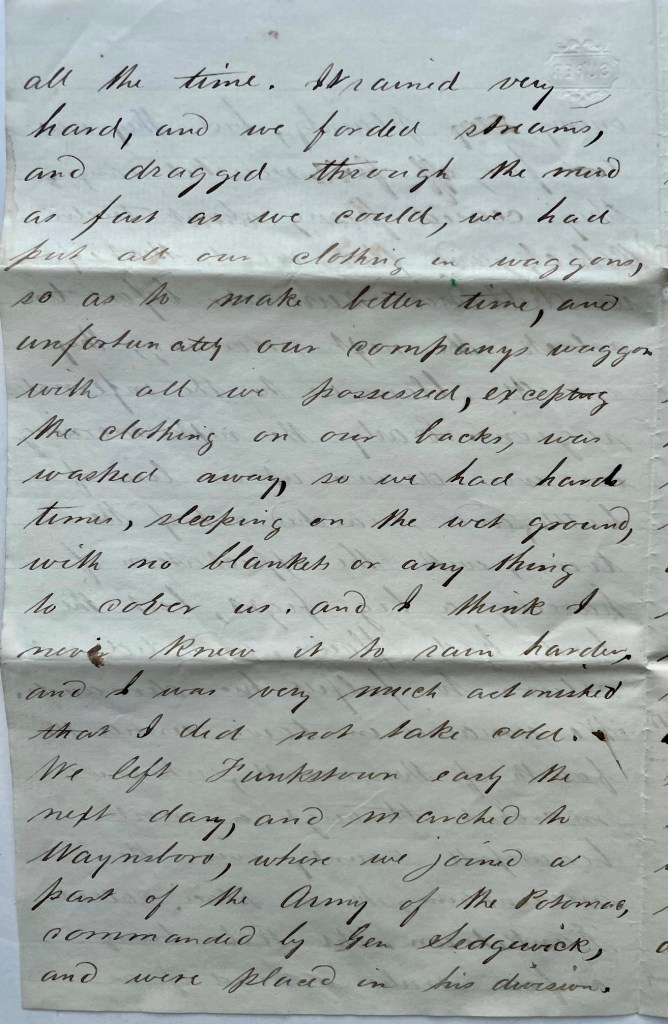
Early the next morning we were drawn up in line of battle and marched out of the town with the expectation of having a big fight, but the bird had flown and did not return to fulfill his demands. We remained in town until the fourth of the month when we marched through a most beautiful country over the mountains to a place called Funkstown, the Rebs being a few miles ahead of us all the time. It rained very hard and we forded streams and dragged through the mud as fast as we could. We had put all our clothing in wagons so as to make better time and unfortunately our company wagon with all we possessed, excepting the clothes on our backs, was washed away so we had to hard times, sleeping on the wet ground with no blankets or anything to cover us. And I think I never knew it to rain harder and I was very much astonished that I did not take cold.
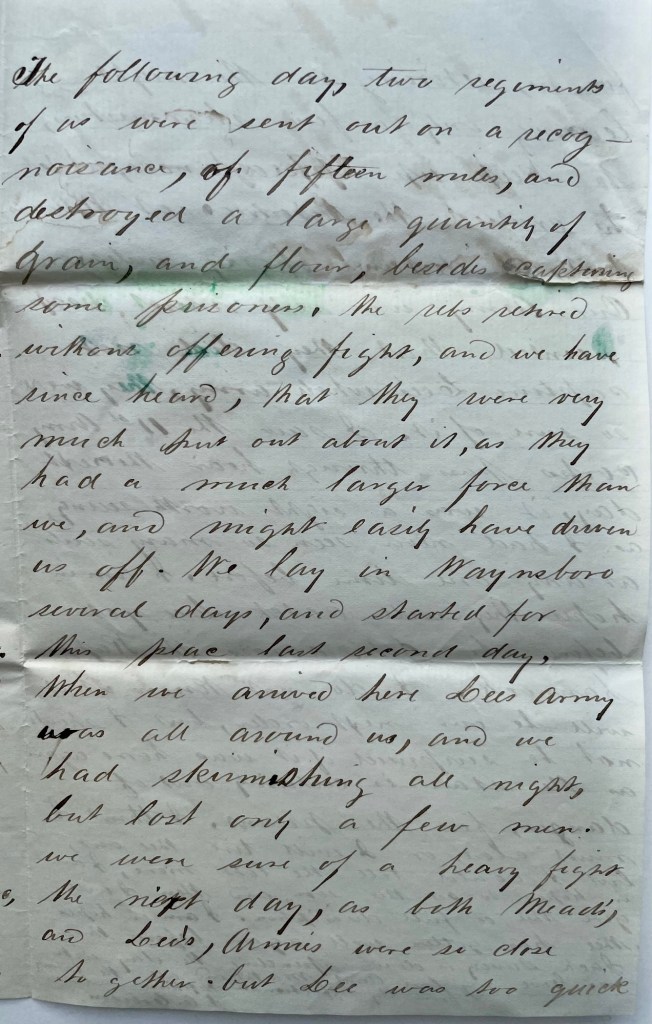
We left Funkstown early the next day and marched to Waynesboro where we joined a part of the Army of the Potomac commanded by Gen. Sedgwick and were placed in his division. The following day two regiments of us were sent out in a reconnoissance of fifteen miles and destroyed a large quantity of grain and flour besides capturing some prisoners. The Rebs retired without offering fight and we have since heard that they were very much put out about it as they had a much larger force than we and might easily have driven us off.
We lay in Waynesboro several days and started for this place last second day [Monday]. When we arrived here, Lee’s army was all around us and we had skirmishing all night but lost only a few men. We were sure of a heavy fight the next day as both Meade’s and Lee’s armies were so close together but Lee was too quick for us, retiring in the night, leaving only a few skirmishers to keep up appearances whilst he crossed the Potomac at Williamsport, a distance of six miles.
Our army was very much disappointed that they did not capture Lee’s whole army. They were so sure of it. I saw the 11th Army Corps pass through here the next day. It was a sight worth seeing as I had never seen so many souls at any one time before. I am in hopes they will catch Lee yet before he gets across the Rappahannock.
I do not know what will be our next order but I should not be surprised if it was home again as the State is certainly out of danger for the present. I think I must close or I will tire thee out, but I could tell thee lots more. I am in hopes to see thee soon and then I will give thee a full description. I am in hopes thee has gotten well again before this. Jack Savey is down spending the day with us. Give my love [to] Aunt Martha and all the family. From your affectionate nephew, — J. C. Cresson




 Spared & Shared 23