
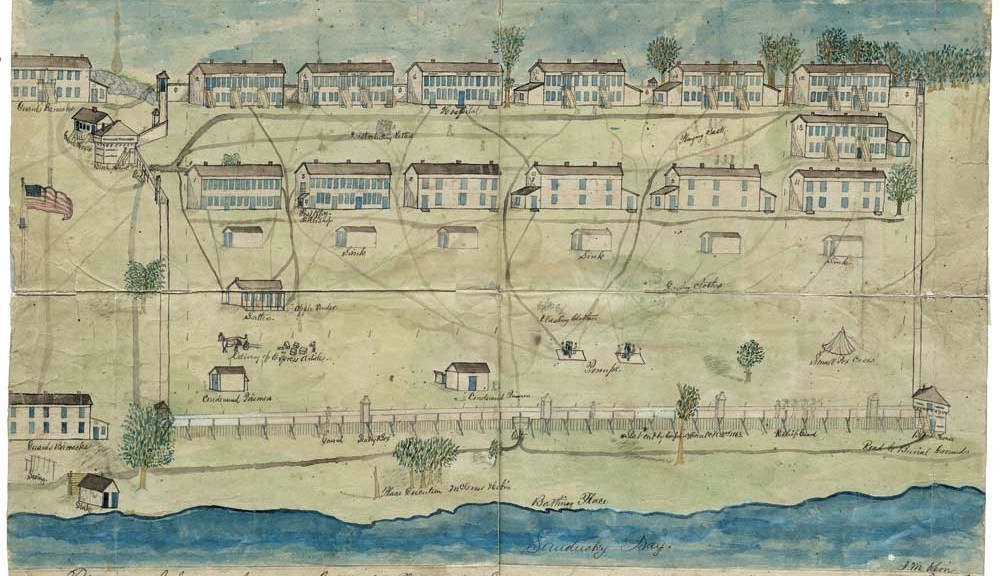
The following diary fragment and two letters written by 35 year-old Capt. John White (1829-1909), Quartermaster of the 5th Alabama Infantry. They are from the collection of Jason Politte who purchased them in the early 1990s from an antique store in Little Rock, Arkansas, and has graciously offered them for transcription and posting on Spared & Shared. They have never been previously published to his knowledge.
John White was the son of lawyer John White, Sr. (1778-1842) and Abigail Dickinson (17xx-1834) who migrated from Virginia to Tennessee, and from there to Northern Alabama in 1814. The Whites lived at Courtland, Lawrence county, Alabama, where John was born in 1829, and then relocated to Talladega county. John had two older brothers who had careers of distinction. Alexander was a member of the US Congress (in 1851) and later chief justice of the Supreme Court of Utah. He was made immortal by his “Bonnie Blue Flag” Speech. Another brother, Robert was a successful physician.
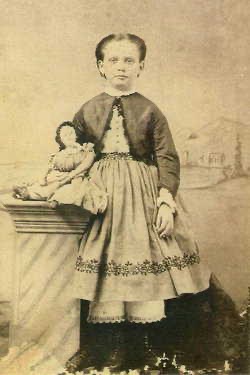
It was here in the heartland of Alabama that John met and married Mary Jane Finley (1832-1874), the daughter of Alva and Sarah (Hall) Finley of Talladega. The couple were in enumerated in Talladega, Alabama, in the 1850 US Census; John practicing law like his father, having been admitted to the bar in 1849. Their oldest child, Sarah Alvena White (1849-1917) was born in Talladega. John and his family relocated to Cahaba, Dallas county, Alabama in 1858 and took their mail at the Moseley’s Grove post office. A second daughter named Kate Belle Champman White (1858-1942) was born in Dallas county. Undoubtedly there were other children born to the couple but these two may have been the only ones to survive childhood (a 9 year-old son named Charles appears in the 1860 census). After the war, John lived in Selma, and later Birmingham.
In early March 1862, John enlisted in the Confederate service at Cahaba as a private in Co. F, 5th Alabama Infantry. After about three months, he was promoted to captain and appointed as the quartermaster of the regiment. However, his service was interrupted when he was captured on 4 July 1863 during the retreat from Gettysburg. Subsequently, he was taken to Johnson’s Island, near Sandusky, Ohio, where he was held with other Confederate officers until 13 March 1865, when he was finally chosen for exchange. The two letters presented here were written in June 1864, after nearly a year of captivity. These are typical prisoner of war letters, limited to one page and subject to censorship review. Additionally, the diary fragment documents his journey from Johnson’s Island Prison back to Alabama via Point Lookout, Maryland, and City Point, Virginia, eventually arriving at Aikens Landing on the James River, where he was exchanged and granted a furlough to visit his family. The diary concludes before his arrival at home, as the reunion with his family was delayed due to the presence of Union troopers occupying Selma and the surrounding region, including Cahaba, where the raiders successfully liberated Union soldiers held in the prison there (see Wilson’s Raid and the Battle of Selma).
A brief obituary for Capt. White was posted in the Selma Times on 11 May 1909 which read in part: “Captain White was born at Courtland, Alabama, April 17, 1829. He served in both the War between the States, and the Mexican War (1st Alabama Regiment), gaining distinction in both hostilities. He was a lawyer by profession and until his retirement was accorded to be one of the leading legal exponents of the state. He was a member of the Episcopal church and of the masonic fraternity and was always held in high esteem among the citizens of Alabama…”
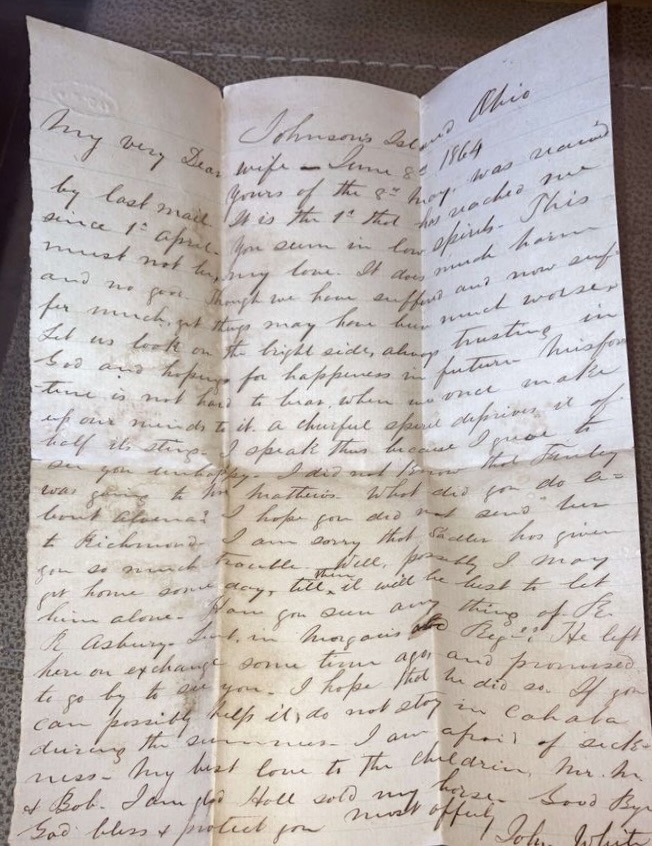
Letter 1
Johnson’s Island, Ohio
June 8th 1864
My very dear wife,
Yours of the 8th May was received by last mail. It is the 1st that has reached me since 1st April. You seem in low spirits. This must not be, my love. It does much harm and no good. Though we have suffered and now suffer much, yet things may have been much worse. Let us look on the bright side, always trusting in God and hoping for happiness in future. Misfortune is not hard to bear when we once make up our minds to it. A cheerful spirit deprives us of half its sting. I speak thus because I grieve to see you unhappy.
I did not know that Finley was going to Mr. Mathew’s. What did you do about Alvena? I hope you did not send her to Richmond. I am sorry that Sadler has given you so much trouble. Well, possibly I may get home some day. Till then, it will be best to let him alone. Have you seen anything of R. R. Asbury, Lieut. in Morgan’s Regiment? 1 He left here on exchange some time ago, and promised to go by to see you. I hope that he did so. If you can possibly help it, do not stay in Cahaba during the summer. I am afraid of sickness. My best love to the children, Mr. M[athews] & Bob. I am glad Hall sold my horse. Goodbye. God bless & protect you. Most affectionately, — John White.
1 Reuben R. Asbury [Asberry] served as a 2nd Lieutenant in Co. F, 52st Alabama (Partison Rangers). He was from Talladega and was taken prisoner at Shelbyville, Tennessee, while riding with Col. Morgan on 27 June 1863. He was sent first to Louisville, to Columbus (OH), then Baltimore, and finally to Johnson’s Island. He was exchanged on 3 May 1864 at Point Lookout, Maryland.
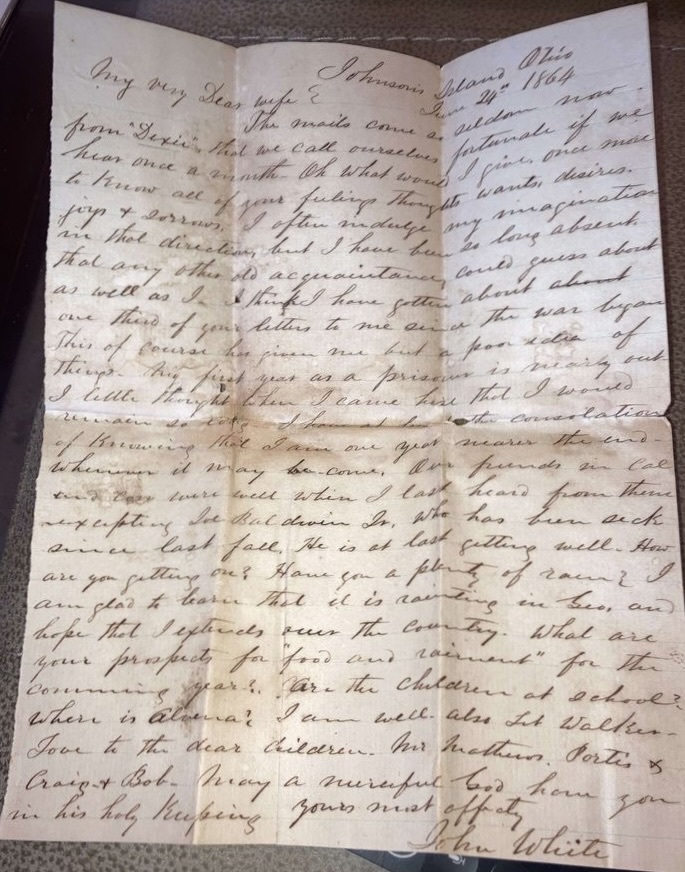
Letter 2
Johnson’s Island, Ohio
June 24, 1864
My very dear wife,
The mails come so seldom now from “Dixie” that we call ourselves fortunate if we hear once a month. Oh what would I give once more to know all of your feelings, thoughts, wants, desires, joys & sorrows. I often indulge my imagination in that direction, but I have been so long absent that any other old acquaintance could guess about as well as I. I think I have gotten about one third of your letters to me since the war began. This of course has given me but a poor idea of things.
My first year as a prisoner is nearly out. I little thought when I came here that I would remain so long. I have at least the consolation of knowing that I am one year nearer the end—whenever it may come. Our friends in Cal[ifornia] and Can[ada] were well when I last heard from them, excepting Joe Baldwin, Jr. who has been sick since last fall. He is at last getting well. 1 How are you getting on? Have you a plenty of rain? I am glad to learn that it is raining in Georgia and hope that it extends over the country. What are your prospects for “food and raiment” for the coming year? Are the children at school? Where is Alvena? I am well. Also Lt. Walker. Love to the dear children, Mr. Mathews, Portis and Craig and Bob. May a merciful God have you in his holy keeping. Yours most affectionately, — John White.
1 One of John White’s sister married Joseph J. Baldwin, the author of “Flush Times in Alabama and Mississippi” and “Party Leaders.” He later moved his family to California where he became a member of the California Supreme Court and died there during the Civil War.
Transcription of Diary
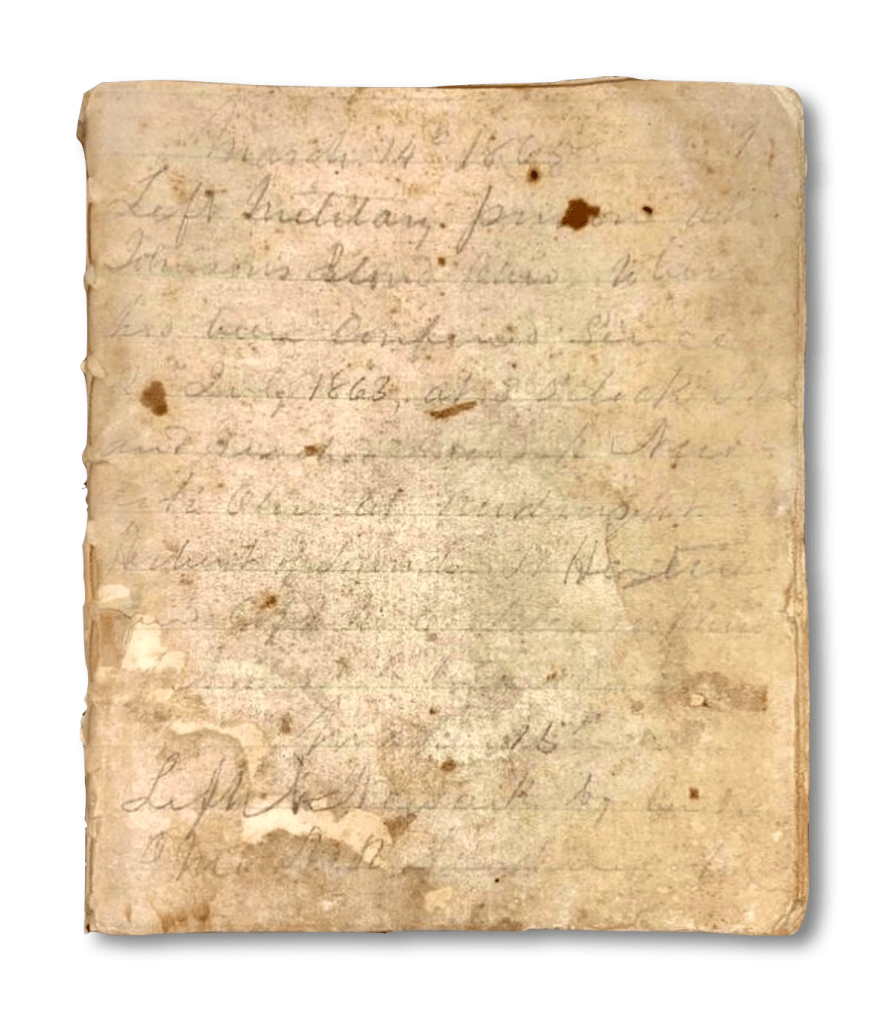
March 14th, 1865 — Left military prison at Johnson’s Island, Ohio, where I had been confined since 21st July, 1863 at 8 o’clock p.m., and reached Newark, Ohio, at midnight. [Remainder of this date’s entry is illegible.]
March 15th — Left Newark by Baltimore & Ohio railroad leaving for Wheeling Virginia. Passed through Zanesville, Ohio, at 9 in the evening. Struck the Ohio River at Bellaire, four miles below Wheeling at 3am [on the] 16th. Did not go to Wheeling but went directly down river (on railroad) towards Cumberland. The country through which we passed shows signs of the mountains and is not very rich.
March 16th — Left Bellaire on the Ohio four miles below Wheeling at five o’clock a.m. Traveled all day towards Cumberland, Maryland, making very slow time. The country is little else than mountains. This road (the Baltimore & Ohio) is a tremendous work. We have passed through six tunnels today, one of which is one-and-a-half miles in length. Night found us in the mountains.
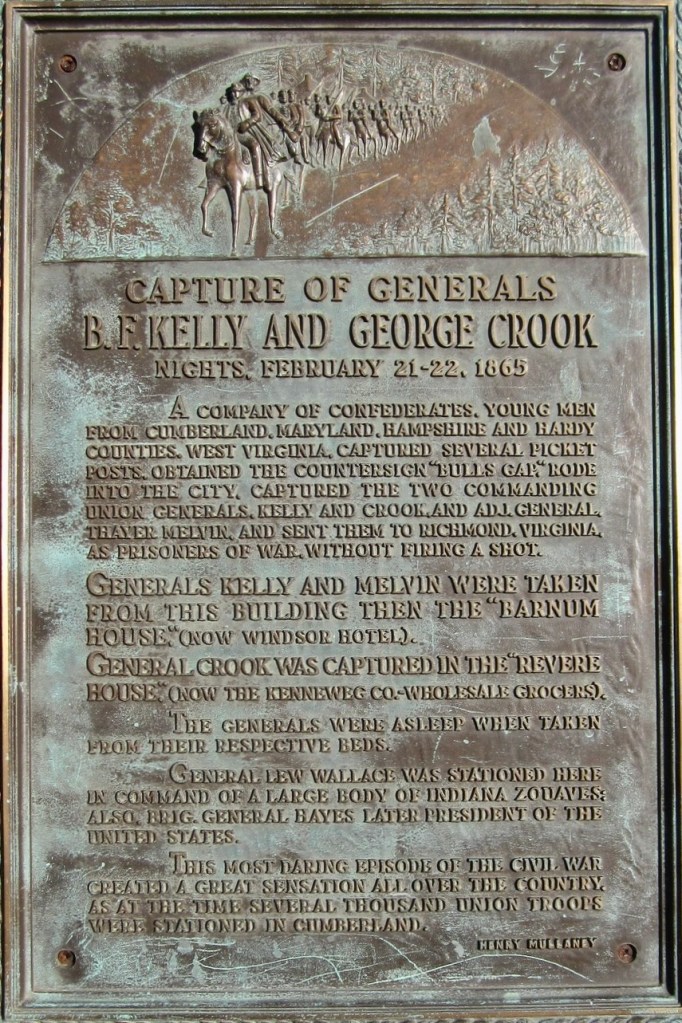
March 17th — After passing Cheat Mountain which divides the waters of the Ohio from those of the Potomac, we came to and descended one of the branches of the latter to Cumberland, Maryland, where we arrived about 12 a.m. Here we learned that a bridge had been washed away below which has since detoured us. This is the place where Lt. McNeill captured Gens. Crook and [B. F.] Kelly.
March 18th — Left Cumberland at 10 am. Crossed the Potomac about ten miles below and traveling very slowly. Passed a tunnel 1,300 yards long 50 miles above Martinsburg.
March 19th — At daylight found ourselves at Martinsburg [West Virginia] —a place which I have not forgotten. 1 Left at sunup and got to Harpers Ferry at ten. This is a [mountainous?] ground [?] The passages through the mountains for the two rivers seems to have been cleared by the hand of Omnipotence. Left at 11. Reached Baltimore at sunset. Were marched straight on board of the Steamer Robert Morris. Were allowed no communication whatsoever with anyone. Brothers were not permitted to see their sisters. Left at 11 o’clock p.m. for Point Lookout.
1 The 5th Alabama passed through Martinsburg, West Virginia, on 14 June, 1863 enroute to Gettysburg. John S. Tucker of the 5th Alabama wrote in his diary: “Reached Martinsburg at sundown and drove the Yankees out in double quick time. Captured several pieces of artillery and a good many stores. Some of the women and children were delighted to see us though the town is rotten to the core.”
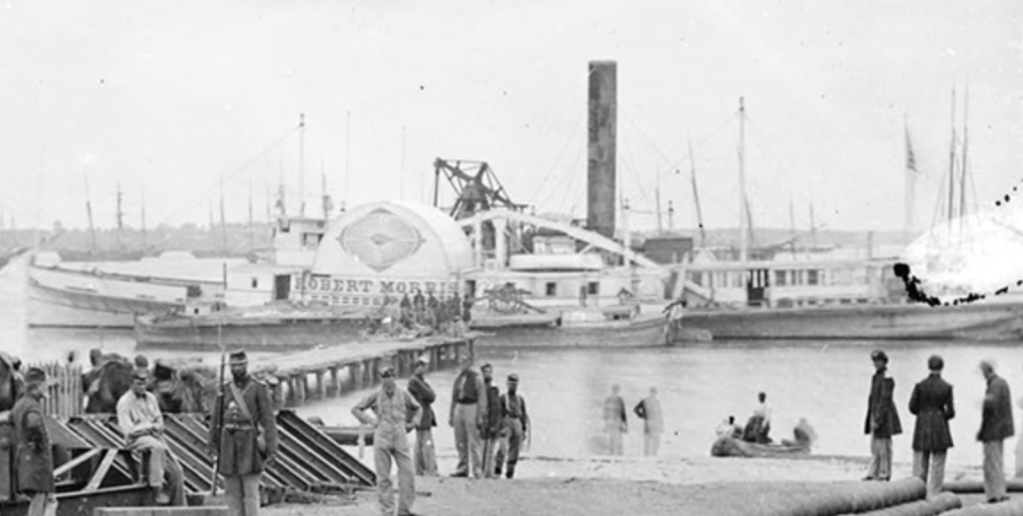
March 20th — Reached Point Lookout at 11 o’clock a.m. and left at three pm. Passed Fortress Monroe about 9 p.m. and anchored six miles above for the night. The weather during our whole trek has been very fine and wonderfully different from Johnson’s Island.
March 21st — Started for City Point at daylight where we arrived at 1 p.m. Left at nine and reached Aiken’s Landing—alias Varina—at night when we anchored in the stream till morning.
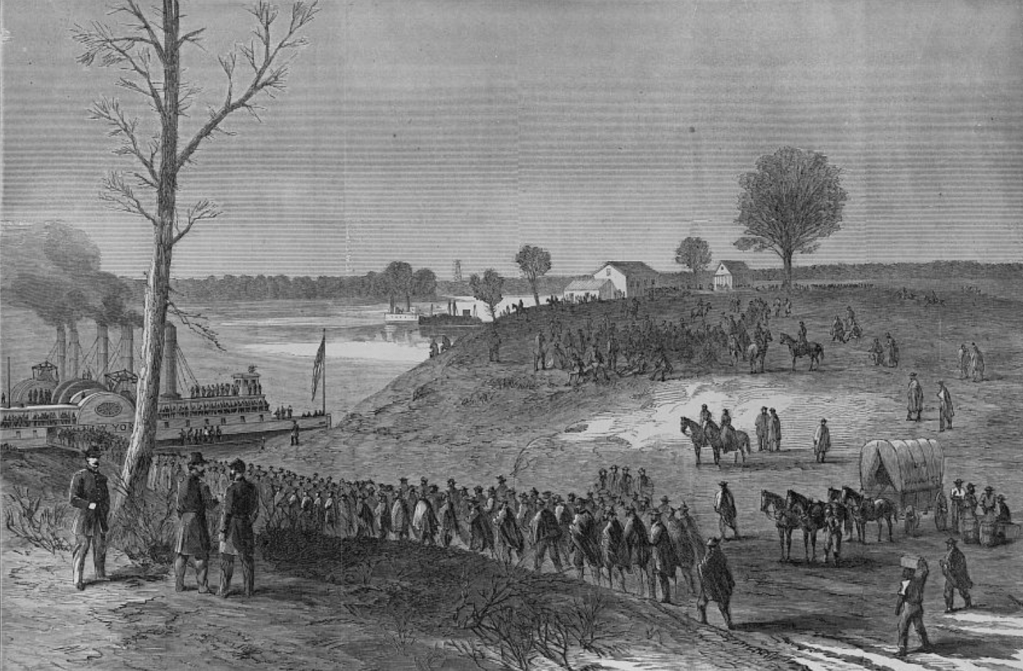
March 22nd — At 10 a.m. marched across a neck of land to a point one mile from Varina where we were delivered to Col. [William H.] Hatch 2 at 7 p.m. and left for Richmond which we reached at 4. Stopped at American Hotel, board $50 per day. Took tea at Wm. H. Richardson’s. Got furlough for 30 days after supper.
2 Col. William Henry Hatch was one of the Confederate Agents of Exchange. He was arrested by Federal authorities after the cessation of hostilities and held in Libby Prison, accused of stealing from Union POWs.
March 23rd — Called to see General A[lexander] R. Lawton. He instructed me to leave a note stating that I had lost my place as QM of 5th Alabama and my address. He said that when my furlough was out I would be subject to orders but that I had better write him again then and await his orders at home. Left Richmond for home at 10 p.m. and drew pay to 2nd March.
March 24th — Have been ever since 6 p. m. 23rd coming from Richmond to this place, Danville, a distance of 140 miles. The railroads are in a most wretched condition. Here we are to stay till 9 a.m. in morning.
Saturday, March 25th. Sunday — Left Danville 9 a.m. and reached Greensboro, North Carolina, at 3 p.m., 45 miles. Here we learned that the train does not leave till tomorrow, 10 o’clock. Maj. Foster, Lt. Webster and others who left Richmond yesterday evening overtook us here. Went to see George B. Hall. The weather here is cold and windy.
March 26th Sunday — Left Greensboro at 11 am and reached Salisbury at 6 pm. 42 miles. Left in an hour and arrived at Charlotte at 2 a.m., 45 miles. Weather good.
Monday March 27th — Leaving Charlotte at 8 a.m., reached Blackstock [South Carolina], 50 miles and end of railroad at 2 p. m. From this place we had to walk. We made about 12 miles and slept at an old negro’s. Fairfield District. Weather clear.
Tuesday March 28th — Started at daylight. Walked three miles to breakfast and then made 17 miles by night, being five miles from Newberry where we are to take the cars for Abbeville. Weather cloudy and pleasant.
Wednesday March 29th — Made 5 miles to Newberry where we take cars, reaching Abbeville [ ] miles at 3 p.m. Drew rations and had them cooked. Started at sunset on foot for Washington, Georgia. Marched 9 miles through rain, mud, and darkness when we camped under a blanket tent.
Thursday March 30th — Left camp at daylight and at 5 miles overtook wagon train which took us to within 9 miles of Washington from which place we walked 7 1/2 miles and slept in a portico. It rained on us very hard early in the morning but blew off clear and cold about 10 a.m.
Friday March 31st — Got to Washington at sunup and left on cars at 8 and a half and went 18 miles to the Augusta & Atlanta Railroad. At Barnett 58 miles from Augusta and 113 from Atlanta by 11 a. m. Left for Covington—the end of track—at 11 1/2 a. m. Reached in 73 miles by sunset. Here we staid all night.
Saturday, May [should be April] 1st — From Covington to Atlanta it is 41 miles by railroad and 30 by the wagon road. I walked it starting at 6 am and getting to Atlanta at 4 a.m. next day. Weather fine.
Sunday April 2nd — Left Atlanta for West Point [Georgia] at 8 a.m. which we reached at 4 p.m. Left for Montgomery at 5 where we arrived at 4 a.m. Put up at Exchange.
Monday, April 3rd — Here I learned that the Yanks had taken Selma the evening before, thus cutting me off from home. Never was I so disappointed. Found Mrs. Clarke and a Mr. Alexander coming up to Jacksonville in an ambulance. As I could not get home, I determined to go with them to Talladega. Reached Lauchlen McCauley’s of Wetumpka. Stayed all night. He is well.
the 51st Alabama Cavalry.
Tuesday, April 4th — Hearing at Wetumpka that the Yanks were coming down from Talladega, I turned to the left from the plank road and spent the night at Mr. Frank Sims’ 17 miles from Wetumpka. I found him a very clever man.
Wednesday, April 5th — Did not leave Mr. Sims’ that evening when hearing that the reported [Wilson’s] raid was a [ ] we left to the plank road. Traveled 9 miles, stayed at Mr. Adam Heil’s. He an invalid. His wife a very disagreeable woman. 7 miles below Blackford’s [?] factory.
Thursday April 6th — Traveled 24 miles to Sylacauga where we spent the night. Saw Mr. Simpson and wife at factory. Very kind. Stayed the night with Dr. W. C. Patterson.
Friday April 7th.
Rained all night and made the road so bad that I could not go any further with Mrs. Clarke so they left me.
[end of diary]
 Spared & Shared 23