

The following letter was written by Pvt. George H. Reed who mustered into the 48th New York Infantry at Brooklyn on 10 September 1861 when he was 23 years old. He was initially mustered into Co. C but soon after transferred to Co. D. Company C’s members were mostly Brooklyn Boys so it may be that George requested the transfer to be with his friends from Trenton in Co. D. He was discharged from the service on 22 September 1864 after three years. He was carried on the muster rolls as “Reid” but he clearly spelled his name “Reed.”
George was the son of George and Sarah (Wright) reed of Mercer county, New Jersey. He mentions the birth of a niece in the last paragraph.
“The 48th New York is one of the lesser-known regiments involved in the fight for Fort Wagner. Yet, it was a key component of the history of that campaign. Theregiment helped secure the southern tip of Morris Island during the initial Federal landing on July 10th, and was integral to the Federal grand assault on the evening of July 18th. In fact, of all the Federal regiments involved during the battles for Fort Wagner, the 48th ranks highest in terms of total number of soldiers killed. By war’s end, it would rank 17th (out of the all Union regiments) in total number of soldiers killed during its time of service.Plus, its storied history would show that the 48th New York suffered its greatest sacrifice during the fight for Fort Wagner.” [Source: “So Rudely Sepulchered: The 48th New York Volunteer Infantry Regiment During the Campaign for Charleston, July 1863,” Thesis by Luis M. Evans, University of Oklahoma]
Transcription
Daw Fuskie [Daufuskie] Island
February 10th 1862
Dear friends,
You have doubtless heard before this is my joining the army in the defense of my country. It was just five months ago yesterday since I enlisted and in that short time I have become pretty well initiated into the arts of war. When I was down to your house last summer, I had not the least idea enlisting but after I had got back to town, I was so taken with the war fever that I could not resist, but the first thing I knew after I had come to my senses was that I belonged to Uncle Sam. Since that time I have seen quite considerable of the world and have experienced some of its hardships.
The regiment that I joined was laying in Brooklyn, New York, near Hamilton. I joined on the 9th September and about the 17th we left for Washington. We had a most delightful ride in going from New York to Washington. After we had been about two weeks at the latter place, we again struck again and went to Annapolis. There we stayed about two weeks and again we was ordered to pack up for another move.
At Annapolis we was taken on board of vessels and for three weeks and two days we were kept on board. The worst part of it all was the storm at sea. The wind whistled through her rigging like a whirl wind and the rain fell in torrents, the thunder roared, the lightning flashed, and the waves ran mountain high. Our noble ship [the Empire City], she struggled hard. Every once and a while a large swell would take her and her paddle wheels would dip clear under. Two or three times the bow of the boat dipped clear under and the water would be a foot deep on deck. If you have ever seen a panorama of a storm at sea, you may have some idea of our situation at that time, but it is out of my power to give anything like a description of the scene. But we got through all right and never lost a thing.
Our regiment—which was the last to land—went ashore on Sunday, the 10th of November. We remained at Hilton Head until two weeks ago last Saturday. During our stay there we seen pretty good times. Of course we had to drill and to do some work but that only served to pass away time. Before we left there, we had the place very strongly fortified.
Where we are now, or close by, we have been building a battery where we have to work in mud and water up to our knees. The battery is intended to cut off communication between Fort Pulaski and Savannah. Our encampment is about six miles from Fort Pulaski and within 14 miles of Savannah. I am in hopes that we will be in the city before long, for ever since we came to this place we have had to work night and day and Sunday in the bargain.
When I enlisted I thought that I should get home by spring but I begin to think otherwise now for I don’t believe the war will be ended in a year yet to come. And a soldier while engaged in active warfare has but a slim chance of ever getting home until the end of the war.
How is times up your way this winter? Is there anything going on? What kind of luck did you have with your crops this year? How is John and Cad getting along? I have no doubt they were a little surprised when they heard that I had gone to war for I didn’t talk much like going when I was there. What is George driving at? Is he still working out by the year or has [he] gone to the wars. When did you see Uncle Charles’ folks last? I expect they are all fixed in their new house before this, are they not? Does Uncle Charlie drink yet as bad as ever?
I got a letter from Reuben last week. He says Druscilla’s husband is dead and buried. Mell has had a young daughter since I left. They call it Ida Violette Estella Pownall. 1 They have moved to No. 33 Broad Street, Mill Hill [Trenton, New Jersey], where they intend to keep a shop. I will now bring my letter to a close. Please write soon and give my love to all my friends. Yours truly, — George H. Reed
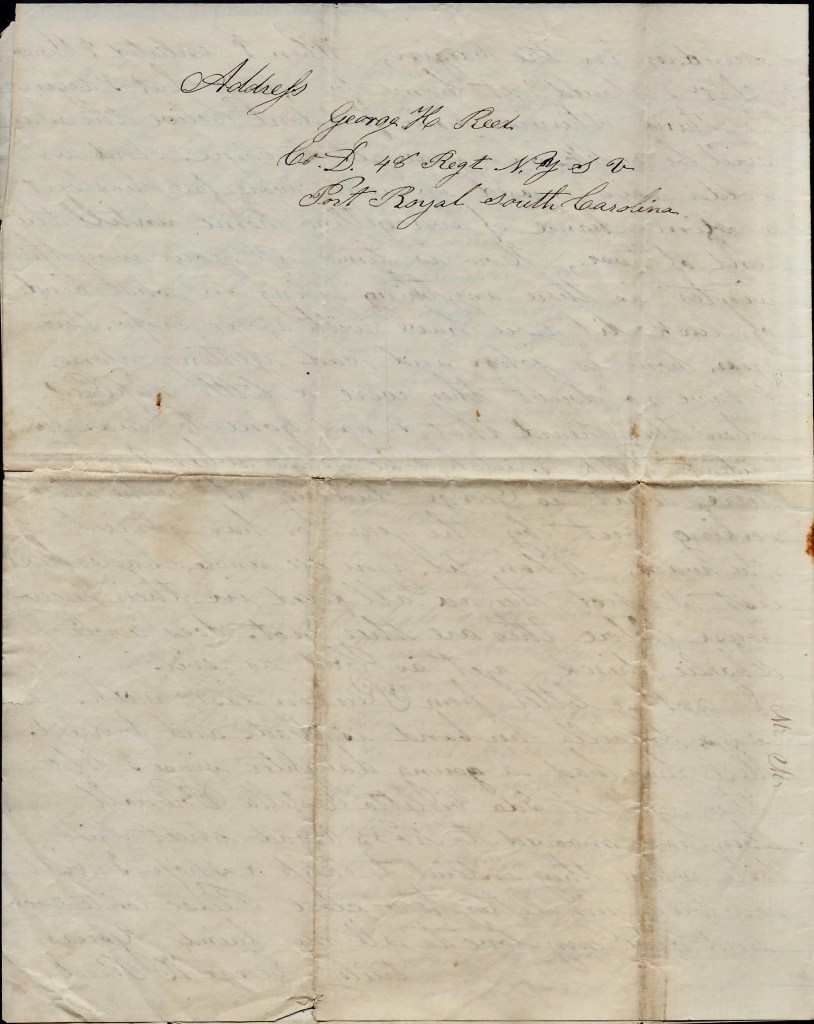
Address: George H. Reed, Co. D, 48th NYSV, Port Royal, South Carolina
1 Ida V. E. Pownall (1861-1923) was born on 10 November 1861, the daughter of Reuben Pownall (1831-1895) and Charlotte Malvina (“Mell”) Reed (1836-1898). She was married to Harry D. Beatty (1855-1936) in 1877.


 Spared & Shared 23