
The following letter was written by Pvt. John J. Davis (1839-1864) who enlisted at Utica on 27 August 1862 when he was 23 years old to serve three years in Co. D, 8th New York Cavalry. He went missing in action near Culpeper, Virginia, on 11 October 1863, and died on 28 March 1864 while a paroled prisoner of war at the US Hospital at Annapolis, Maryland.

John was the son of John and Jane Davis of Remson, Oneida county, New York. In the 1860 US Census, John was enumerated in the household of Edward Langdon, identified as a 21 year-old farm laborer. His place of birth was given as Wales.
In his letter, John mentions having recently participated in the Battle of Brandy Station on 9 June 1863—regarded by many as the first battle of the “Gettysburg Campaign”—and the largest cavalry action of the war. Nearly 1500 casualties resulted from the clash of cavalry in an all-day battle in eastern Culpeper county. For his part, John claims to have killed four Rebs in “hand-to-hand fighting with saber and revolver,” though he himself sustained a deep (to the bone”) saber wound to his thigh. “I will not quit duty for that,” however, he assured his correspondent.
[Note. This letter is from the personal collection of Greg Herr and was made available for transcription and publication on Spared & Shared by express consent.]

Transcription
Catlett Station, Virginia
June 15, 1863
Dear Friend Bidwell,
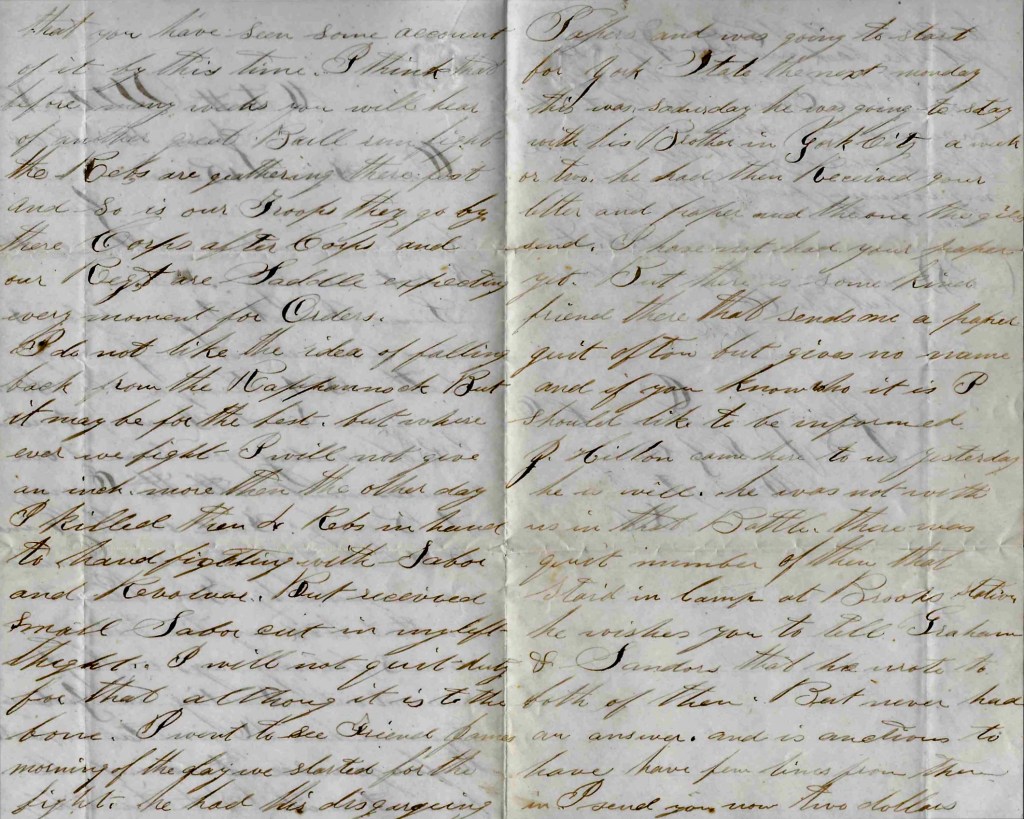
Your kind and welcome letter of the 3rd inst. was duly received. Since I wrote to you before, I have been almost in jaws of death. But through the blessing of our Lord, I am yet alive. I thought of sending you some of our [ ] with the enemy at Beverly’s Ford on the 9th inst. But the next day the whole Division was inspected by Gen. Pleasanton so that took my time that day and three following days our regiment was sent out scouting and yesterday again we had regimental inspection. Therefore, you see it was impossible for me to do it. But it is likely that you have seen some account of it by this time.
I think that before many weeks you will hear of another great Bull Run fight. The Rebs are gathering there fast and so is our troops. They go by there Corps after Corps and our regiment are saddled expecting every moment for orders.
I do not like the idea of falling back from the Rappahannock but it may be for the best. But wherever we fight, I will not give an inch more than the other day. I killed then four Rebs in hand to hand fighting with saber and revolver but received a small saber cut in my left thigh. I will not quit duty for that although it is to the bone.
I went to see friend James on the morning of the day we started for the fight. He had his discharging papers and was going to start for York State the next Monday. This was Saturday. He was going to stay with his brother in York City a week or two. He had then received your letter and paper and the one the girls sent. I have not had your paper yet. But there is some kind friend there that sends me a paper quite often but gives no name and if you know who it is, I should like to be informed.
J[ames] Hilton came here to us yesterday. He is well. He was not with us in that battle. There was quite a number of them that staid in camp at Brooks Station. He wishes you to tell Graham & Sanders that he wrote to both of them but never had an answer and is anxious to have a few lines from them. 1
I send you now two dollars to get me the Rural and please get the back months if you can. Now I must close in hopes that you will excuse this short letter on account of my circumstances. Please give my best respects to all my enquiring friends & you please accept the same.
Yours truly, — J. J. D.
P. S. When you write again, please put the Co. — J. J. D.
John J. Davis, Co. D, 8th New York Cavalry, Washington, D. C.
1 James Hilton enlisted at Utica on 23 August 1862 in Co. C, 8th New York Cavalry. He went missing in action at Tuntestown on 6 July 1863 and deserted at Boonsboro, Maryland, on 5 July 1863.


 Spared & Shared 23