
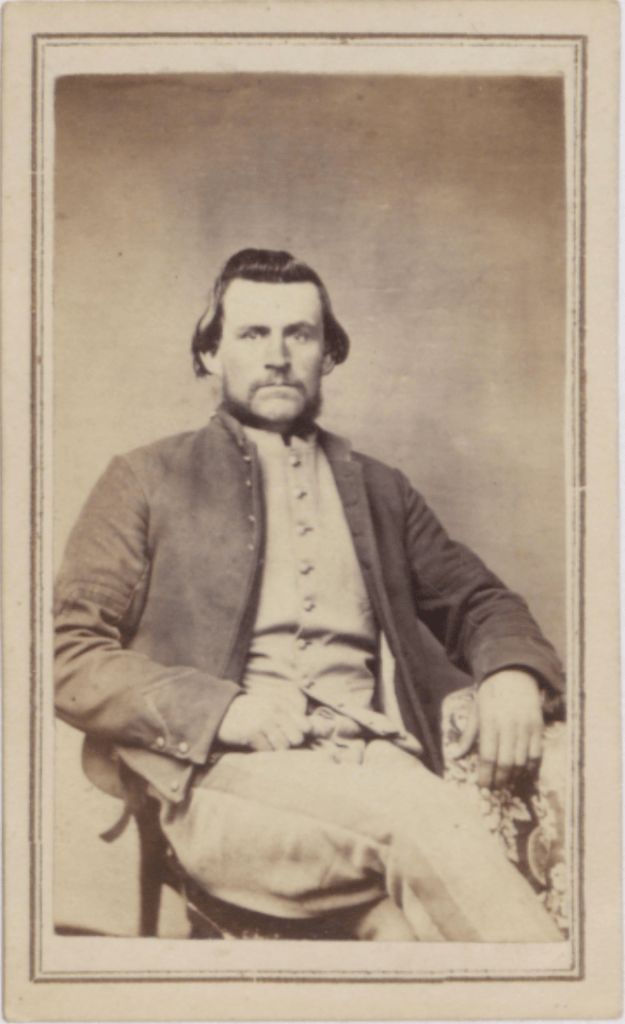
The following two letters were written by Esther (Warner) Calkins (1834-1880), the wife of Peter Berdic Calkins (1833-1897). The couple were married in Richland, Oswego county, New York and were living in Elm Creek Township. Saline county, Kansas, during the Civil War.
Esther wrote the letter to her sisters-in-law, Jane (Calkins) Alexander, the wife of Samuel Alexander, and Phebe (Calkins) Hager (1831-1898), the wife of John Hager (1829-1897) of Altmont, Michigan.
Esther’s letter indicates that her husband Peter had recently become a soldier. Peter enlisted in Co. L, 11th Kansas Cavalry on 31 March 1864. He was discharged for disability on 14 June 1865 at Fort Riley. Both letters were written while Esther was home alone in Saline county with her two little girls—Mary (b. 1856) and Jane (b. 1863).
Letter 1
Salina [Kansas]
June 11, 1864
Ever dear Brother and Sister,
I improve the time this morning in answering your kind and affectionate letter which came to hand in due time. I was very glad to hear from you. I and my little children are well. It has been 3 weeks since I have seen Peter. He says he likes a soldier’s life first rate. His health is much better since he enlisted, but it has been very lonely for me since he has gone. He has been at Fort Riley all the spring, until within a few days he has gone to Fort Scott.
It has been a very cold backward spring. The winter wheat is an entire failure. How I wish I could come and spend the summer with you and Phebe. I think I should enjoy myself better than I shall here.
The Indians have been trying to be troublesome this spring. Four weeks ago, news came to us; the Indians was just above town killing everybody they came to. We thought if they were that near to us it was time for us to be leaving. The man that I live with got his team and we started and went 15 miles before we stopped but to find out the truth of it, there was one white man and three Indians killed [and] that was about 70 miles from us. We were all very badly scared but I think that we are safe now. The soldiers came and drove them back. The men in Salina have built a fort so they will be ready for the rebels if they ever come to make war with the whites. I hope we won’t have any more trouble with the Indians.
I hope this cruel war will come to a close this year. It is enough to make one’s heart ache to think how many homes it has made desolate. Good of all kinds re very high. Calico is 35 cents a yard. Coffee 55 cents a pound and everything according. I have 7 cows with me and five yearlings and 2 horses. Peter has bought nine head of cattle since he has been in the war. I have not got them home yet.
I can’t think of much to write since Hattie died and Peter has gone in the war, I ain’t myself any more. Tell Phebe that I will write to her soon. Peter’s post office: Fort Riley, Company L, Kansas 11th, in care of Capt. Henry Booth. If I could see you I could tell you more then. I can write no more at this time but ever remain your sister until death. Let us try and meet in heaven where we never shall take the parting hand. — Esther
Goodbye.


Letter 2

Salina [Kansas]
July 10, 1864
My dear sister Phebe,
I take my pen in hand to let you know that I have not forgotten you. I am well today and I hope when this reaches you it will find you enjoying the same blessing. Dear Phebe, I can sympathize with you in your loneliness. I got a letter from Peter today. He was well and seems to enjoy himself first rate. He is about 75 miles from home.
The Indians are quite troublesome this summer. They have killed two white men this summer. The soldiers are out all the time keeping them back. Whether they will come into this place I cannot tell.
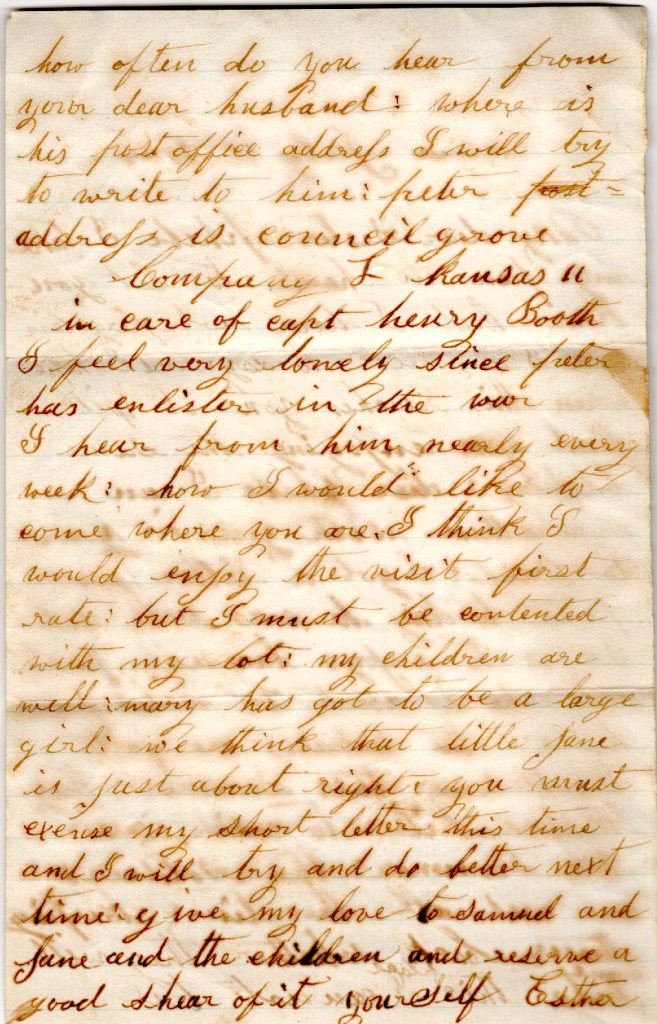
How often do you hear from your dear husband? Where is his post office address. I will try to write to him. Peter’s address is Council Grove, Company L, Kansas 11th, in care of Captain Henry Booth.
I feel very lonely since Peter has enlisted in the war. I hear from him nearly every week. How I would like to come where you are. I think I would enjoy the visit first rate. But I must be contented with my lot. My children are well. Mary has got to be a large girl. We think that little Jane is just about right.
And you must excuse my short letter this time and I will try and do better next time. Give my love to Samuel and Jane and the children and reserve a good I share of it yourself, — Esther

 Spared & Shared 23