
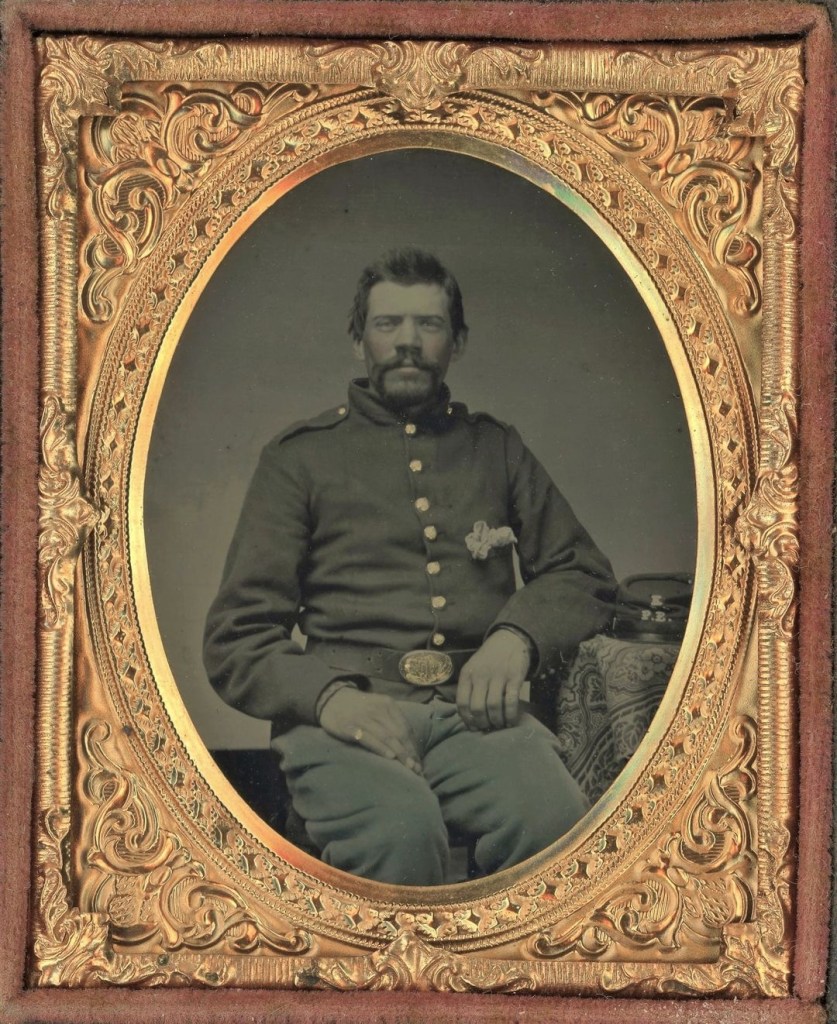
The following letter was written by Pvt. Julian Knowlton (1834-1881) of Co. A, 44th New York Infantry. The 44th was organized at Albany, New York, and was transported to Washington D. C. in late October 1861 where they were attached to Butterfield’s Brigade, Fitz-John Porter’s Division of the Army of the Potomac. They did not see their first action until the siege of Yorktown in April 1862. Julian was captured in action during the Battle of Gaines’ Mills but soon paroled. He then was wounded in the Battle of Gettysburg on the second day of fighting, having participated in turning back Longstreet’s assault on the Union left. A member of Co. A later wrote of that day: “Our regiment lost very heavy; 111 out of 300. Our company lost more than any other company in the regiment, 22 out of 40, had 5 killed. Each company cared for their wounded. [Julian] Knowlton, from Forestville, was badly wounded in the knee. I helped carry him off from the field. The last I heard from him, he was doing well. Both of my tent mates were wounded.—After we had carried our wounded of from the field, we then buried our dead. Three boys from our company together with myself, carried four of our dead comrades back. It seemed hard, I tell you. They had stood right beside us, in the ranks all through everything until now.” Though Julian survived the war, his right leg continued to cause him pain, and it was finally amputated in 1880. He died the following year in Elliott, Ford county, Illinois.
The letter was datelined from Camp Butterfield on Christmas day, 1861—just five days after the Battle of Dranesville—a skirmish really—in which both sides suffered relatively low casualties. The Union infantry regiments engaged in the fight included the 9th, 12th and 13th Pennsylvania Reserves (the latter being designated the 42nd Pennsylvania, the 1st Pennsylvania Rifles, or more popularly referred to as “Kane’s Bucktails”). Julian’s younger brother, Byron (“By”) D. Knowlton (1842-1923) was a member of Co. D in the Bucktails but we learn from Julian’s letter that By was not in the battle. Rather, he was on guard duty at their camp on the day of the battle.13th Pennsylvania Reserves, Officially designated the 42nd Pennsylvania Volunteer Infantry, the unit was also known as the 13th Pennsylvania Reserves, the 1st Pennsylvania Rifles, and the Kane Rifles.
Julian and Byron were the sons of William and Mary Ann (Whipple) Knowlton of Forestville, Chautauqua county, New York. Though unnamed, Julian no doubt wrote the letter to his brother Jerome (b. 1836).
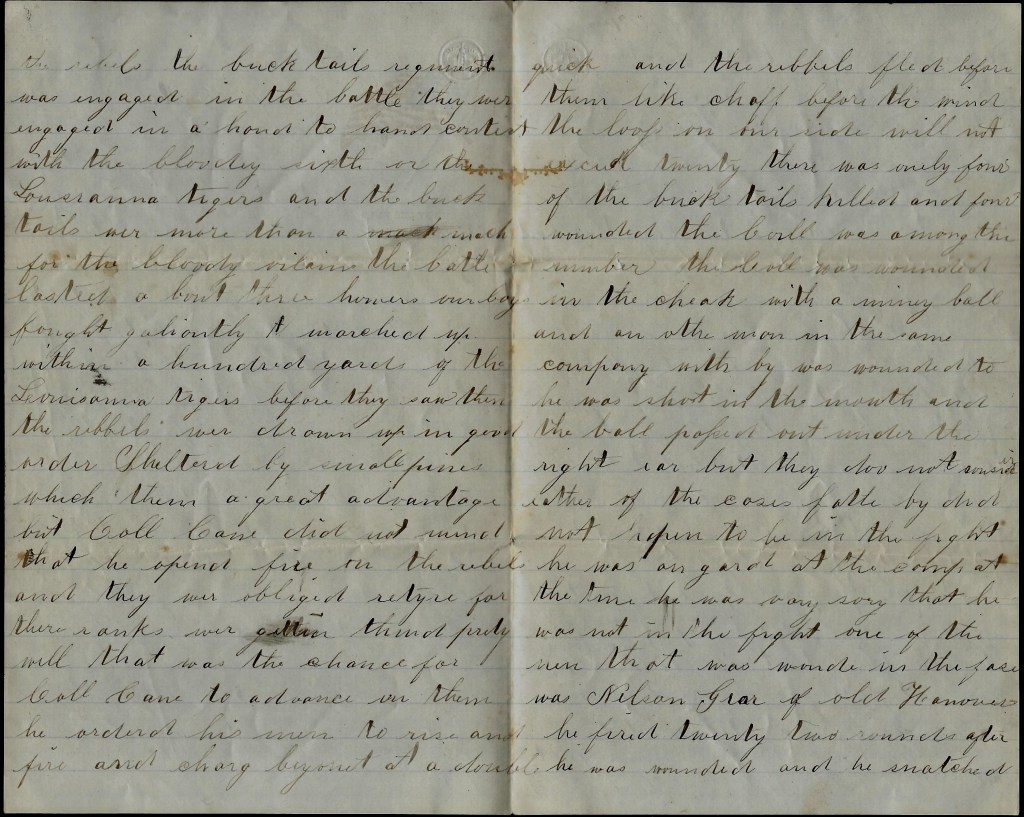
Transcription
Camp Butterfield
[December] 25, 1861
Dear Brother,
It is with pleasure I resume my pen to inform you that I received your letter and was very glad to hear from you and to hear that you were well. I was glad to hear that you received the money that I sent you. I began to think that you had not received it. I am as well as usual and I hope that these few lines will find you enjoying the same blessing.
We still remain in our old camp but I do not think that we shall not remain here long for the rebels are getting rather bold of late. They have made several charges on our pickets and our men had quite a battle. There was three regiments of our men engaged with four or five regiments of the rebels. The Bucktails regiment was engaged in the battle. They were engaged in a hand-to-hand contest with the Bloody Sixth or the Louisiana Tigers and the Bucktails were more than a match for the bloody villains.
The battle lasted about three hours. Our boys fought gallantly. It marched up within a hundred yards of the Louisiana Tigers before they saw them. The rebels were drawn up in good order sheltered by small pines which [give] them a great advantage but Col. [Theodore L.] Kane did not mind that. He opened fire on the rebels and they were obliged to retire for their ranks were gettin’ thinned pretty well. That was the chance for Col. Kane to advance on them. He ordered his men to rise and fire and charge bayonet at a double quick and the rebels fled before them like chaff before the wind.
The loss on our side will not exceed twenty. There was only four of the Bucktails killed and four wounded. The Colonel was among the number. The Colonel was wounded in the cheek with a minié ball and one other man in the same company with By [Byron] was wounded too. He was shot in the mouth and the ball passed out under the right ear but they do not consider either of the cases fatal. By did not happen to be in the fight. He was on guard at the camp at the time. He was very sorry that he was not in the fight. One of the men that was wounded in the face was Nelson Geer 1 of old Hanover. He fired twenty-two rounds after he was wounded and he snatched a sword from the sheath of a dead rebel and fetched it off as a trophy. The boys brought of numerous things such as revolvers and watches and rifles, &c.
I was over to see By yesterday. The boys were in fine spirits. They have got themselves a very comfortable encampment. I saw Nelt Geer. He looked rather hard. His face was very badly swollen but he does not mind that.
I have nothing of importance to communicate but what I have already written so I will speak of our business. I shall send you twenty or twenty-three dollars the first of next month and I want you to settle my account at the farmers and if there is anything left, I want you to pay Pierce that five dollars that you got him for me. I am owing W. M. Gardner a little but I cannot pay him now as I see. Give my respects to all enquiring friends. Give my respects to Mr. Pierce and tell him that I am much obliged to him. In haste, — J. Knowlton
About the things of mine that you spoke of, you can keep until I give you different orders. I think that they [ ] as well as they are.

1 Nelson Theodore Geer (1842-1895) of Warren county, served as a private in Co. D (the “Raftsman Guard”), 42nd Pennsylvania Rifles. He enlisted in May 1861 and was discharged for wounds in March 1863. He was first wounded in the Battle of Dranesville on 20 December 1861 and wounded a second time at the Battle of Antietam on 17 September 1862.

 Spared & Shared 23