
The following letter was written by 1st Sgt. William J. Clark (1839-1870) who mustered into Co. G, 106th Pennsylvania Volunteers on 27 August 1861 and was discharged for disability on 25 July 1862. After he was discharged from the service, William returned to Norristown where he became a railroad worker. He died of dropsy in 1870.
William was probably the son of David H. Clark and his wife Letitia, emigrants from Ireland who resided in Norristown, Pennsylvania. David was a weaver by trade.
Transcription

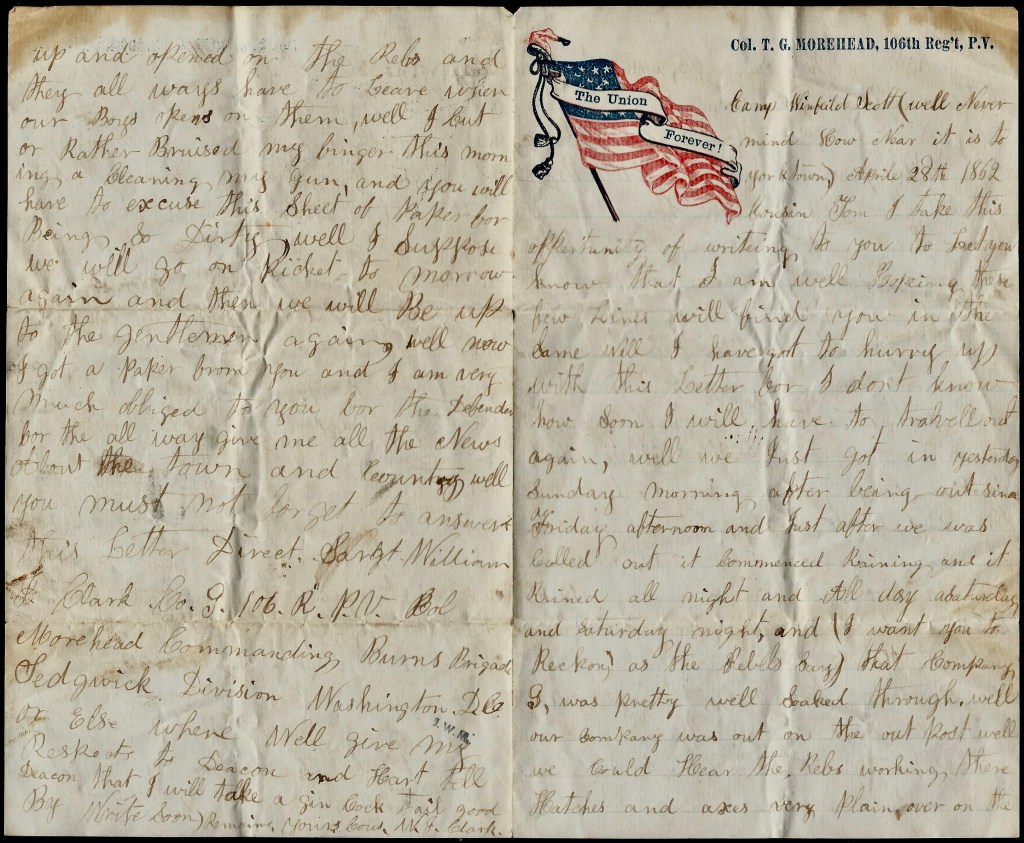
Camp Winfield Scott (well never mind how near it is to Yorktown)
April 28th 1862
Cousin Tom,
I take this opportunity of writing to you to let you know that I am well, hoping these few lines will find you in the same. Well, I have got to hurry up with this letter for I don’t know how soon I will have to travel out again.
Well, we just got in yesterday, Sunday morning, after being out since Friday afternoon and just after we was called out it commenced raining and it rained all night and all day a Saturday and Saturday night and (I want you to reckon, as the Rebels say) that Company G was pretty well soaked through. Well our company was out on the outpost. Well we could hear the rebs working their hatchets and axes very plain over on the other side of the swamp.
Well they have batteries all along but our boys keep them very busy minding themselves and jumping and dodging our shell and bullets. Well Saturday night was the longest night I ever saw or ever put in I will tell you for our regiment was called out on last Friday afternoon and we was out all night Friday night and all day Saturday and then our company was put on the outpost at night. Well, that is nothing for we have just the little bit the best-looking company that I see about in this part of the country. Well we could hear the Rebels a working all night and then every one of their pickets carries a dark lantern and they tried their best to throw the light into the face of two of my men that I had on post for I had two posts with 12 men and a corporal for them both. But the secesh could not make anything out of the Blazers, as our boys call themselves.
Well, Tom, there is nothing but a continual roar of musketry and artillery a going on all the time. But we have got so used to it that we don’t mind it any more. Only once the week before last when our company and company D & F & K—four companies—got saluted by four shells from the Rebel’s batteries. Well, I will tell you how that happened. We were all out working at a fort all night and in the morning after we had finished the fort, we was a going back through the woods to our camp and we got out on a road that was clear and right on our right was a big open field with a Rebel battery. Well they opened on us of course. But they are very bad gunners for their shells all went over our heads. But we had to get out of the road as quick as we could for our artillery come up and opened on the Rebs and they always have to leave when our boys open on them,
Well, I cut or rather bruised my finger this morning a cleaning my gun and you will have to excuse this sheet of paper for being so dirty, Well, I suppose we will go on picket tomorrow again and then we will be up to the gentlemen again. Well, now I got a paper from you and I am very much obliged to you for The Defender for they always give me all the news about the town and country.
Well, you must not forget to answer this letter. Direct to Sergeant William J. Clark, Co. G, 106th Regiment P. V., Col. Morehead Commanding, Burns Brigade, Sedgwick’s Division, Washington D. C. or elsewhere.
Well, give my respects to Deacon and Hart. Tell Deacon that I will take a gin cocktail. Goodbye. Write son. I remain yours, Cousin W. J. Clark

 Spared & Shared 23