
The following letters were written by Pvt. Jesse W. Shaw who enlisted when he was 20 years old in Co. F, 126th Ohio Volunteer Infantry (OVI) on 15 August 1862 for three years. He was discharged on 26 April 1865 for wounds received 11 months earlier in the Wilderness.
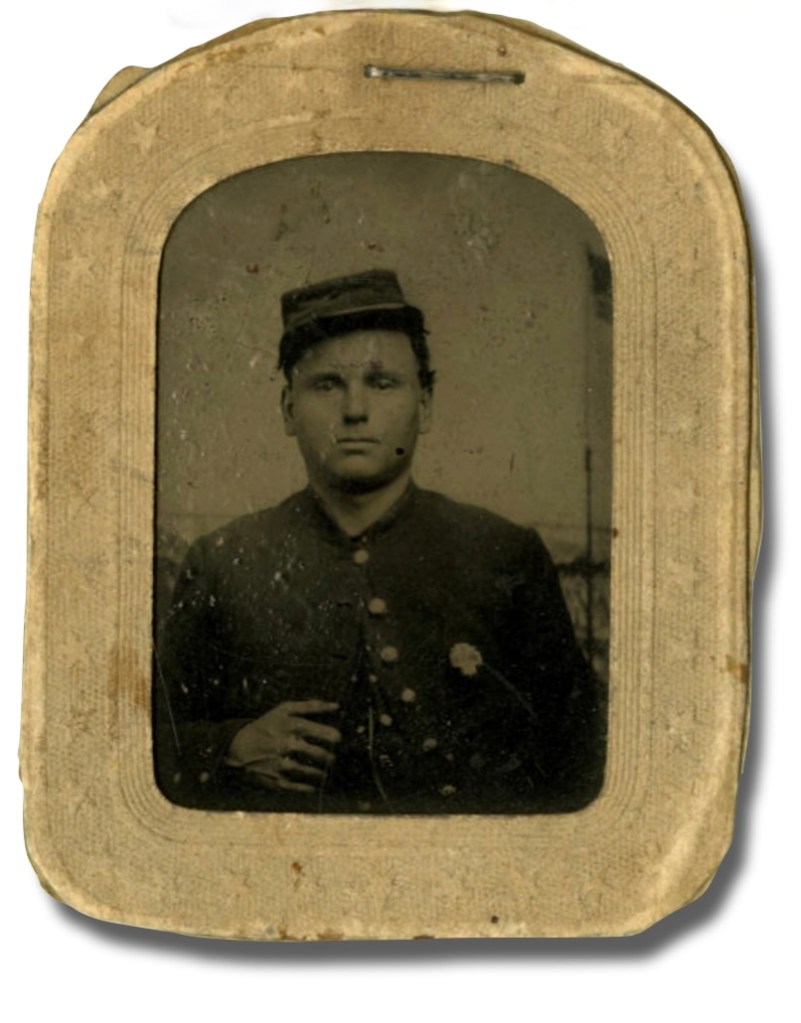
The 126th OVI was organized in September under Colonel Benjamin F. Smith and moved the same month to Parkersburg, West Virginia, and then to Cumberland, Md. It guarded the B&O Railroad during the winter, and in the spring of 1863 operated against guerrillas in West Virginia. In June the Regiment returned to the vicinity of Martinsburg and was severely pressed by the advance of Lee’s army, but escaped to Harper’s Ferry and afterwards moved to Washington City. It soon re-joined the Army of the Potomac and operated in Virginia under Grant. It took part in the battles of Snicker’s Gap, Opequan, Fisher’s Hill, the Wilderness and Petersburg, and joined the pursuit of Lee until the surrender. The Regiment was mustered out June 25, 1865, and lost during its term of service over 500 men in battle.
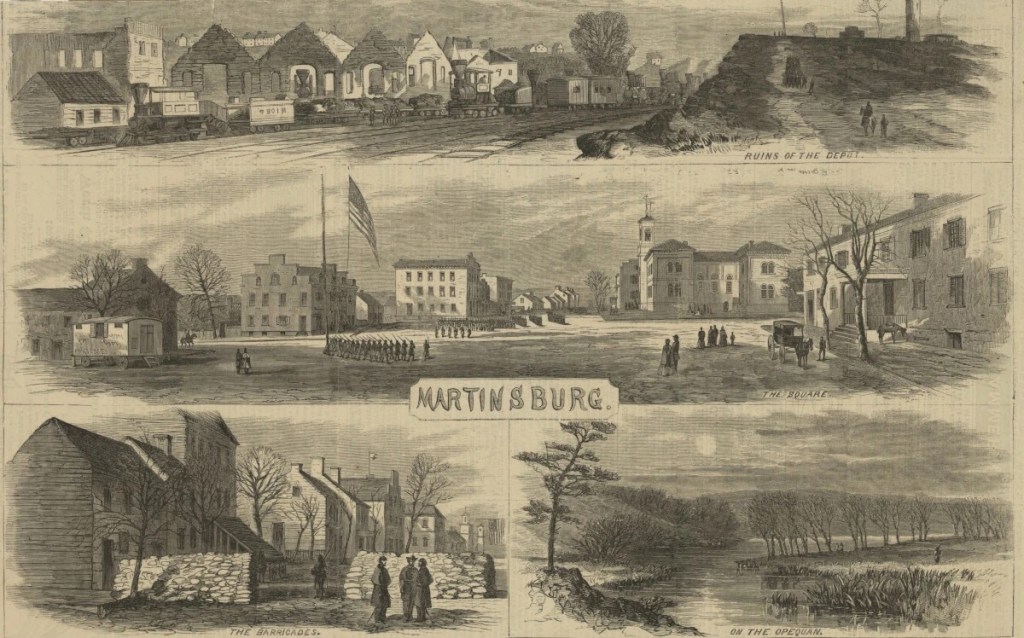
Letter 1
Headquarters 126th [Ohio] Regt., Co. F
Camp Martinsburg
April 15, 1863
Dear Cousin,
It is with pleasure that I attempt to write you a few lines in reply to your last letter. It was received with the greatest of pleasure. I am glad to inform you that our regiment is improving fast. The regiment is nearly one third larger than it was in the winter season. The regiment is a little more like it was at first. We did not think that it would recruit up as well as it has. It looks like a full regiment to what it did a while [ago]. We still have plenty of picketing to perform yet but the health of the regiment is much better than it was, so we have not quite so much guard [duty] to perform as we had some time past. But I must say that there is plenty of it yet. But there was a while that were on every other day. That, I think, is often enough. But the guard [duty] has been reduced a little. That is alright for there were more guards than there was any use of. There is too much duty at this place for one regiment to perform. There is no infantry troops here but the 126th. It is the only regiment that performs the duty.
We have begun to drill this spring so I suppose they will have us to drill this summer also but I think we will not keep it up quite so regular as we did the last summer. I suppose it will be kept up as long as we stay at this place.
The town ladies come to camp every nice evening to see us on dress parade. There is most sure to be some every evening of dress parade. The citizens want this regiment to stay here all summer. We have had several pretty nice days this spring but we have had a good little bit of rain this spring. This is a very wet day here and it appears as though it will remain ugly weather for a while but it is very changeable here. It is hard to tell one day what it will be like the next one. It being close to the mountains, is very changeable weather. There was one or two days that was very hot but the people say that it will get five times as hot after a while. If it does, it will be pretty warm weather for us soldiers for we thought that those few days was warm enough, but we are between the mountains [and] there is mostly a breeze.
It is rumored in camp that this regiment will be separated and placed as guards along the railroads but it is only a report. It may be that it is true or it may not be. There was twelve hundred prisoners of our men went through here the other day. They were going to Camp Chase. They were taken in Tennessee. The while brigade was taken—surrounded by about twenty thousand rebels. 1
Thomas Crawford met with an accident the other day [when] he was placing the relief guard at their post. He was walking down the railroad. There was a bridge he did not know of. It was so dark that it was imperceivable. He fell some eighteen or twenty feet. It broke his leg in two places. I believe he is getting along as well as could be expected.
Well, Tenna, I have not much news to write so I will close but write soon. No more at the present. — Jesse W. Shaw
1 These paroled Union soldiers being transported by traIn to Camp Chase to await exchange were surrendered to Brig. Gen. Nathan Bedford Forrest near Brentwood, Tennessee on 25 March 1863. The Union forces were commanded by Lt. Col. Edward Bloodgood who surrendered 800 men with very little resistance. Major General William S. Rosecrans was disgusted with the lack of fight and had Bloodgood court-martialed for cowardice. In a letter dated 9 April 1863 at Martinsburg, Lt. Rufus Ricksecker of the 126th OVI, wrote his folks that “Day before yesterday there was a long train went by of ‘Paroled Prisoners’ passed here; they stopped about half an hour; after the train had left I understood some of the 51st Ohio were along, I did not get to see any of them. This evening another one passed coming the other way with Rebels. I suppose they are going to be exchanged, they did not appear to like the idea very much, as they said they were so much better fed in the North.” [Source: The 126th Ohio Volunteer Infantry]
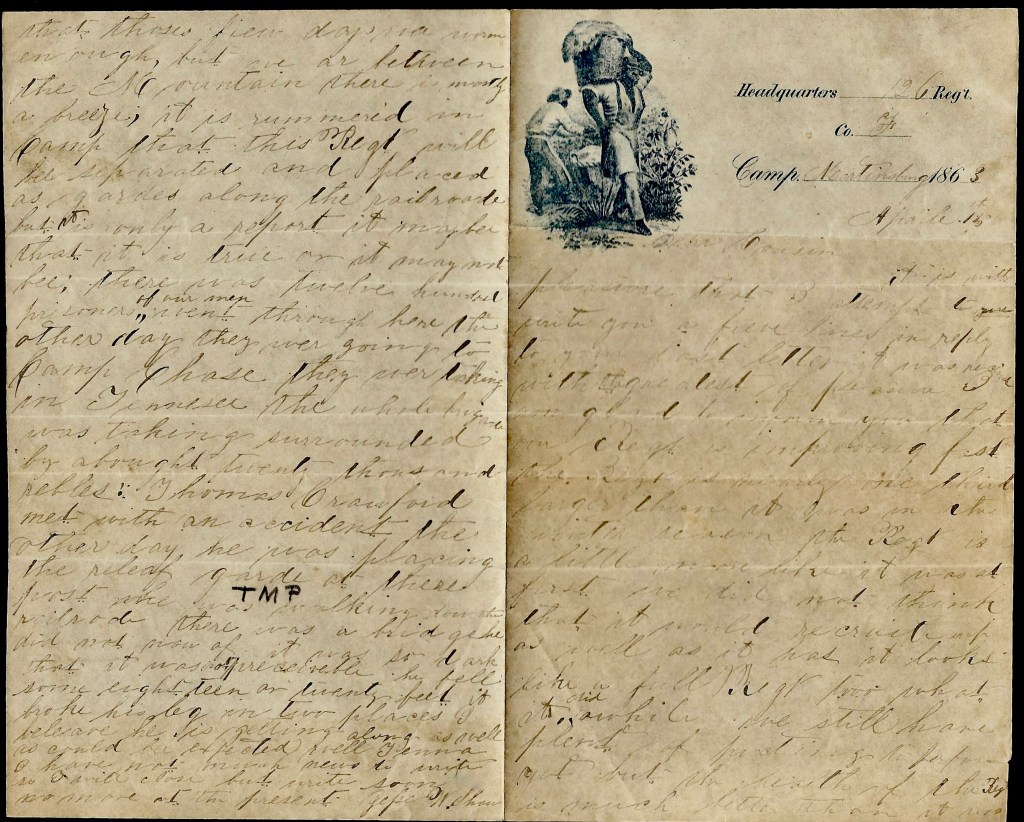

Letter 2
New Creek, Virginia
May 17, 1863
Miss Tenna Caskey
Well Tenna, I thought that I would answer your letter which I received some time ago. We left Martinsburg April 26th. We took the train and rode to New Creek. There we stayed until morning and then was ordered to march to Greenland Gap. We went within 7 miles from the Gap the first day. We were all pretty well tired out [after] the first day’s march. There was 50 or more fell back and come up on the wagon train. We had the creek to cross about 30 times. It kept us wet all the time but we at last stopped for the night. We then got our supper and laid down to sleep. But we did not sleep very much for we were all wet.
We were ordered to march at four o’clock. We then proceeded for the Gap. We arrived at the Gap about 5 o’clock but found no rebels there. They had left but they had a pretty smart fight with 80 of [James Adelbert] Mulligan’s men. They fought 21 hundred of the rebels for five hours. The rebels charged on them three times but were repulsed every time. The 80 men were in a little fort. The rebs dismounted and went around the mountain and come down on them from the top and run them out but they were too spunky to give up so they run to an old Meeting House that stood close by. The rebs set the house on fire but they kept them away as long as they had plenty of ammunition but they run out. The last load they shot was their ramrods. Then threw their guns in the fire and surrendered. 1
The dead was all buried when we got there. The dead horses was lying around plenty. I saw the graves of part of the dead. There was two houses that stood close by that had 25 wounded and killed. They [the rebels] lost 80 killed and wounded. Only one of Mulligan’s men was killed at the time but there was two or three wounded and one died since. There was guns lying around on the ground but I did not pick any of them up. I thought that I had enough to carry for fifty cents per day.
Then we were ordered to follow them. We then proceeded 8 miles farther up the Alleghany Mountains. We arrived at a place by the name of Mt. Storm. There we lay two days. We had not been there long before we heard that the rebs was marching that way. Then the next thing was to prepare for them. We fortified with logs and stone the best we could and waited awhile for them but they did not come. We were then ordered back to New Creek. We had not got quite there until we received the dispatches that the rebs was going through the Gap. Then come the hard times. It was a pretty hard march in the forenoon but it was a harder one in the afternoon. We then started back to the Gap. We were as tired a lot of boys as ever I saw but we arrived there about sundown. We then formed our regiment in as good a position as we could which did not take no little time for they were pretty well scattered along the ways. We then built some fires and got our suppers.
Then come the time for picket to go out and we had already marched 30 miles. I for one had to go on picket. So had John. We were on the same post. I presume if the rebels had come we would not have run very much for we were too tired but we were not disturbed. We were there three or four days and then were ordered back to New Creek. But we had another hard march to perform. We marched 16 miles in the afternoon. We camped for the night 7 miles from New Creek Station. It was then raining. I used to think it was pretty hard for the soldiers to pay out after night in snow or rain but I have experienced right smart of it myself the last month. We are now at New Creek.
Well, I will have to close for this time. Write soon. Direct to New Creek Station, Va., Co. F, 126th Regt. O. V. I., in care of corporal Walton.
— Jesse W. Shaw
1 On April 25, 1863, about 1,500 Confederate soldiers under General William “Grumble” Jones advanced through Greenland Gap, a scenic 820-foot-deep pass in New Creek Mountain in Grant County. Jones’s Confederates clashed with 87 Union soldiers, who’d taken positions in a local church and cabins. The Northern troops held off several assaults over four hours of fighting. After the church was set on fire, the Union forces finally surrendered. The Union side lost two killed and six wounded, while the Confederates lost seven killed and 35 wounded. It was the beginning of what would become known as the Jones-Imboden Raid, an ambitious but ultimately unsuccessful bid by Confederates to disrupt the Baltimore and Ohio Railroad and weaken Union control in what would soon become the new state of West Virginia. For a good summary of this engagement at Greenland Gap, readers are referred to an article by George Skotch (2018) entitled, “To the Last Crust and Cartridge.”


 Spared & Shared 23