
This interesting letter was written by Andrew Jefferson Sagar (1830-1900), a son of William C. Sagar, Jr. (1800-1877) and Dolly Wheeler (1803-1880) of Steuben county, New York, who moved with his family to Virginia in the 1850s to farm in Fairfax county. Andrew married Hannah Atta Bentley (1843-1913) on 7 February 1861.
Sagar wrote the letter to Abram P. Pruyn (1836-1918), the son of Henry Pruyn (1812-1893) and Ann Putnam (1816-1888) of Auriesville, Montgomery county, New York.
Andrew’s letter provides us with a civilian account of the Rebel army’s occupation of Fairfax county after the Second Battle of Bull Run in late August 1862. As natives of New York, and Unionists in Virginia, the Sagars were not anxious to suffer through another rebel occupation as they had following the First Battle of Bull Run when there were no less than three rebel encampments on his property [See newspaper clipping below from the New York Tribune of 20 July 1861.] Andrew informs us of the rebel army taking several Unionist citizens as prisoners.
Andrew wrote the letter from Steuben county where he and his wife and parents took refuge for some time among relatives. In June 1863, he was still there when he registered for the draft. Land records show that he purchased the property in Fairfax county from his parents in 1865.
Transcription
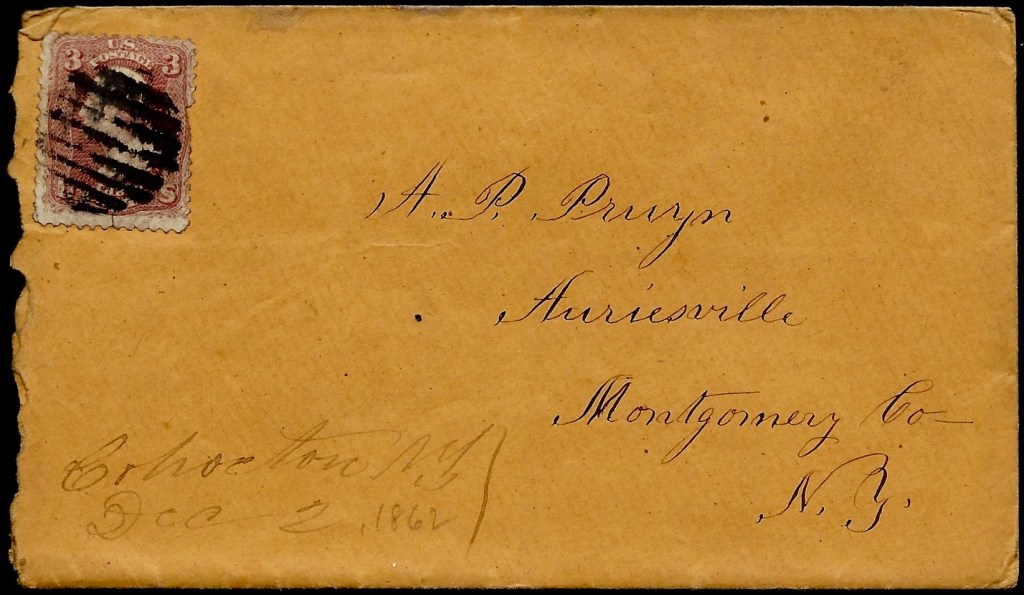
Cohocton [Steuben county, New York]
November 30th 1862
Friend A. P. Pruyn,
You have been anxious undoubtedly to hear of our whereabouts & prospects since our reverse last August & I feel as though I had hardly done right in not writing to you sooner.
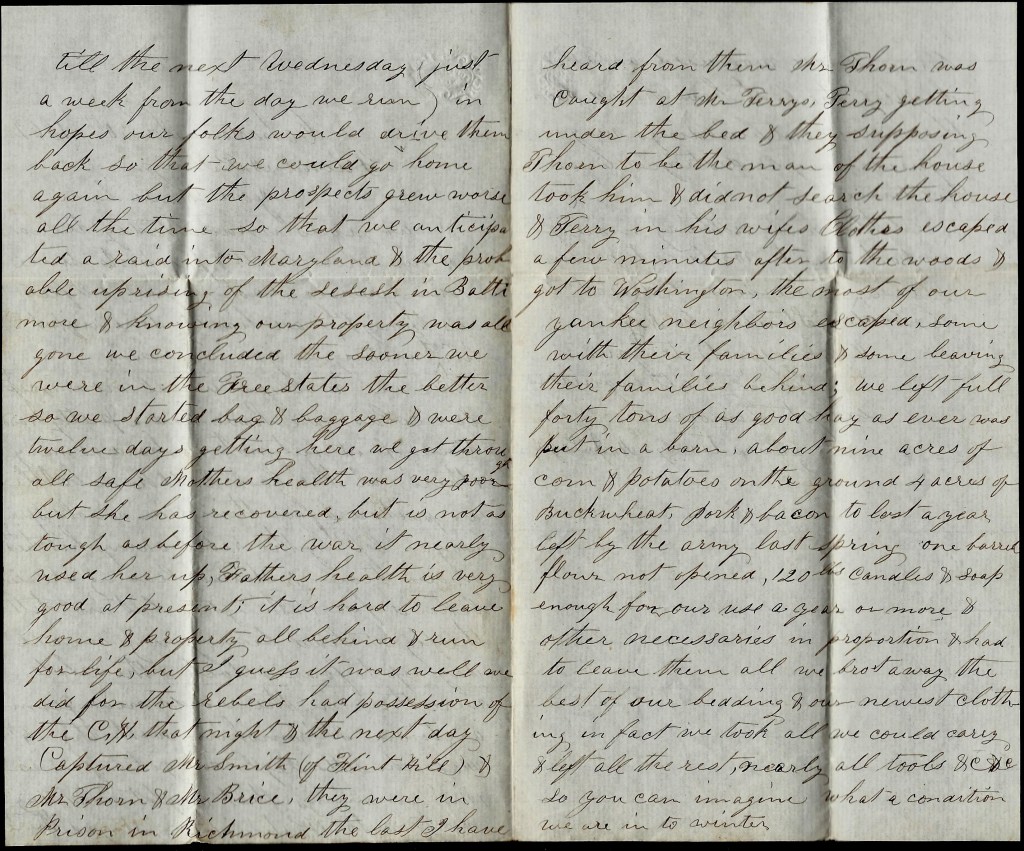
We are all well as usual now except bad color. We have had a pretty hard time of it but not as hard as many others. At the last Bull Run battle we packed a few things in an old spring wagon left by the rebel army, hitched on our team and started leaving all else behind for Washington but not till the fight had been going on all day up to four o’clock & the rebels were then in the woods near Germantown skirmishing with the 13th Massachusetts Regiment. We got as far as Mr. Demmings that night [and] next day went on to Washington & stayed there till the next Wednesday (just a week from the day we run) in hopes our folks would drive them back so that we could go home again but the prospects grew worse all the time so that we anticipated a raid into Maryland & the probably uprising of the sesesh in Baltimore & knowing our property was all gone, we concluded the sooner we were in the Free States the better so we started bag & baggage & were twelve days getting here. We got through all safe.
Mother’s health was very poor but she has recovered, but is not as tough as before the war. It nearly used her up. Father’s health is very good at present. It is hard to leave home & property all behind & run for life but I guess it was well we did for the rebels had possession of the [Fairfax] Court House that night & the next day captured Mr. Smith (of Flint Hill) & Mr. Thorn 1 & Mr. Brice. 2 They were in prison in Richmond the last I have heard from them. Mr. Thorn was caught at Mr. Terry’s, Terry getting under the bed & they supposing Thorn to be the man of the house, took him & did not search the house & Terry in his wife’s clothes escaped a few minutes after to the woods & got to Washington.
The most of our Yankee neighbors escaped, some with their families & some leaving their families behind. We left full forty tons of as good hay as ever was put in a barn, about nine acres of corn and potatoes on the ground, 4 acres of buckwheat, pork & bacon to last a year left by the army last spring, one barrel of flour not opened, 120 lbs. candles & soap enough for our use a year or more, and other necessaries in proportion & had to leave them all. We brot away the best of our bedding & our newest clothing. In fact, we took all we could carry and left all the rest—nearly all tools, &c. &c.—so you can imagine what a condition we are in to winter.
Our house was used as a hospital the last have heard from there & our out buildings very much injured & may be destroyed before this time.
I think of nothing more of importance to write at present. Please write to me soon and direct to Cohocton, Steuben county, New York.
Our respects to your family & all enquirers except Democrats. Yours truly, — A. J. Lagar

1 Possibly Talmadge Thorne.
2 Matthew Bryce (1807-1863) was Unionist from Oakton, Fairfax county, Virginia. He died a prisoner of war in Richmond, Virginia, on 17 March 1863 at the age of 55.


 Spared & Shared 23