
The following letter was written by Corp. John C. Allen who was 22 years old when he enlisted at New York City to serve two years in Co. D, 31st New York Infantry. He entered the service as a private in June 1861 but was shortly after promoted to corporal. During the Peninsula Campaign, John was wounded and captured at Gaines Mill on 27 June 1862 but was paroled and exchanged a month later. He mustered out with his company in June 1863.
The 31st New York was sometimes called the Montezuma Regiment or the Baxter Light Guards. They left the state and served at or near Washington D. C. from the time of their arrival in late June 1861 until joining the Army of the Potomac (AOP) in its Spring 1862 Campaign. At the time this letter was written in late December 1861, the regiment was in General Franklin’s Brigade of the AOP.
TRANSCRIPTION
Alexandria Camp
31st New York Vols.
December 22d 1861
Dear Father,
I take my pen again to write to you. I have been out on picket since I last wrote to you. Was gone four days. We had very mild weather. I suppose you have had good weather.
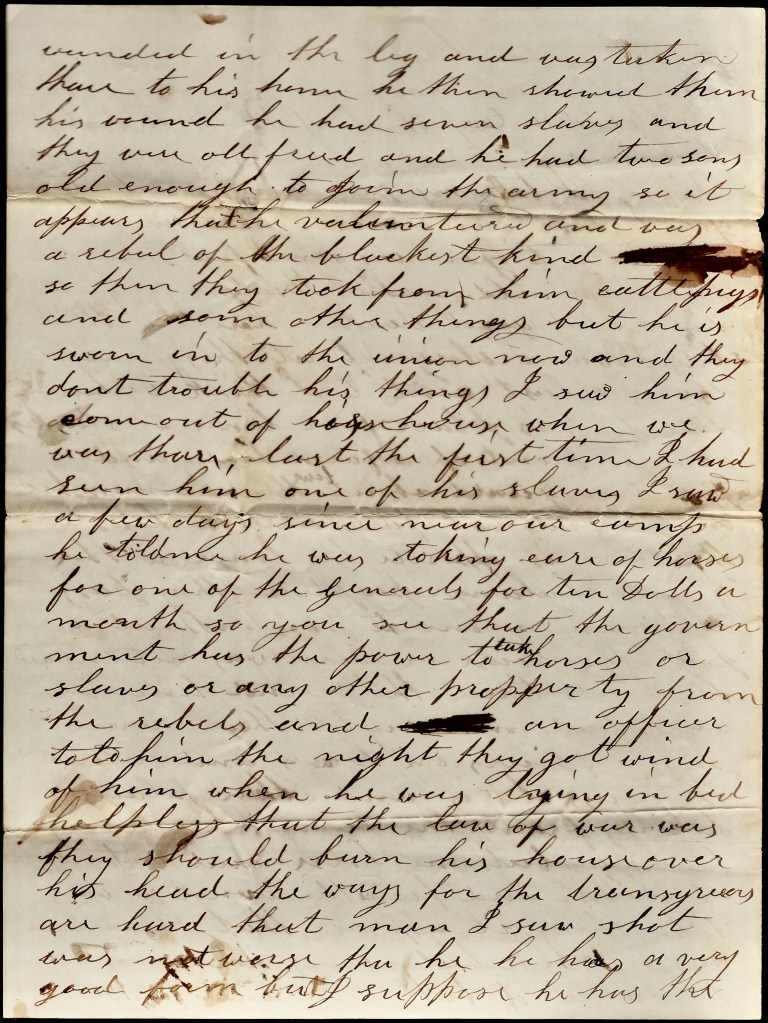
Here I will tell you a story about this place that we last went to. I think we have been to this place four times. We stacked arms in front of a farm house and posted a guard, about three in number, on the road not far from the house. The barn is opposite the house so the guard challenges people as they pass, allowing no one to pass without a pass. The house or barn was not entered the first time. The second time we went at midnight. There came some officers on horses and entered the house, barn and other places, taking from the barn three horses leaving but one horse and entered the house and found the owner as was told them. It appears that this man was in the rebel army and was in the Battle of Bull Run and was wounded in the leg and was taken there to his home. He then showed them his wound. He had seven slaves and they were all freed and he had two sons old enough to join the army so it appears that he volunteered and was a rebel of the blackest kind.
So then they took from him cattle, pigs and some other things but he is sworn into the Union now and they don’t trouble his things. I saw him come out of his hog house when we was there last—the first time I had seen him. One of this slaves I saw a few days since near our camp. He told me he was taking care of horses for one of the Generals for ten dollars a month so you see that the Government has the power to take horses or slaves or any other property from the rebels and an officer told him the night they got wind of him when he was laying in bed helpless that the law of war was they should burn his house over his head. The ways for the transgressors are hard.
That man I saw shot was not worse than he. He has a very good farm but I suppose he has that same old heart. The woodland is all cut down. Gen. Lee of the rebel army has a large tract of land there—the wood being all cut down last fall and now they are cutting it in four feet [lengths] and carting it to the different camps.
Nothing very uncommon took place [on picket]. We came in on Friday. I took as much tobacco as I wanted out of a field that was left by a rebel, I suppose, as it is too late to gather it at this season of year. I venture to say that 99 out a 100 of the inhabitants of this neighborhood are rebels.
It is dark. You see I don’t get on the line. Will say if there is any tax for me to pay, let me know and I will send it on. It begins to rain. Without any regard to receiving your letters from you, I write to you. It may be some time before I write and it may not so if you do not receive letters from me regular, you must not think strange. I hear that in New York there is three feet of snow. If so, it is much milder here than there.
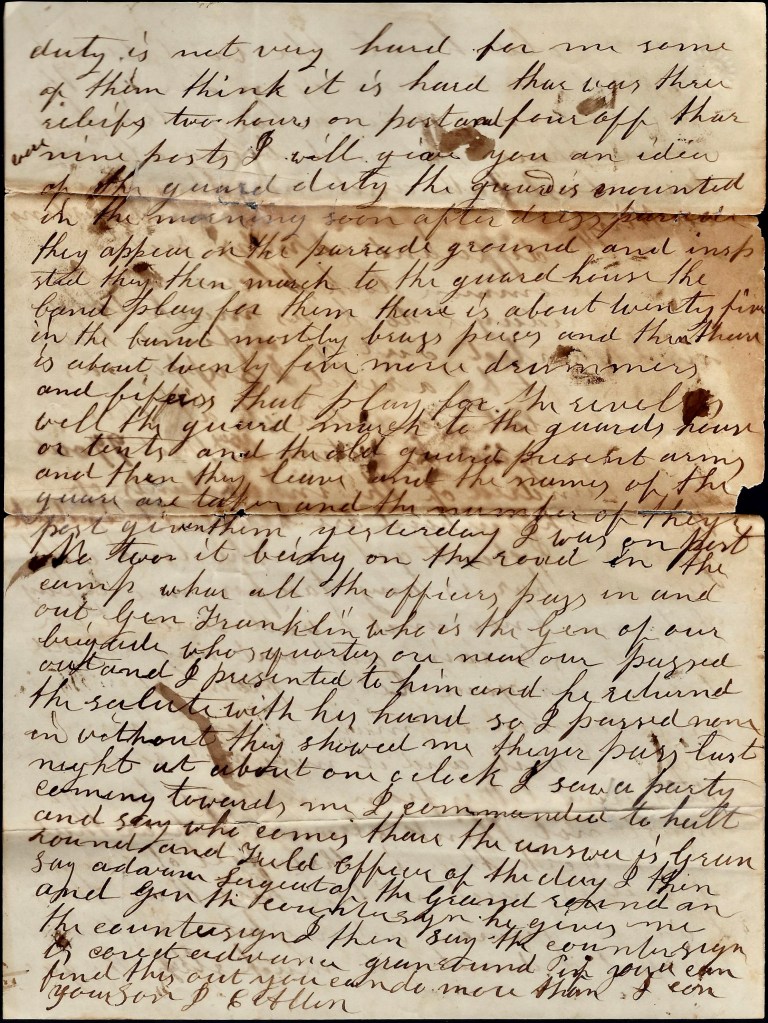
I was on guard last night in the camp. I did not get much sleep. The guard duty is not very hard for me. Some of them think it is hard. There was three reliefs—two hours on post and four off. There were nine posts. I will give you an idea of the guard duty. The guard is mounted in the morning soon after dress parade. They appear on the parade ground and inspected. They then march to the guard house. The band play for them. There is about twenty-five in the band, mostly brass pieces, and then there is about twenty-five more drummers and fifers that play for the reveilles. Well the guard march to the guard house or tents and the old guard present arms and then they leave and the names of the guard are taken and the number of the post given them.

Yesterday I was on Post No. 2, it being on the road in the camp where all the officers pass in and out. Gen. Franklin, who is the general of our brigade, whose quarters are near ours, passed out and I presented to him and he returned the salute with his hand, so I passed none in without they showed me their pass.
Last night at about one o’clock, I saw a party coming towards me. I commanded to halt and say who comes there. The answer is Grand Round and Field Officer of the day. I then say, “Advance Sergeant of the Grand Round, and give the countersign.” He gives me the countersign, then I say, “The countersign is correct. Advance Grand Round.” If you can find this out, you can do more than I can. Your son, — J. C. Allen


 Spared & Shared 23