
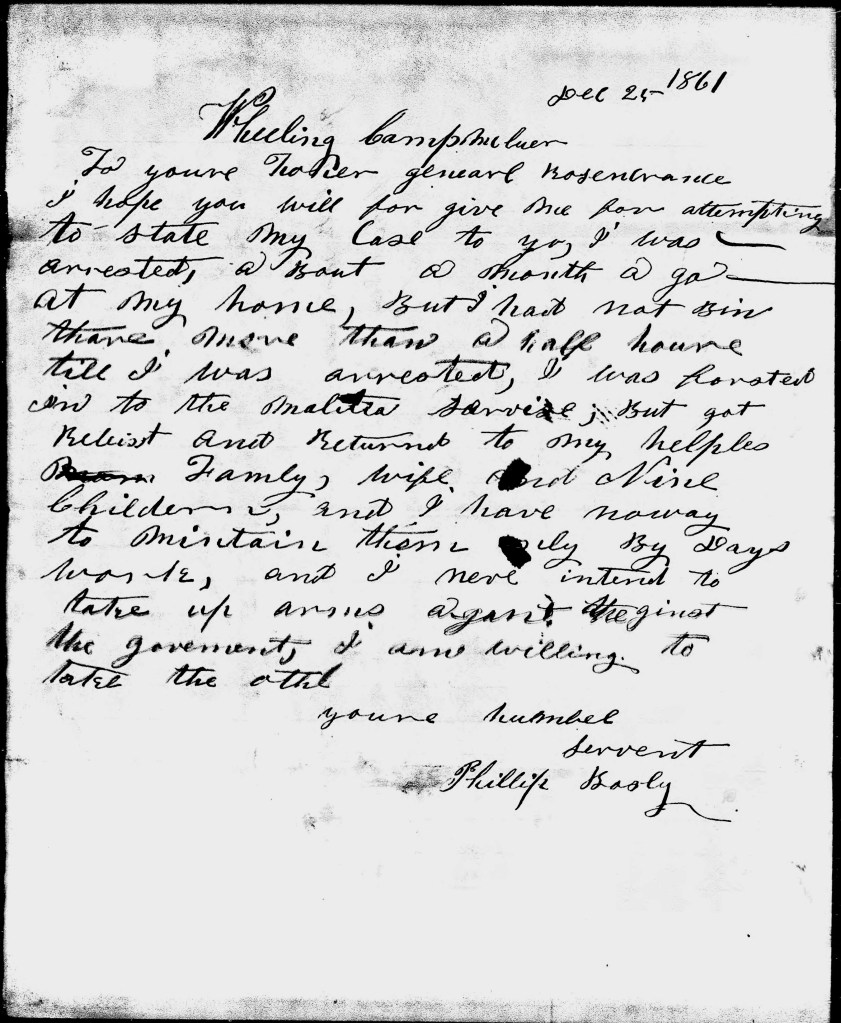
The following letter was sent to me by Mark R. Terry who asked me to confirm his transcription of a record from the Union Provost Marshal’s Papers (see Union Provost Marshals’ File of Papers Relating to Individual Civilians, 1861–1867; Microfilm publication M345, 300 rolls; NAID: 2133278. War Department Collection of Confederate Records, Record Group 109; The National Archives in Washington, D.C.). Mark had a question particularly about the camp name and wondered if I might confirm the author’s identity. While I’m certain the author attempted to write “McLure” as the camp name—the McLure house being the headquarters of Gen. Rosecrans at the time, I am unable to confirm that the author was his g-g-g-grandfather of the same name though I think it’s likely. What’s not clear is whether the author wrote the letter from or to Camp McClure. In other words, was the McLure House used to hold prisoners? I did find some evidence that it was though it may have been only a temporary holding place. The October 19, 1861 edition of the Atlantic Democrat tells the story of a Mrs. Poole who was “placed in confinement at the McLure House, charged with aiding and abetting the escape” of her daughter charged with being a spy.

General William S. Rosecrans established his headquarters at the McLure House—a hotel on the Corner of Market and Monroe (now 12th) Streets in downtown Wheeling, West Virginia in December 1861. Rosecrans, who commanded all Union troops in western Virginia, at the time lived in Wheeling from December 1861 to March 1862.
Terry’s ancestor, Philip Obed Bosley (1818-1909) was born in and lived his entire life in Hardy county, (West) Virginia. Terry has found evidence from newspaper accounts that four men—one named “Bosley”—were arrested subsequent to the attack on the wagons of a Union foraging party not far from were his ancestor lived and it’s logical to conclude that any Confederate militia or guerrillas rounded up by the Union army would have been taken eventually to Wheeling for confinement. Terry’s ancestor was also married and had nine children by the time of his arrest in 1861.
There’s no evidence that Terry’s ancestor ever served officially in the Confederate service prior to or subsequent to his arrest, though he may have engaged in some guerrilla activity if the family bore anti-administration sentiments as Terry claims they did. Whether Rosecrans acted on Bosley’s Christmas Day petition for clemency is unknown but he was undoubtedly released sometime not long after as this part of Virginia fell under strong Union control by the spring of 1862 and most of its citizens lived unmolested.
Transcription
Wheeling, Camp McLure
December 25, 1861
To your honor General Rosecrans,
I hope you will forgive me for attempting to state my case to you. I was arrested about a month ago at my home but I had not been there more than a half hour till I was arrested. I was forced into the militia service but got released and returned to my helpless family—wife and nine children—and I have no way to maintain them only by days work and I never intend to take up arms again against the government. I am willing to take the oath.
Your humble servant, — Philip Bosley
 Spared & Shared 23