
Regrettably, the author’s identity of this unsigned essay remains a tantalizing mystery, with scant clues to piece together even a fleeting guess at authorship. If I had to wager, I’d propose it was penned by a young man from New York City—perhaps in his late teens—who harbored lofty theological ambitions and possibly attending classes in Litchfield, Connecticut. Despite my internet sleuthing, I’ve come up empty-handed; no evidence suggests this piece was ever published in a book or newspaper. My gut tells me it was likely a personal draft, perhaps intended for publication, yet its final resting place remains unknown.
Though it can’t be pinned to a specific hand, this essay vividly encapsulates the turmoil rippling through the Northern states from the moment the shots rang out over Fort Sumter until the rise of Gen. McClellan—who is described as “the gift of God to a devoted, loyal people.” Such language perfectly encapsulates the anxiety and fervor of the times, and invokes the belief that calamity will only befall a Nation that does not place its trust in God.
Transcription
New York [City]
August 21, 1861
One month ago today occurred the battle and the panic of Bull’s Run and in that month thus following so great a national disaster, there has been time and cause for many hours of bitter thoughtfulness. We entered upon this serious crisis in our history with such a confidence in the right of our cause and the stability of our government that the determined effort to crush rebellion and annihilate that treasonable spirit which had been growing in our midst for years did not appear at the outset a formidable work to accomplish. But today, with no less confidence in our ultimate success and no less faith in Him who gave us the precious government for which we are contending, we are awake to the consciousness that God has given us a task to accomplish which we must perform in sorrow and the seed of which we must sow in tears. We know that we are not just passing beneath a cloud the end of which we cannot see, that in its deepest darkness there must be privations, sufferings and painful sacrifices, but we also feel with a conviction the intensity of which is sublimely prophetic that He who gave us so miraculously our existence as a Nation will never desert us in our terrible struggle to preserve that existence and that nationality under the government which He has always blessed to us.
The month just passed has seemed a breathing space in the commencement of a weary struggle. The mind has availed itself of a relief from immediate excitement to review the past few months of our eventful history and call up one by one the incidents that here give it so great an interest.
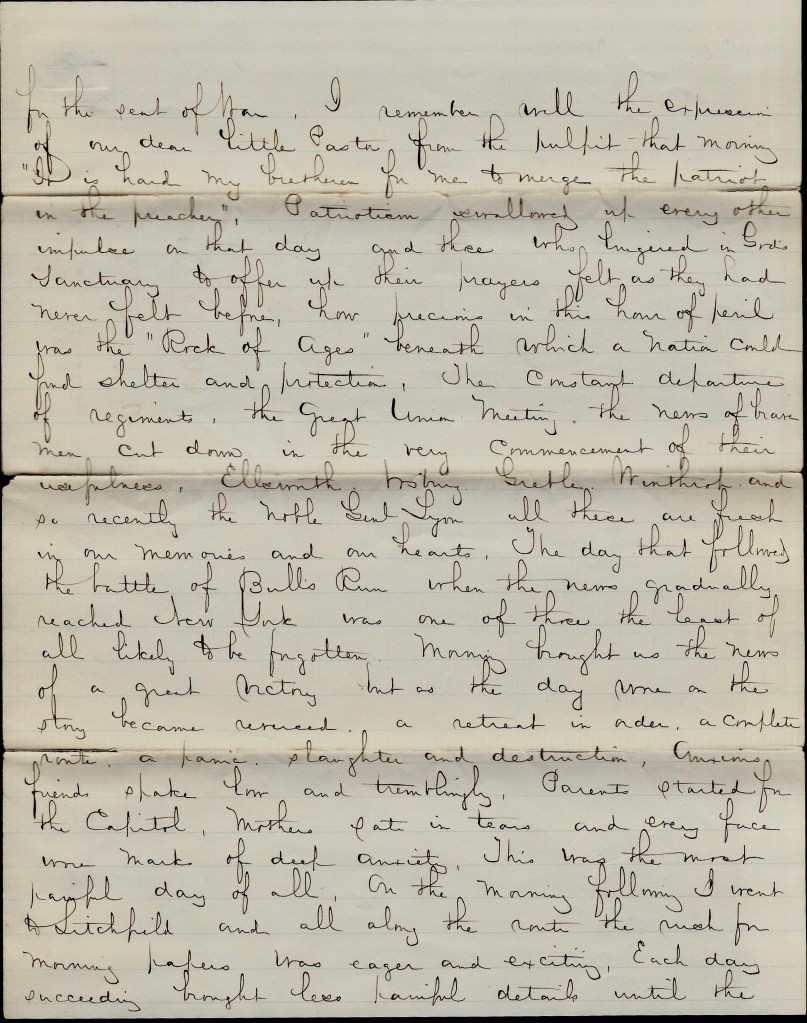
First came that Friday night on the 12th of April last when the scarcely credited intelligence fell on the ear that the bombardment of Fort Sumpter ad commenced. I went down to the news offices between 8 and 9 o’clock in the evening and read the announcement on the different bulletins with feelings strange and new. On the cars in the street, in every place of business, the expression passed from mouth to mouth, “The war has actually begun.” A nation went to a troubled slumber on that Friday night. Then followed the day of wild excitement when almost every home brought some fresh account of the disastrous and uneven siege until night closed in upon the week with the news that the gallant little garrison had been overpowered by besieging thousand and Sumpter had fallen into rebel hands. What a day was that Sabbath which followed the intense excitement of a few preceding hours. What a week did it open to an aroused and patriotic people. What a springing to arms. What an impetus towards Washington and the following Sabbath. Who ever saw a Sabbath like it in the City of New York? When the usual quietude of Sunday was broken by strains of martial music and churches were almost deserted in the eagerness to bid farewell to thousands who embarked that morning for the seat of war. I remember well the expression of our dear little pastor from the pulpit that morning: “It is hard, my brethren, for me to merge the patriot in the preacher.”
Patriotism swallowed up every other impulse on that day and those who lingered in God’s sanctuary to offer up their prayers felt as they had never felt before. How precious in the hour of peril was the “Rock of Ages” beneath which a Nation could find shelter and protection. The constant departure of regiments, the Great Union Meeting, the news of brave men cut down in the very commencement of their usefulness—Ellsworth, [ ], Greble, Withrop, and so recently, the noble Gen. Lyon. All these are fresh in our memories and our hearts.
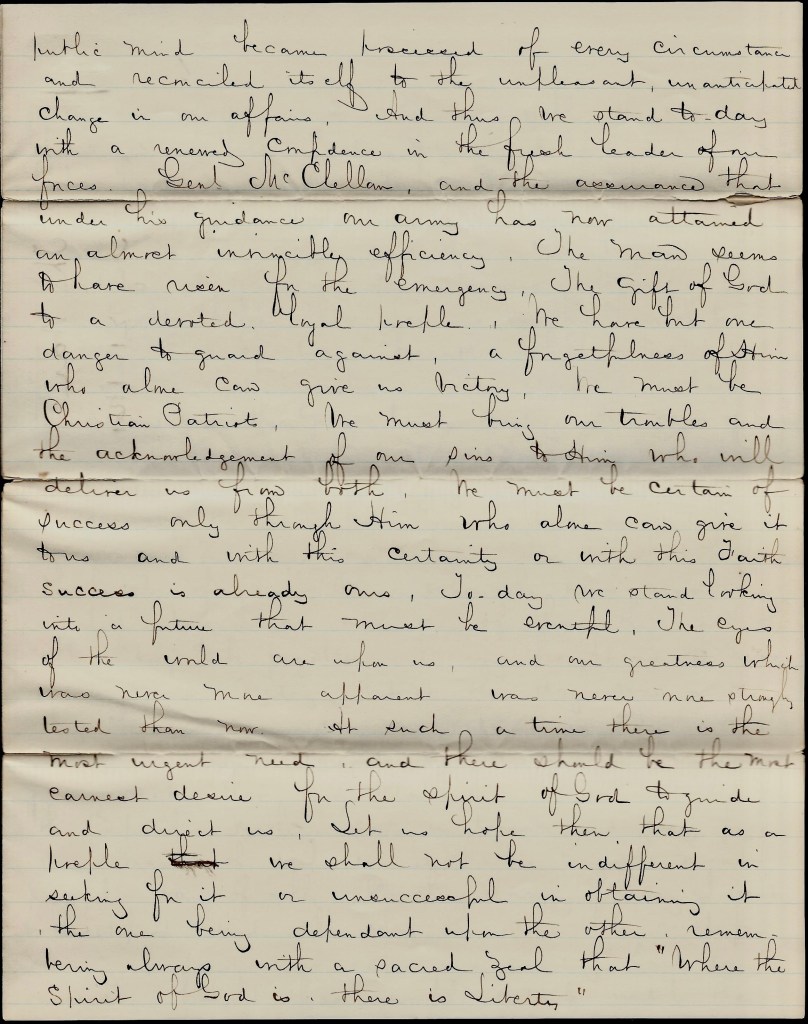
The day that followed the battle of Bull’s Run when the news gradually reached New York was one of those the least of all likely to be forgotten. Morning brought us the news of a great victory but as the day come on, the story became reversed, a retreat in order, a complete rout, a panic, slaughter and destruction, anxious friends spoke low and tremblingly. Parents started for the Capitol. Mothers sat in tears and every face wore marks of deep anxiety. This was the most painful day of all. On the morning following I went to Litchfield and all along the route the sush for morning papers was eager and exciting. Each day succeeding brought less painful details until the public mind became possessed of every circumstance and reconciled itself to the unpleasant, unanticipated change in our affairs. And thus we stand today with a renewed confidence in the fresh leader of our forces, General McClellan, and the assurance that under his guidance, our army has now attained an almost invincible efficiency. The man seems to have risen for the emergency—the gift of God to a devoted, loyal people.
We have but one danger to guard against, a forgetfulness ofHim who alone can give us a victory. We must be Christian Patriots. We must bring our troubles and the acknowledgment of our sins to Him who will deliver us from both. We must be certain of success only through Him who alone can give it to us and with this certainty or with this Faith success is already ours. Today we stand looking into a future that must be eventful. The eyes of the world are upon us and our greatness which was never more apparent was never more strongly tested than now. At such a time there is the most urgent need and there should be the most earnest desire for the spirit of God to guide and direct us. Let us hope then that as a people we shall not be indifferent in seeking for it, or unsuccessful in obtaining it—the one being dependent upon the other, remembering always with a sacred zeal that “where the Spirit of God is, there is Liberty.” 1
1 “Where the Spirit of God is, there is Liberty.” 2 Corinthians 3:17.


 Spared & Shared 23