
The following letters were written by Lydia Elizabeth Morrison (1832-1904), the daughter of John Bush Morrison (1793-1853) and Sarah Dougherty (1796-1872) of Plattekill, Ulster county, New York. In the 1860 US Census, 25 year-old Lydia was residing in Plattekill with her 64 year-old widowed mother and 21 year-old brother Charles Drake Morrison.

The letters pertain to the illness and death of her brother Charles who enlisted as a private in Co. E, 156th New York Infantry in August 1862 and rose in rank to 1st Sergeant before he died of typhoid fever on 18 May 1863 at the Soldiers Hospital in Baton Rouge, Louisiana. He lies buried in Grave No. 2179 of Section 33 at the Baton Rouge National Cemetery. When he enlisted, Charlie was described as a 24 year-old farmer with brown hair and blue eyes who stood 5 feet 10 inches tall.
Lydia wrote the letters to Capt. Matthias S. Euen (1833-1898) of Co. E, 156th New York Infantry. He was wounded at Port Hudson on 14 June 1863 (shortly after the 2nd letter was written) and was later promoted to Major and Colonel of the 156th New York.
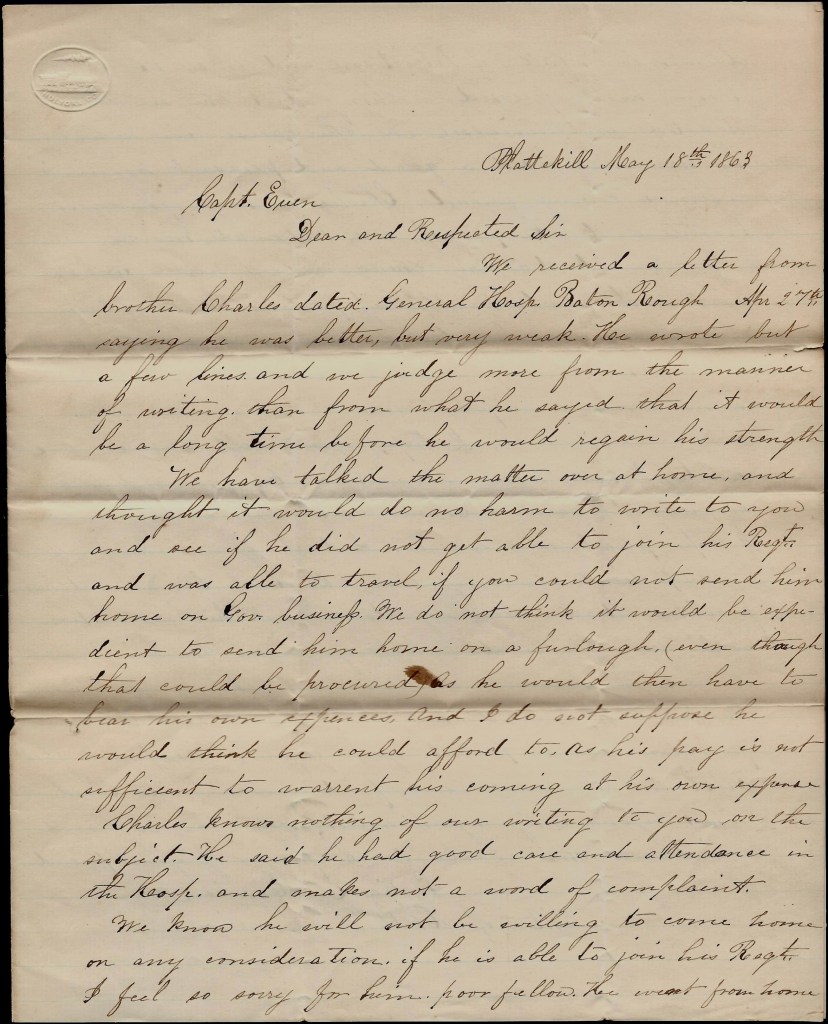
Letter 1
Plattekill [Ulster county, New York]
May 18th 1863
Capt. Euen
Dear and respected sir,
We received a letter from brother Charles dated General Hospital, Baton Rouge, April 27th, saying he was better but very weak. He wrote but a few lines and we judge more from the manner of writing than from what he said that it would be a long time before he would regain his strength.
We have talked the matter over at home and thought it would do no harm to write to you and see if he did not get able to join his regiment and was able to travel, if you could not send him home on Gov. business. We do not think it would be expedient to send him home on a furlough (even though that could be procured) as he would then have to bear his own expenses and I do not suppose he would think he could afford to as his pay is not sufficient to warrant his coming at his own expense. Charles knows nothing of our writing to you on the subject. He said he had good care and attendance in the hospital and makes not a word of complaint.
We know he will not be willing to come home on any consideration if he is able to join his regiment. I feel so sorry for him—poor fellow. He went from home brimming full of patriotism and in all his letters home has expressed nothing but the most devoted enthusiasm in the cause in which he has sacrificed a good and pleasant home and warm and loving friends. Charlie is my youngest brother and the pet of my widowed mother. We would do anything in our power to have him restored to health if possible. He complains that he has not heard from home since the first of March although we have written to him some seven or eight times.
I hope you will excuse the liberty I have taken in writing to you and our anxiety to secure Charlie’s return to health will I hope please my excuse. And if you can find it expedient in any way to have him sent home provided it is necessary to ensure his restoration, will you please do what you can for him, and in return receive the warmest thanks of his mother and friends. That an all-wise and kind Providence will protect you from sickness and that Rebel bullets may never find your hearts blood, that you may again meet your family and friends in this world is the prayer of your friend, — Lydia E. Morrison, sister of Charles D. Morrison
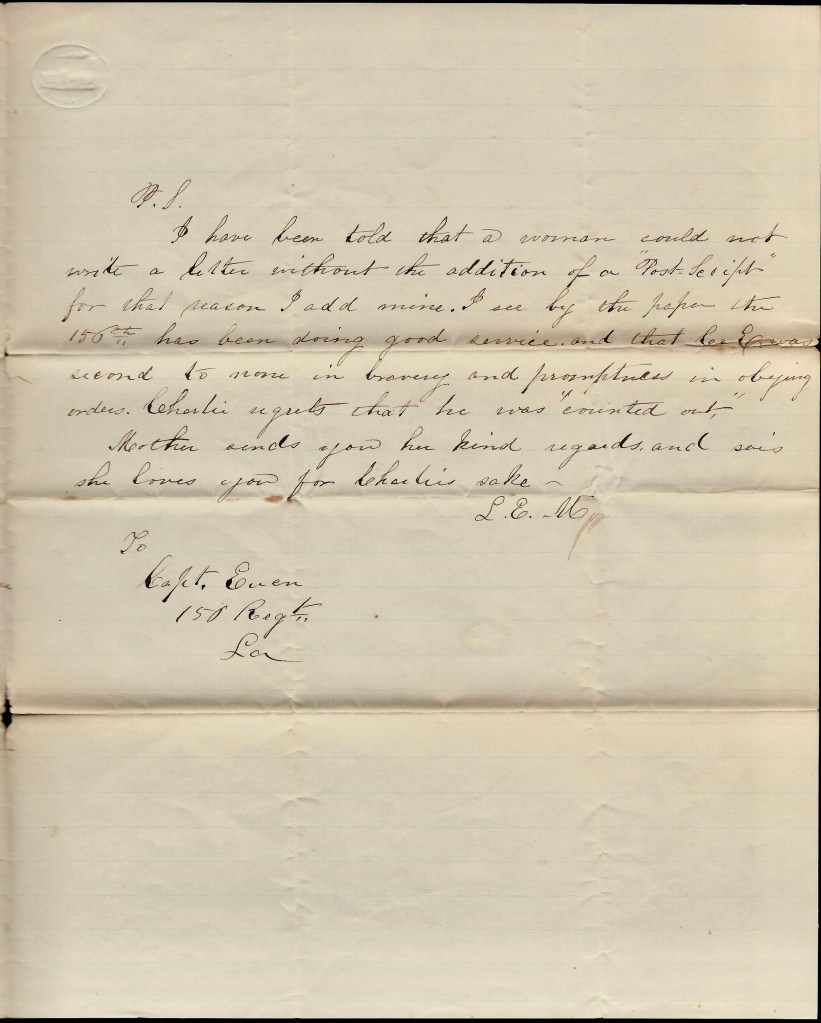
P. S. I have been told that a woman could not write a letter without the addition of a “post script.” For that reason I add mine. I see by the paper the 156th has been doing good service and that Co. E was second to none in bravery and promtness in obeying orders. Charlie regrets that he was “counted out.” Mother sends you her kind regards and says she loves you for Charlie’s sake. — L. E. M.
To Capt. Euen, 156th Regt., Louisiana.

Letter 2
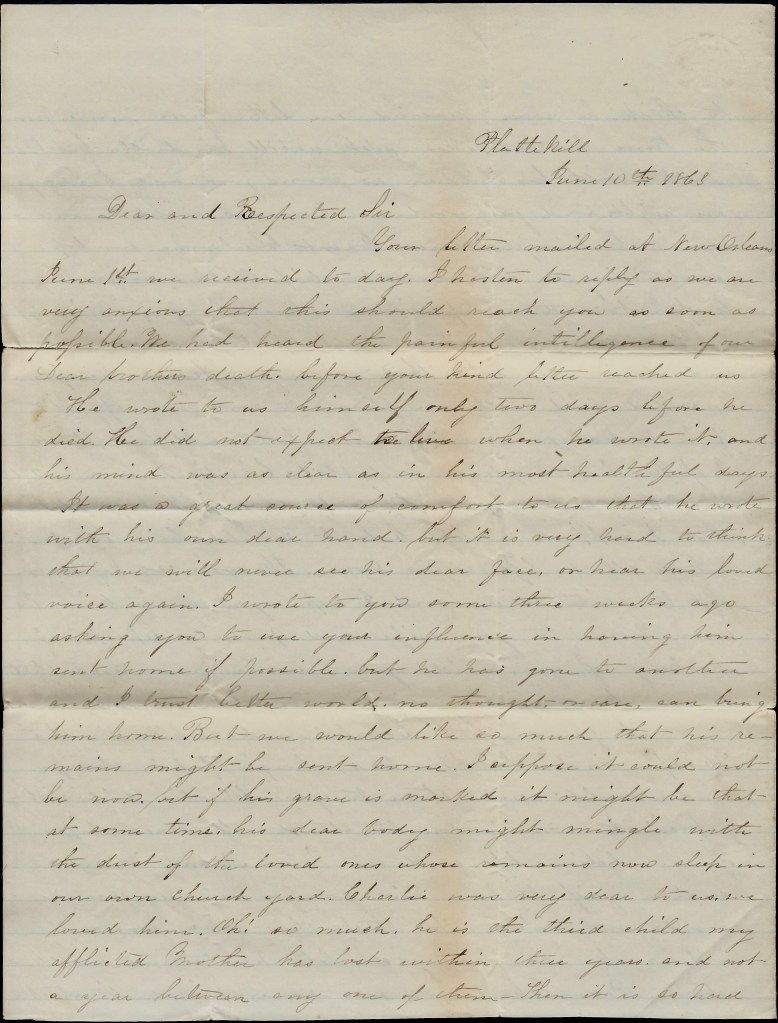
Plattekill, [New York]
June 10th 1863
Dear and respected sir,
Your letter mailed at New Orleans June 1st we received today. I hasten to reply as we are very anxious that this should reach you as soon as possible. We had heard of the painful intelligence of our dear brother’s death before your kind letter reached us. He wrote to us himself only two days before he died. He did not expect to live when he wrote it and his mind was as clear as in his most healthful days. It was a great source of comfort to us that he wrote with his own dear hand but it is very hard to think that we will never see his dear face or hear his loved voice again.
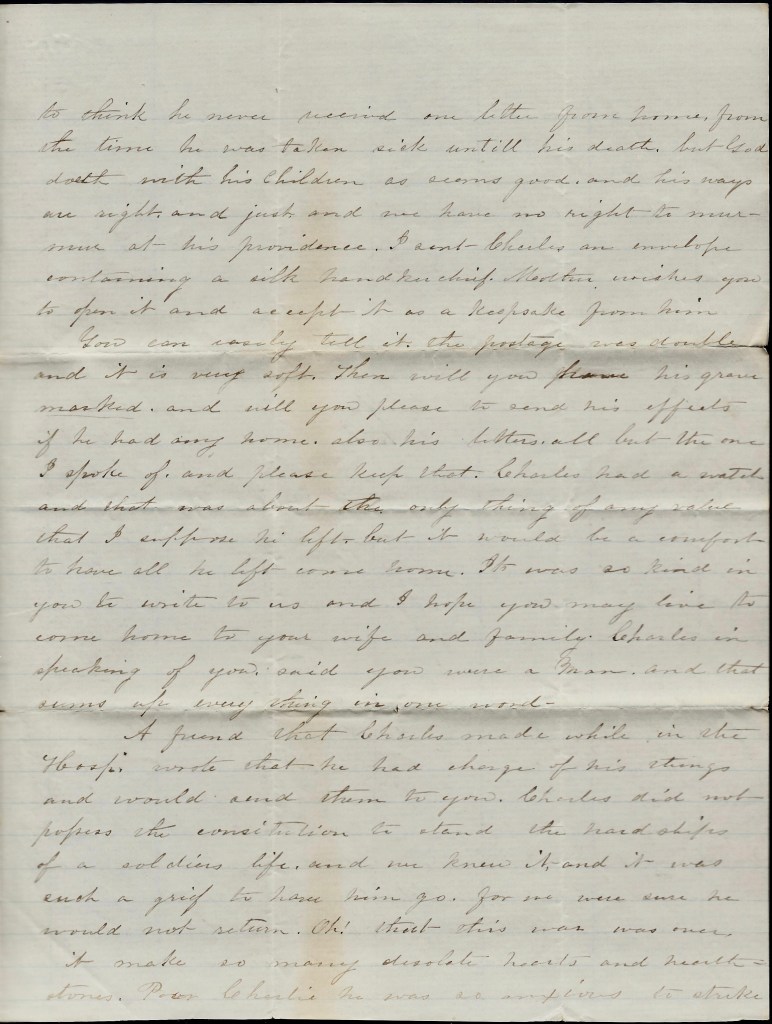
I wrote to you some three weeks ago asking you to use your influence un having him sent home of possible but he has gone to another and I trust better world. No thought or care can bring him home. But we would like so much that his remains might be sent home. I suppose it could not be now but if his grave is marked, it might be that at some time his dear body might mingle with the dust of his loved ones whose remains now sleep in our own church yard. Charlie was very dear to us. We loved him. Oh! so much. He is the third child my afflicted mother has lost within three years and not a year between any of them. 1 Then it is so hard to think he never received one letter from home, from the time he was taken sick until his death. But God doeth with His children as seems good and His ways are right and just, and we have no right to murmur at His providence.
I sent Charles an envelope containing a silk handkerchief. Mother wishes you to open it and accept it as a keepsake from him. You can easily tell it. The postage was double and it is very soft. Then will you have his grave marked and will you please to send his effects if he had any home. Also his letters—all but the one I spoke of and please keep that. Charles had a watch and that was about the only thing of any value that I suppose he left but it would be a comfort to have all he left come home.
It was so kind in you to write to us and I hope you may live to come home to your wife and family. Charles in speaking of you said you were a man and that sums up everything in one word.
A friend that Charles made wile in the hospital wrote that he had charge of his things and would send them to you. Charles did not possess the constitution to stand the hardships of a soldier’s life and we knew it, and it was such a grief to have him go for we were sure he would not return. Oh! that this was was over. It makes so many desolate hearts and hearthstones. Poor Charlie, he was so anxious to strike a blow for his country, but it was not to be.
I will not intrude further on your time—only to say that though you are a stranger to us, yet we are your warm friends. And our best wishes and earnest prayer will follow you that you may come home when your duty as a soldier is performed. And may God bless you is our earnest desire. I am respectfully your friend, — Lydia E. Morrison
Plattekill, New York
1 The other siblings were Isabella H. Morrison (1825-1862) and Mary Caroline Morrison (1838-1861).

 Spared & Shared 23
If only you had the letter from Captain Euen
to transcribe.
https://www.loc.gov/resource/ppmsca.49559/
LikeLike
This letter is from a collection of letters written to Captain Euen which is somewhat rare. Most letters that survive are those written from soldiers to the home front. I have transcribed numerous letters by officers (usually Captains) who saw it as their duty to write death notification letters to the deceased relatives back home—a sad duty and a frequent one.
LikeLike