
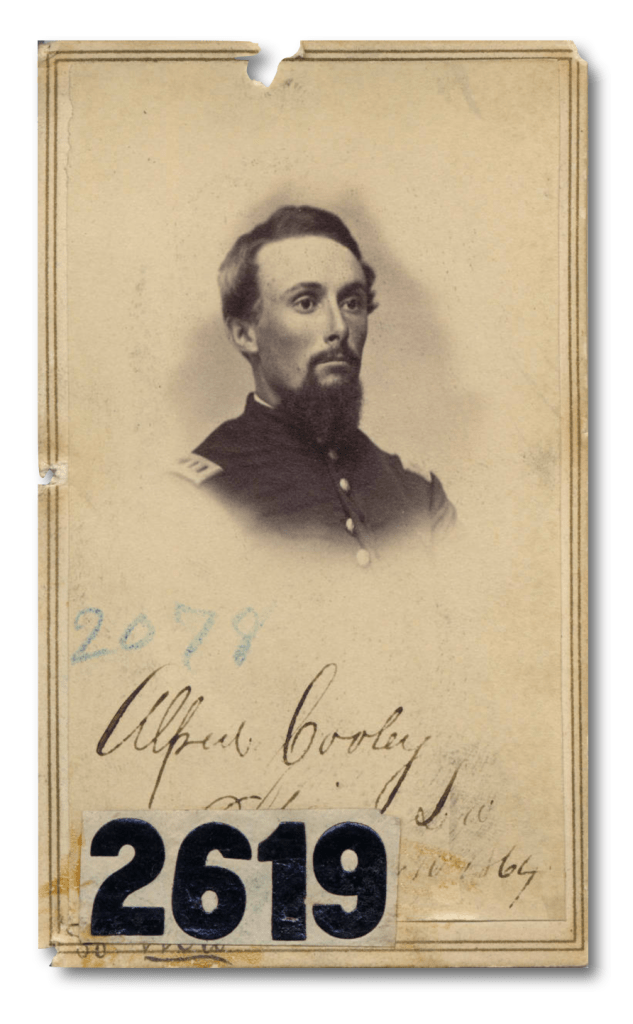
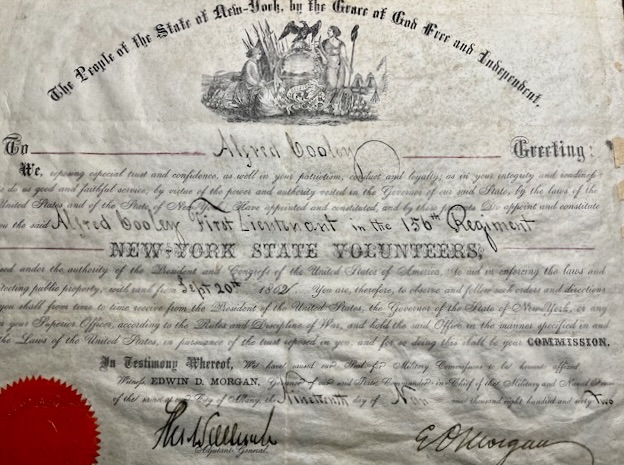
The following letters were written by Alfred Cooley (1839-1899) of Ulster county, New York, who was 28 years old when he enlisted to serve three years in the 156th New York Infantry. He was mustered in as 1st Lieutenant of Co. E on 20 September 1862 and was promoted to Captain of Co. G on 26 January 1864, replacing Capt. John Donaldson who died of disease in September 1863. Alfred survived the war and mustered out with his company at Augusta, Georgia, in October 1865.
Cooley commanded his company in the fight at Cedar Creek where the regiment lost 92 killed, wounded and missing. It was in this engagement, after several of the color-guard had fallen, that the regimental colors were narrowly saved from capture by the bravery of Capt. Alfred Cooley, who stripped the colors from the staff and brought them safely off the field.
Alfred was the son of Charles E. Cooley (1808-1860) and Margaret Ann Esterly (1811-1882) of Modena, Ulster county, New York.
Both letters were addressed to his captain, Matthias S. Euen, Co. E, 156th New York Volunteers. Captain Euen had been wounded at Port Hudson in June 1863 but was sent East in the fall of 1863 to gather conscripts for the regiment.
Letter 1
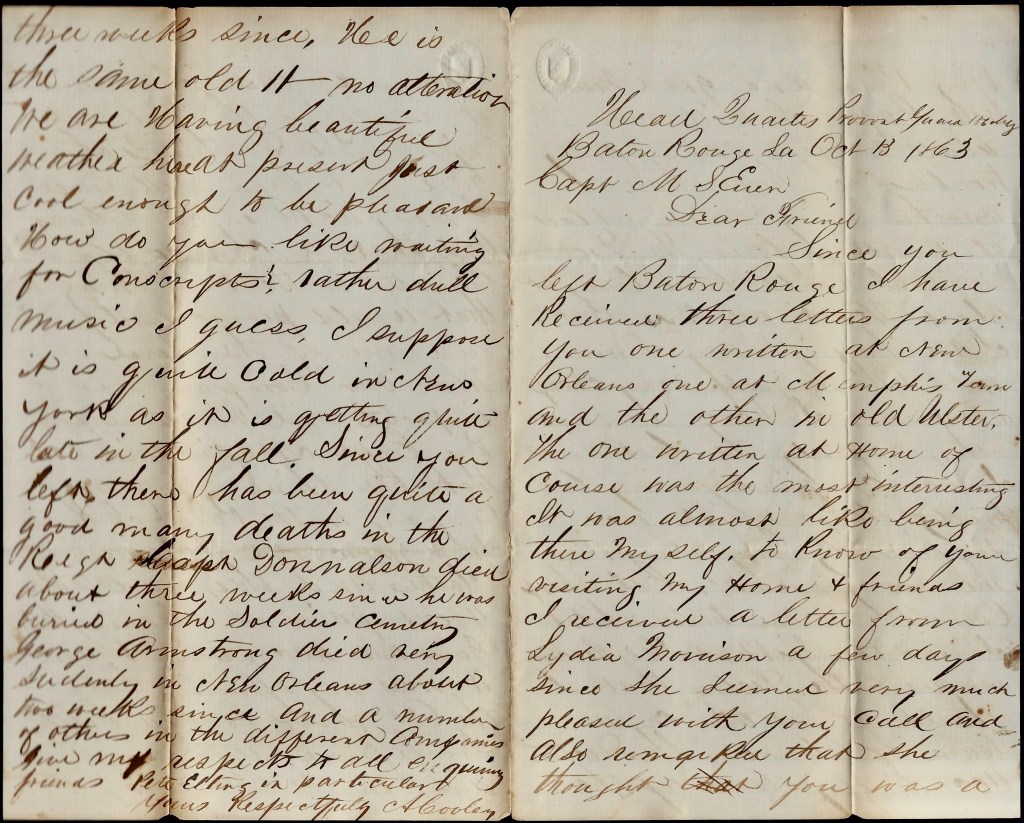
Headquarters Provost Guard 156th NY
Baton Rouge, La.
October 13, 1863
Capt. M. S. Euen
Dear friend,
Since you left Baton Rouge, I have received three letters from you—one written at New Orleans, one at Memphis, Tenn., and the other in old Ulster. The one written at home of course was the most interesting. It was almost like being there myself to know of your visiting my home & friends. I received a letter from Lydia Morrison a few days since. She seemed very much pleased with your call and also remarked that she thought you was a very kind and good man.
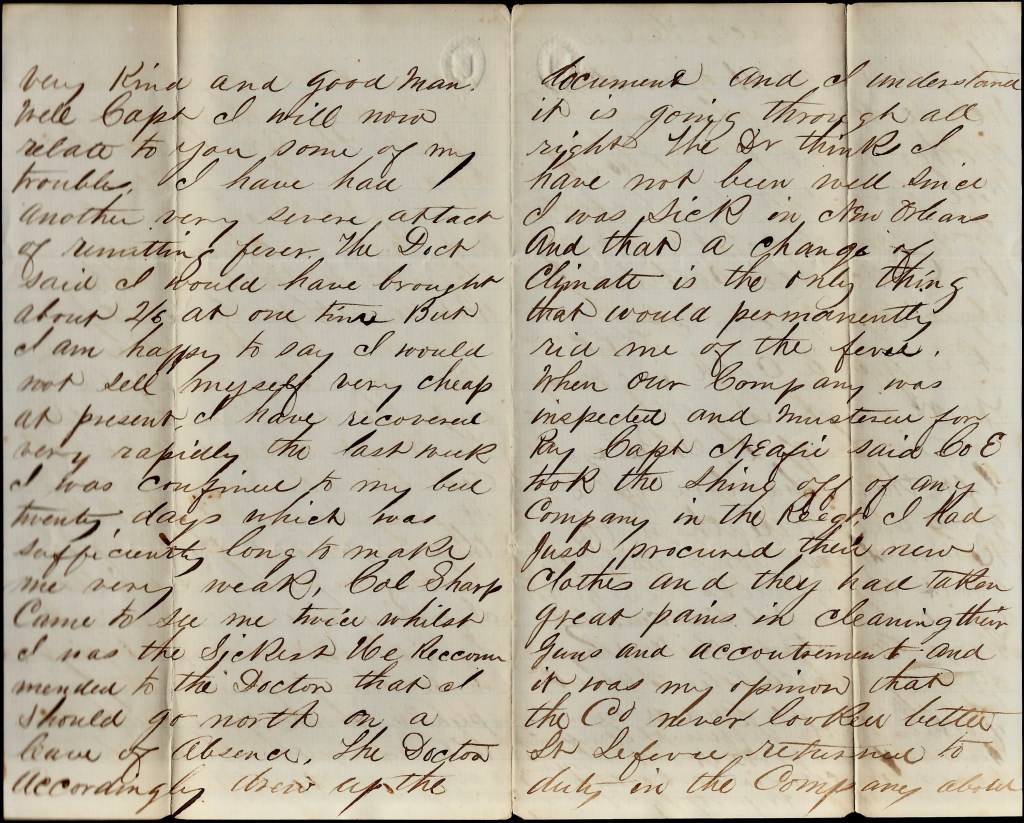
Well, Capt., I will now relate to you some of my troubles. I have had another very severe attack of remittent fever. The doctor said I would have brought about 2/6 at one time. But I am happy to say I would not sell myself very cheap at present. I have recovered very rapidly the last week. I was confined to my bed twenty days which was sufficiently long to make me very weak. Col. Sharpe came to see me twice whilst I was the sickest. He recommended to the doctor that I should go North on a leave of absence. The doctor accordingly drew up the documents and I understand it is going through all right. The doctor thinks I have not been well since I was sick in New Orleans and that a change of climate is the only thing that would permanently rid me of the fever.
When our company was inspected and mustered for pay, Capt. [Alfred] Neafie said Co. E too the shine off of any company in the regiment. I had just procured then new clothes and they had taken great pains in cleaning their guns and accoutrements and it was my opinion that the company never looked better.
Lt. [Johannes] Lefevre returned to duty in the company about three weeks since. He is the same old Lt.—no alteration.
We are having beautiful weather here at present—just cool enough to be pleasant. How do you like waiting for conscripts? Rather dull music I guess. I suppose it is quite cold in New York as it is getting quite late in the fall. Since you left there has been quite a good many deaths in the regiment. Capt. [John] Donaldson died about three weeks since. He was buried in the Soldier’s Cemetery. George Armstrong died very suddenly in New Orleans about two weeks since and a number of others in the different companies.
Give my respects to all enquiring friends—Pete Elting in particular. Yours respectfully, — A. Cooley
Letter 2
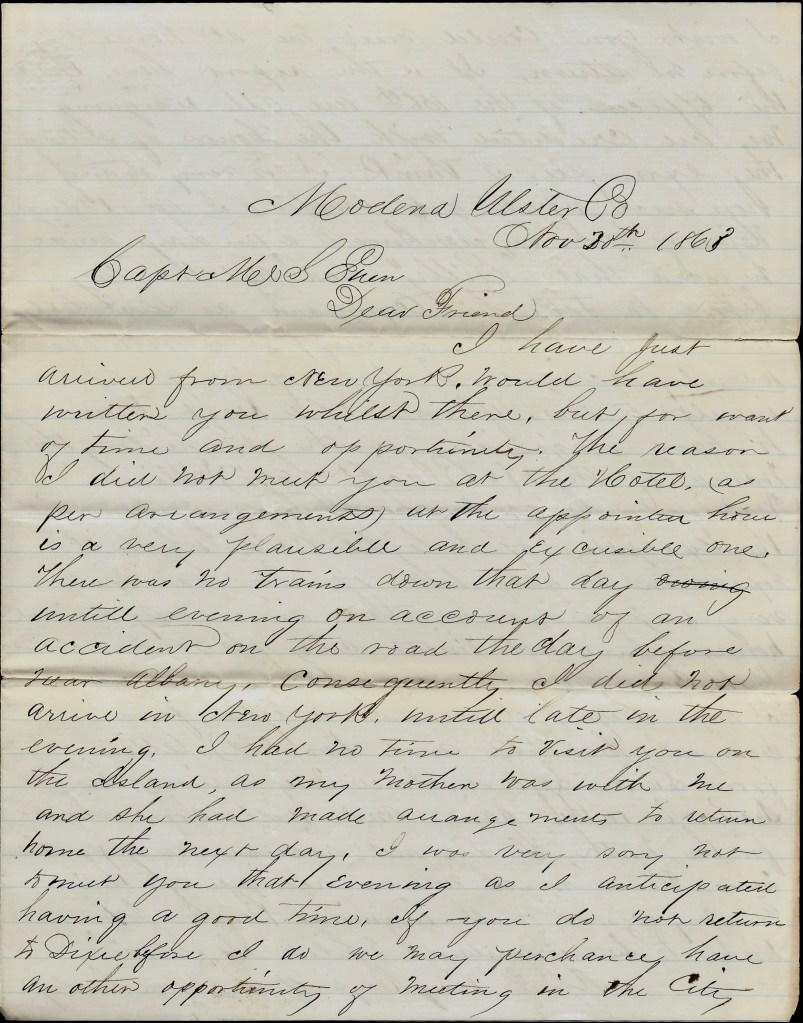
Modena, Ulster county [New York]
November 20, 1863
Capt. M. S. Euen
Dear friend,
I have just arrived from New York. Would have written you whilst there but for want of time and opportunity. The reason I did not meet you at the Hotel (as per arrangements) at the appointed hour is a very plausible and excusable one. There was no trains down that day until evening on account of an accident on the road the day before near Albany. Consequently, I did not arrive in New York until late in the evening. I had not time to visit you on the Island as my Mother was with me and she had made arrangements to return home the next day. I was very sorry not to meet you that evening as I anticipated having a good time. If you do not return to Dixie before I do, we may perchance have another opportunity of meeting in the City. I wish you could visit me at home before we return.
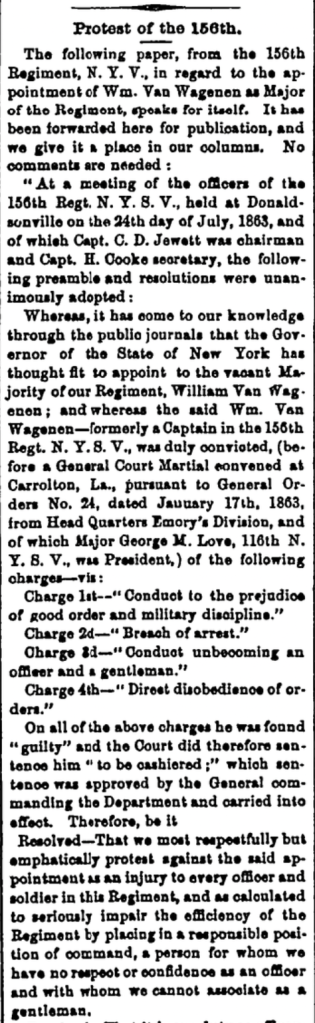
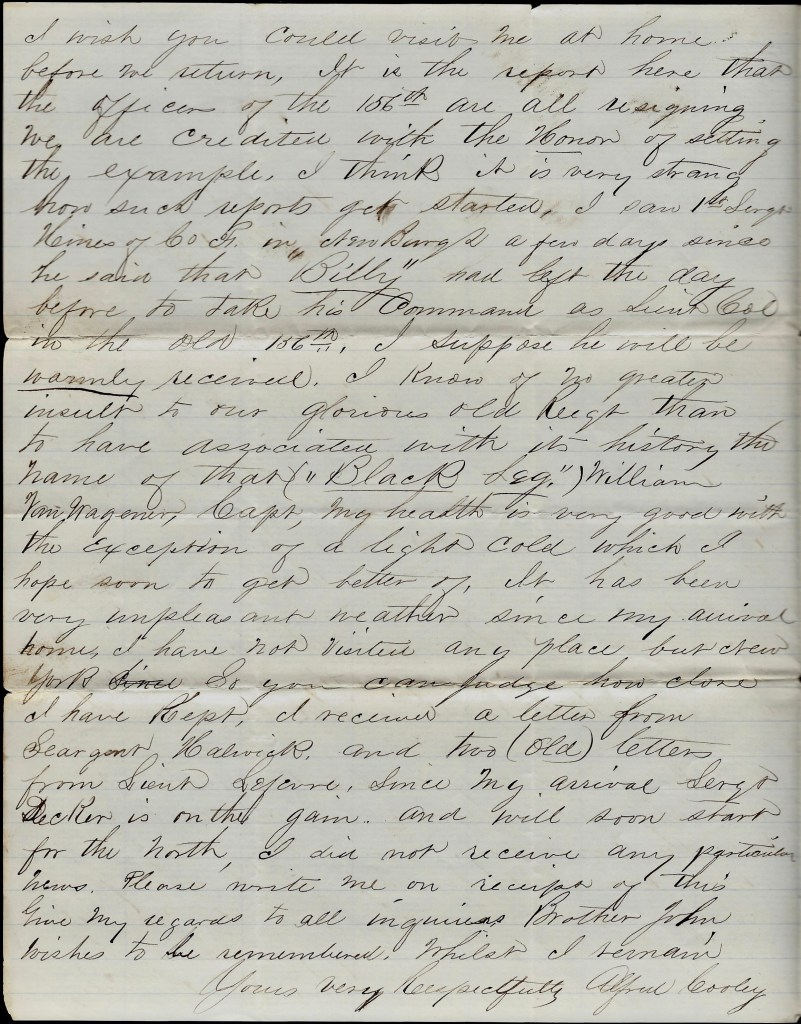
It is the report here that the officers of the 156th are all resigning. We are credited with the Honor of setting an example. I think it is very strange how such reports get started. I saw 1st Sergeant Hines of Co. F in Newburgh a few days since. He said that “Billy” had left the day before to take his command as Lieut. Colonel in the old 156th. I suppose he will be warmly received. I know of no greater insult to our glorious old regiment than to have associated with its history the name of that (“Black Leg”) William Van Wagenen. 1
Capt., my health is very good with the exception of a light cold which I hope soon to get better of. It has been very unpleasant weather since my arrival home. I have not visited any place but New York so you can judge how close I have kept.
I received a letter from Sergeant [Peter M.] Halwick and two (old) letters from Lieut. [Johannes] Lefevre since my arrival. Sergt. [Philip T.] Decker is on the gain and will soon start for the North. I did not receive any particular news. Please write me on receipt of this. Give my regards to all inquiries. Brother John wishes to be remembered. Whilst I remain yours very respectfully, — Alfred Cooley
1 William Van Wagenen was 40 years old when he was mustered into the 156th New York Infantry as captain of Co. C. He was courtmartialed in March 1863, found guilty of numerous charges and fellow officers resisted efforts by Van Wagenen to be reinstated by his political allies. Later in the year he was found guilty of making false statements under oath connected with “a false muster” of himself as Major of the 156th Regiment. He was even arrested and thrown in jail for defrauding recruits from their bounty. See 1863: Evert D. Keator’s Deposition.
 Spared & Shared 23