

The following letter was written by Benjamin Joseph Rose (1819-1864) of Lewiston, Niagara County, New York, who enlisted in late July 1862 to serve three years in Co. B, 8th New York Heavy Artillery. Except for the brief excursion described in this letter, the unit garrisoned the forts in Baltimore harbor until May 1864 when they were ordered to participate as infantrymen in Grant’s Overland Campaign. Write to a friend back home, Benjamin stated emphatically, “I am quite certain I shall never fall in battle. My impression is that I will come home as good as I went.” But it was not to be. He was killed on the battlefield at Cold Harbor on 3 June 1864.
Benjamin was married to Louisa Minerva Bull (1819-1880) in April 1845 and when he died, he had three dependent children besides his wife.
[Note: This letter is from the personal collection of Greg Herr and was offered for transcription and publication on Spared & Shared by express consent.]
Transcription
Fort McHenry [Baltimore, Maryland]
February 25, 1864
Dear Brother Orton,
I sit down this morning to write a few lines to you in reply to your letter which was received in due time. I am well as usual, thank the good Lord. I would have written before but a few days after I received your letter, our regiment was ordered to Virginia, and being in camp most of the time, and very uncomfortable quarters, and extreme cold weather, and all the confusion—I found it very difficult to write. Our little expedition—what I saw and heard, will be the main subject of this communication.

We were ordered on the first day of the month to get ready for Harpers Ferry, and about nine on the evening were in the cars and on our way. I saw none of the country between Baltimore and the Ferry either way as it was night both times we went over the road, but we made slow time, as it was sunrise when we were at the Ferry—a distance of 84 miles. John Brown’s raid on Harpers Ferry you have not forgotten. The place gives unmistakable signs of hard times. Many fine buildings are in ruins. Any quantity of gun barrels and other implements of war that are ruined are still to be seen. I saw where Brown was captured and where he was confined until he went to Charlestown for trial and execution. I must pass over a considerable that might be interesting to you. Harpers Ferry is strongly fortified now. Two regiments of men I think could effectually prevent any army from coming down the Shenandoah Valley.
We soon learned that our destination was beyond this place. We soon reached Martinsburg. All the railroad property here was destroyed. The buildings covered a large area of ground, all in ruins. The Village is quite pleasant and the country around is good for farming. I noticed a great deal of good wheat on the ground, sheep and cattle in the fields, but strange enough, not a barn worthy of the name is to be seen. The winters are so mild that cattle run out in the fields all winter. But the country changes as we go up the river. It soon became very mountainous. In some places the scenery is most grand. Mountains piled on mountains, with the Potomac winding its serpentine course between them. The railroad is equally crooked. In many places the locomotive can be seen for a mile at a time, in many places small streams make down between the mountains, making a huge chasm a thousand feet deep where it is possible a road runs into the country.
Nothing of importance occurred until we got within about twenty miles of Cumberland when we heard that the rebs had made a dash on the railroad and had burned a bridge that day. From here on we went very cautiously. At length we arrived at Patterson’s Creek. Here was the scene of the raid. A few cavalry had made a dash through an open country and had surprised and captured an entire company of the 54th Pennsylvania Regiment that was stationed there to guard the bridge over the creek at that place. One man was killed. The poor fellows paid dear for their carelessness. They had no pickets whatever. They did not see them until they were within a few rods of them. The rebs set fire to the bridge and all the railroad property at the place. They burned a house that belonged to a man that worked for the Co., and burned the quarters of the soldiers they had taken. When we got there, everything was mostly consumed. 1
We then fell back to the South Green Spring Run. The next Friday we were ordered to journey a distance of 18 miles. We performed the journey in 7 hours carrying heavy knapsacks and three days rations besides 40 rounds of cartridges, I never was so completely exhausted in my life. Romney’s the county seat of Hampshire County, Western Virginia. It has been held alternately by both armies. Although beautifully located and well laid out and adorned with many fine buildings, it is in ruins a great deal of it. The jail is a mass of ruins. The court house—a fine building—has been used as a stable for cavalry horses. Also a fine church. I shall always regret that I did not pay it a visit and obtain some old relic. There are bushels of documents (so the boys say) on the floor in one room. Some of them date back to the time of George the Second—over two hundred years old.
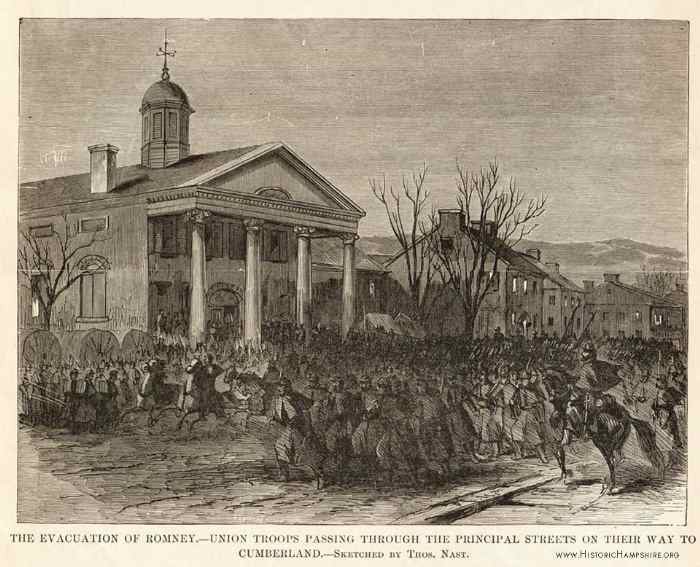
The next day we fell back to Springfield, a village halfway from the “Run” to Romney. We were quartered for the night in a small brick church. Springfield is about like Pekin but much older, has had two churches and a schoolhouse, but the hand of war has been laid heavily upon it. One church was used for a guard house. The prisoners set it on fire. Everything was burned but the orchestra. The walls were not injured. The church in which we were quartered never had been occupied by soldiers. It was a plain, neat little building. Directly in front of the church was an old burying ground. The whole had been surrounded by a fence but it has disappeared. The burying ground is a common now. The tombstones are common mountain stone. The inscriptions, I think, are home made. I saw one that dated back to 1793 but whether the dead were Christian or infidels, dare not appear. There was nothing on the tombstones about their religious faith. All public houses in both places are closed. Some of the boys did not like it very much. They could not get nary drop of the critter. No, not a meal of victuals. It was a hard living up here.
Sunday morning we fell back to Green Spring Run where we remained until the 19th when we returned to Fort McHenry without even seeing a rebel or effecting anything that we know of. We had some very cold weather and suffered some. Still we were all glad that we went. We saw some of the country and that was a satisfaction. I cannot help thinking God was in it all for after we had left the fort a few hours, a government transport anchored out in the bay with an order for one regiment to go to New Orleans but fortunately (I think) we were on our way for Virginia.
Our regiment is now a full Artillery Regiment. I think we are destined to leave here in the spring. We may, however, stay here and garrison the three forts as we are just about strong enough. But the Lord only knows what disposition will be made of us. But I am quite certain I shall never fall in battle. My impression is that I will come home as good as I went. Our time is now half out. 18 months looks like a long time. Still it will soon roll around.
I long for the Society that I left behind. I feel a great want of your Monday evening prayer meetings. They were the most spiritual meeting I ever attended. I shall rejoice when I can meet with the Church of Pekin again. We have three meetings in the week here but there is but little spirituality among the worshippers. A lifeless form is the order here to a great extent. There are some that love God truly. Brother McRernin and Rowan and two or three others have the power as well as the form of Godliness. Sometimes indeed our meetings are quite spiritual but somehow the spirit is stayed in many instances. There is not that freedom here as at home—at least I do not have it. It may be the fault is in me. Perhaps it is. Still I feel that God upholds me and sometimes gives me large measure of grace. I praise God that I am upheld by HIs spirit. I am still trying to serve Go and get to heaven. I expect, I believe, that God will take me there in His own good time. I want you to pray for me. Remember me to all the Church—especially Mother Van Slyke. I often think of her. Remember me to Brother Austin. I should like to hear from him. Remember me to Mr. Daybush and family. I would write to them but I suppose Emery Wilcox writes frequently to John about everything that transpires worth writing about. The weather was very mild in February except a few days. There was not an hour’s rain in the whole month. But this morning, March the 1st, it is snowing but not cold.
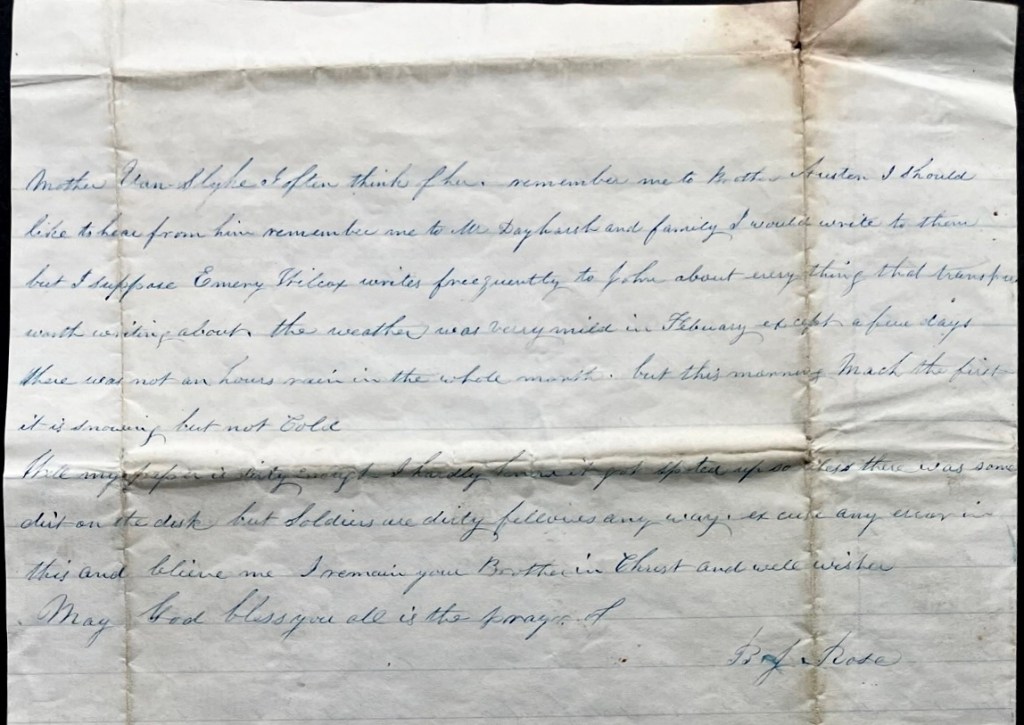
Well, my paper is dirty enough. I hardly [know] how it got spotted up so unless there was some dirt on the desk. But soldiers are dirty fellows anyway. Excuse any errors in this and believe me I remain your Brother in Christ and well wisher. May God bless you all is the prayer of, — B. J. Rose
1 “On February 2, 1864, I was stationed at Cumberland, Md. On that day Co. F, Capt. John W. Hibler, 54th Pennsylvania Volunteers, with 57 men of my brigade, was stationed at Patterson’s Creek bridge, Baltimore and Ohio Railroad, and a detachment of the company at the North Branch bridge as pickets. I had warned Captain Hibler to be on the alert and to keep scouts well out, but it seems that General Rosser (rebel), with from 400 to 500 cavalry, succeeded in penetrating to Patterson’s Creek bridge on the 2d of February. His advance guard were dressed in Federal uniforms, and succeeded in getting up to Captain Hibler’s by representing themselves as part of the Ringgold Cavalry (Union), and thus successively captured all the pickets on the Patterson’s Creek road, and then rapidly dashed into camp while the men were at dinner. A slight skirmish ensued, in which we had 1 man killed, 1 mortally and 3 slightly wounded. The rebels captured 1 captain and 36 men, with all the camp and garrison equipage of the company, 40 Enfield rifles, and 4,000 rounds of rifle cartridges. They then set fire to the Patterson’s Creek bridge, Baltimore and Ohio Railroad, and thence went to the North Branch bridge, Baltimore and Ohio Railroad, and fired it, the guard at the latter bridge making their escape. I may here say that as there was known to be a large Union force some 18 miles south and west of Patterson’s Creek, and part of the Ringgold Cavalry there, taken in connection with the fact that the rebels wore our uniform and claimed to be Union cavalry, may, in a measure, account for the pickets being deceived. Neither the Patterson’s Creek bridge nor the North Branch bridge were protected by block-houses, and the only protection for them was the company of infantry which the rebels captured.” — Col. J. M. Campbell, Commanding 1st Brigade


 Spared & Shared 23