
This unsigned or partial was written by a soldier who most likely served in the 37th Illinois, the 9th Missouri Infantry 9changed to 59th Illinois), the 5th Iowa Infantry, or 1st Kansas Infantry as they were brigaded together in late September 1861 at Boonville, Missouri, under the command of J. C. Kelton.
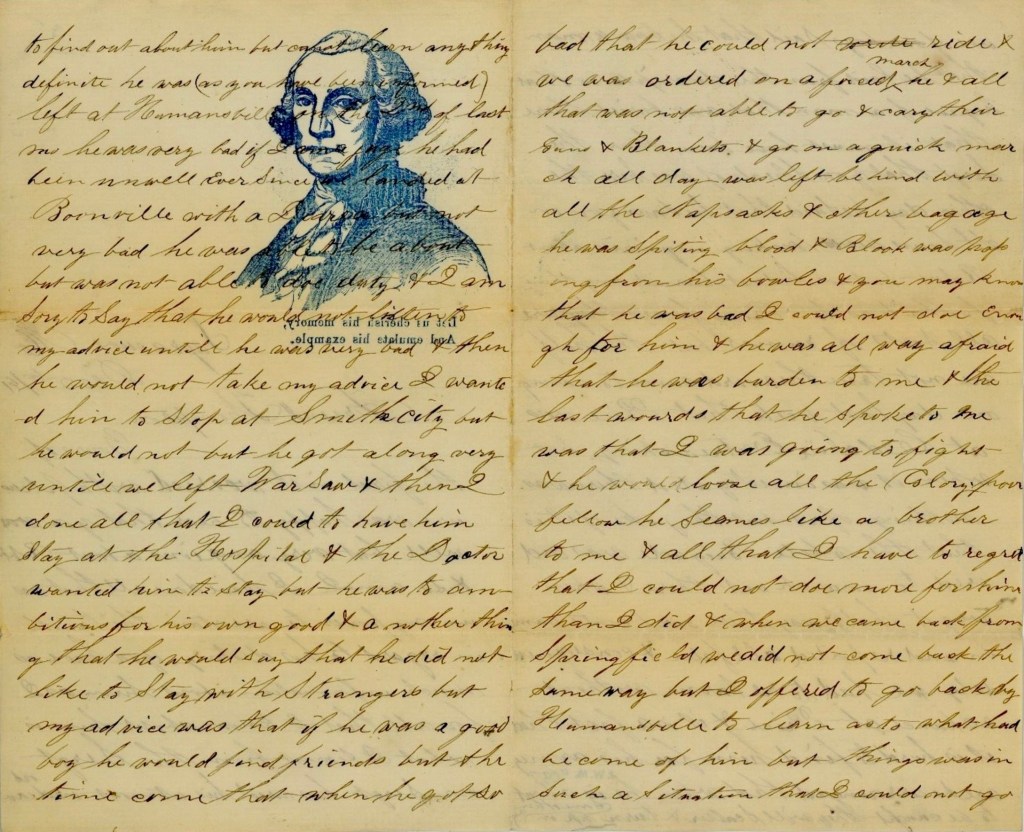
Transcription
Syracuse, Missouri
December 5th 1861
Friend Thompson,
Yours of the 1st inst. was received with pleasure. Was happy to hear that you was well but very anxious about Robert & so am I. I have done all that was in my power to ascertain the truth in regard to his destiny. You have as much information about him as I for all that I know about him is what I learnt from the Sergeant. Our sergeant has used his utmost endeavors to find out about him but cannot learn anything definite.
He was (as you have been informed) left at Humansville 1 on the 2nd of last month. He was very bad if I can judge. He had been unwell ever since we landed at Boonville with a diarrhea but not very bad. He was able to be about but was not able to do duty & I am sorry to say that he would not listen to my advice until he was very bad & then he would not take my advice.
I wanted him to stop at Smith City but he would not, but he got along very [well] until we left Warsaw & then I done all that I could to have him stay at the hospital & the Doctor wanted him to stay but he was too ambitious for his own good and another thing that he would say that he did not like to stay with strangers, But my advice was that if he was a good boy, he would find friends. But the time come that he got so bad that he could not ride & we was ordered on a forced march. He and all that was not able to go & carry their guns and blankets and go on a quick march all day was left behind with all the knapsacks & other baggage.
He was spitting blood & blood was pooping from his bowels & you may know that he was bad. I could not do enough for him & he was always afraid that he was a burden to me & the last words that he spoke to me was that I was going to fight & he would lose all the glory. Poor fellow. He seems like a brother to me & all that I have to regret [is] that I could not do more for him that I did. And when we came back from Springfield, we did not come back the same way but I offered to go back by Humansville to learn as to what had become of him but things was in such a situation that I could not go.
One of our boys said that he saw a man that he said from the description that he gave of a man that was buried there that it must have been him. The Sergeant that you speak of was here the other day. He said that he saw you in St. Louis . He was making inquiries about Robert but we had not learned anything further.
And as to Price’s forces, there are all sorts of rumors but the half are not true. The word came to camp one day last week that Price was at Sedalia entrenching but when it was investigated, there was nothing of it. But the joke of it is that the whole brigade was ordered to march out there and when we got half way there, our scouts came in and reported all false & consequently we had to return without a chance at Price. And it is a fact that it is hard to find him for his army are so arranged that she he is about to be caught, they will scatter & turn up in some other way. [unsigned or partial]
1 In the regimental history of the 59th Illinois Infantry, Humansville was described as a “small town in Hickory County, Mo., and is the only place where any demonstrations were made, in honor of the stars and stripes, between Boonville and Springfield. Here the soldiers of the Union were welcomed by the waiving of flags and the smiles of the women, and the kindly greetings of the citizens generally. A portion of Price’s army had passed through this place, some three weeks before, and had carried off all the goods belonging to the merchants, and had mistreated the inhabitants of the town and vicinity to such a degree, that they were heartily tired of their presence, and were rejoiced at the approach of the Federal troops….The sick of the regiment, had been increasing for the last ten days, to such an extent, that now there was no means of conveying them any farther. Thus far, they had been transported in wagons, but it was now necessary to select such as could not, in a measure, provide for themselves, and leave them behind. The Surgeon, therefore, fitted up the Meeting-house in town, in the best possible manner, and removed the sick to it. A cook, some nurses, and several days rations, were left with them. Poor fellows! they all nearly starved to death before they could get away, and three did die from the effects of disease and want of proper nourishment. After the army left, the patriotism of the ladies and gentlemen of the town, oozed out at their fingers ends, and our sick boys could get nothing from them. One man, John Clemens, of Co. H, who was very sick when taken there, died on the 4th of November. Bromwell Kitchen, of Co. F, soon followed, and Nathaniel B. Westbrook, of Co. A, died on the 20th. The others eventually found their way to the regiment.”

 Spared & Shared 23