
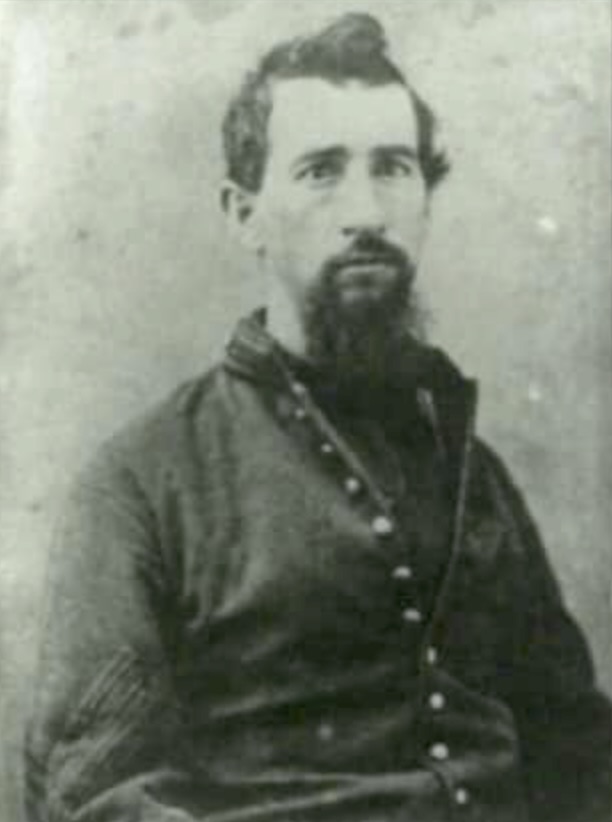
These letters (some partial and unsigned) were written by Pvt. Willard J. Smith (1835-1868) of Co. I, 5th Indiana Cavalry. Willard enlisted in the regiment on 9 August 1862 and he mustered out of the regiment on 23 June 1865.
Willard wrote the letters to younger brother James Hall Smith (1839-1909), the son of John W. Smith (1808-1877) and Electa A. Jackson (1810-1864) of Boone township, Porter county, Indiana.
From Willard’s letter of May 22, 1865, we learn that he spent the winter of 1864/65 in Andersonville Prison with a number of other members of the 5th Indiana Cavalry—several of whom died there. Willard himself was reported to have died at Andersonville on August 15, 1864, but inconsistently also reports him to have been mustered out of the regiment on 15 June 1865. Most of the 5th Indiana Cavalry regiment was captured during Stoneman’s Raid at Sunshine Church, Hillsboro, between July 30-31, 1864.
Though Willard survived the ordeal of Andersonville Prison, his health must have been irreparably broken as he died on 14 October 1868 at the age of 33. His gravestone in Fleming Cemetery does not even recognize his military service, let alone his confinement at Andersonville.
Letter 1
November the 23, 1862
Well Jim, this is Sunday morning & I hain’t anything to do only to write to you. The first thing I have to tell you is that I am well & hope that these few lines will find you all the same. We are going to have an election this afternoon to elect another captain. Our captain [Ephraim N. Banks] has been promoted to regimental surgeon. He is going to the 54th [Indiana] Regiment. He will leave us tonight. I have to have him leave the worst way because he is the right kind of a man. We are going to put Dock Macon [John T. McKean] in his place and the orderly in [Arthur M.] Buell’s place. I think Mr. Buell will be shoved clear out of the company. I hope so at any rate. ¹
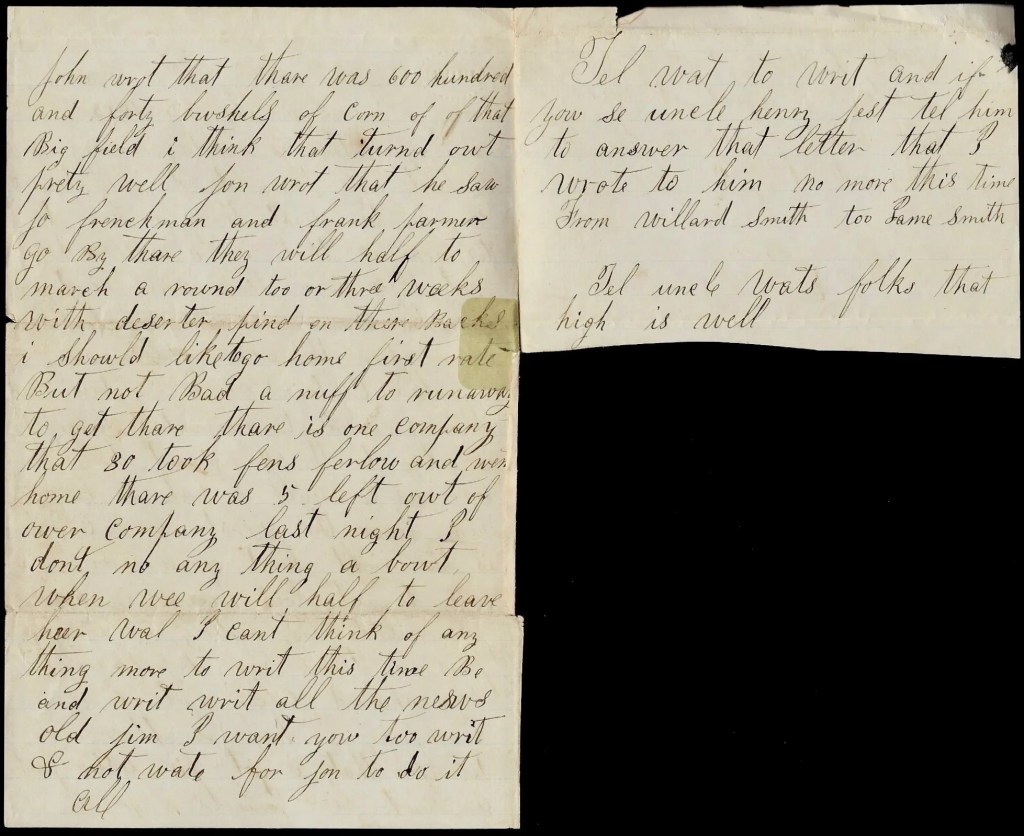
Tell John that I got his letter just about five minutes ago. John wrote that there was 600 and 40 bushels of corn off that big field. I think that turned out pretty well. John wrote that he saw Joe Frenchman and Frank Farmer go by there. They will have to march around two or three weeks with “deserter” pinned on their backs. I should like to go home first rate but not bad enough to run away to get there. There is one company that 30 took French furlough and went home. There was 5 left out of our company last night.
I don’t know anything about when we will have to leave here. Well, I can’t think of anything more to write this time. Be [good] and write all the news, old Jim. I want you to write & not wait for John to do it all.
Tell Wat ² to write and if you see Uncle Henry, just tell him to answer that letter that I wrote to him. No more this time.
From Willard Smith
to James Smith
Tell Uncle Wat’s folks that high is well.
¹ Arthur M. Buell resigned his 1st Lieutenant’s commission on 1 December 1862. Apparently he was roundly disliked by the men. He was replaced by Edgar L. Morse of Lowell, Indiana, and eventually became captain.
² Waterman J. Smith (1832-1901) was Willard’s older brother. “Wat” served in Co. D, 23rd Indiana Infantry.

Letter 2
December the 18, 1862
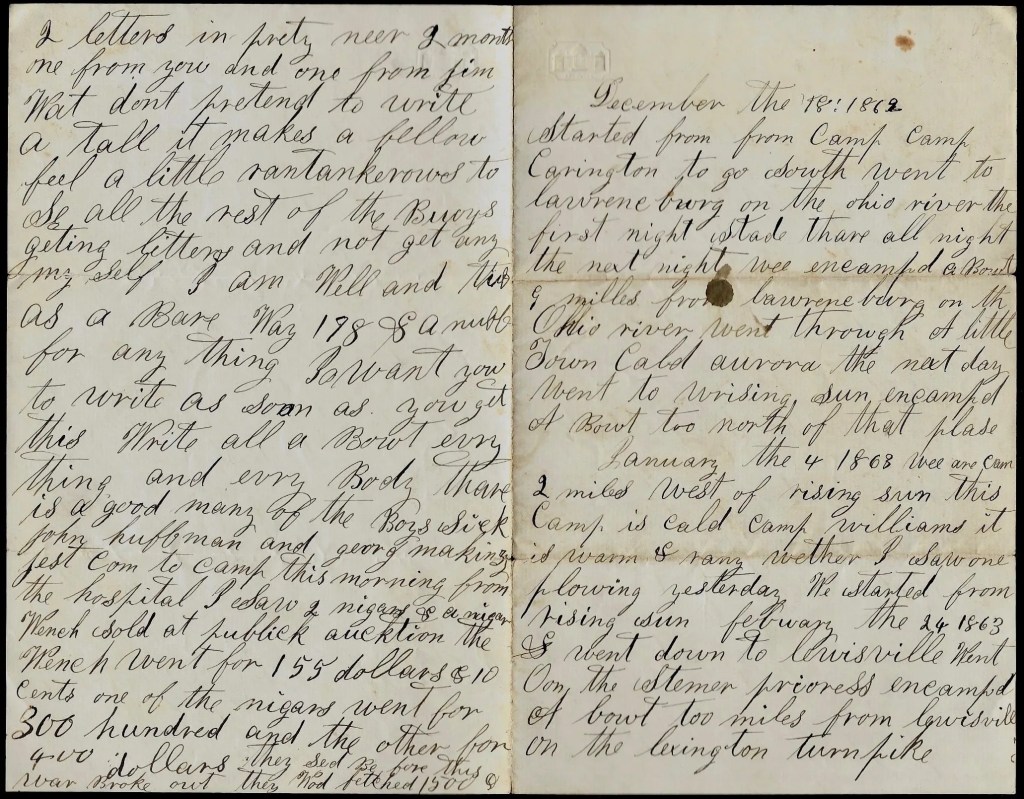
Started from camp Carington to go south. Went to Lawrenceburg on the Ohio River the first night, stayed there all night. The next night we encamped about 9 miles from Lawrenceburg on the Ohio River. Went through a little town called Aurora. The next day went to Rising Sun. Encamped about two [miles] north of that place.
January 4, 1863, we are camped two miles west of Rising Sun. This camp is called Camp Williams. It is warm & rainy weather. I saw one plowing yesterday. We started from Rising Sun February the 24, 1863 & went down to Louisville. Went on the steamer Princess. Encamped about two miles from Louisville on the Lexington turnpike.
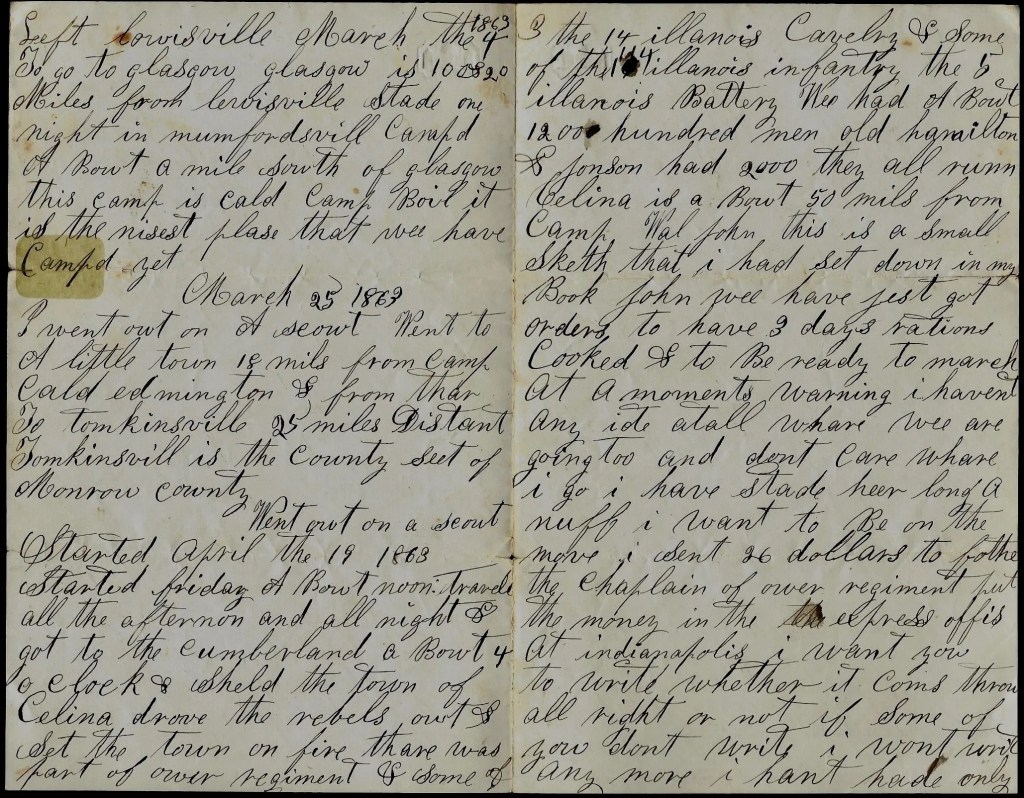
Left Louisville March the 4, 1863 to go to Glasgow. Glasgow is 100 & 20 miles from Louisville. Stayed one night in Mumfordsville. Camped about a mile south of Glasgow. This camp is called Camp Boyle. It is the nicest place that we have camped yet.
March 25, 1863, I went out on a scout. Went to a little town 18 miles from camp called Edmington & from there to Tompkinsville 25 miles distant. Tompkinsville is the County Seat of Monroe County.
Went out on a scout. Started April the 19, 1863. Started Friday about noon. Travelled all the afternoon and all night & got to the Cumberland about 4 o’clock & shelled the town of Celina, drove the rebels out & set the town on fire. There was part of our regiment & some of the 14th Illinois Cavalry & some of the 14 Illinois Infantry [and] the 5th Illinois Battery. We had about 1200 men. Old Hamilton and Johnson had 2,000. They all run. Celina is about 50 miles from camp.
Well, John, this a small sketch that I had set down in my book. John, we have just got orders to have 3 days rations cooked & to be ready to march at a moment’s warning. I haven’t any idea at all where we are going to and don’t care where I go. I have stayed here long enough.
I sent 26 dollars to Father. The Chaplain [Amos D. Cunningham] of our regiment put the money in the express office at Indianapolis. I want you to write whether it comes through all right or not. If some of you don’t write, I won’t write anymore. I hain’t had only 2 letters in pretty near 2 months—one from you and one from Jim. Wat don’t pretend to write at all. It makes a fellow feel a little rantankerous to see all the rest of the boys getting letters and not get any myself.
I am well and thick as a bear. Weigh 178 and enough for anything. I want you to write as soon as you get this. Write all about everything and everybody. There is a good many of the boys sick. John Huffman and George Mckinsey just came to camp this morning from the hospital. I saw 2 niggers & a nigger wench sold at public auction. The wench went for 155 dollars & 10 cents. One of the niggers went for 300 hundred and the other for 400 dollars. They said before this war broke out they would have fetched $1500 dollars.
Letter 3
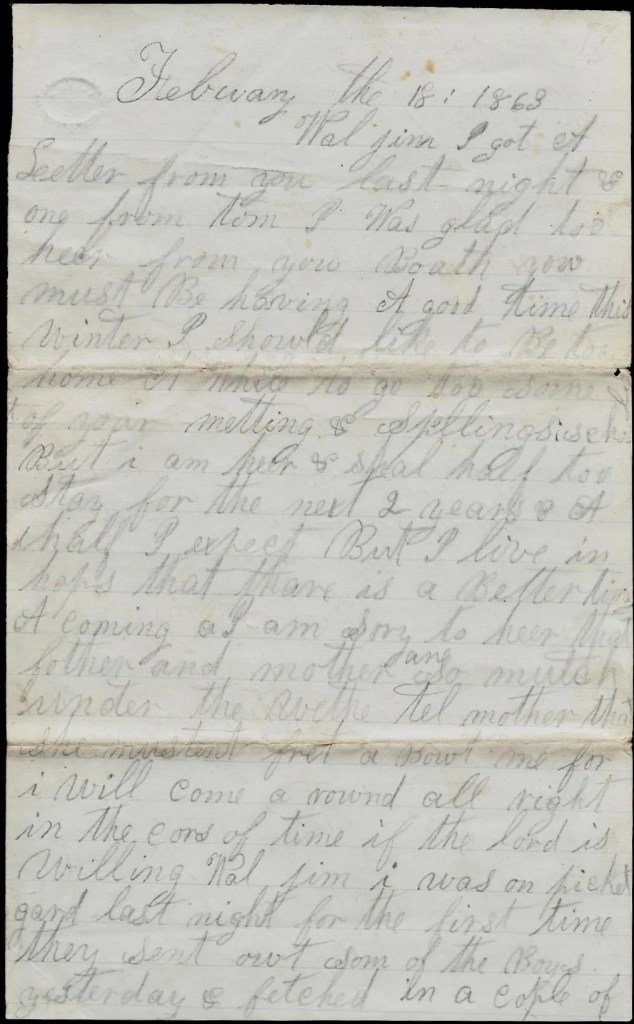
February 18, 1863
Well Jim, I got a letter from you last night & one from Tom. I was glad to hear from you both. You must be having a good time this winter. I should like to be to home awhile to go to some of your meetings and spelling schools, but I am here & shall have to stay for the next two years and a half, I expect. But I live in hopes that there is a better time a coming. I am sorry to hear that Father and Mother are so much under the weather. Tell Mother that she mustn’t fret about me for I will come around all right in the course of time if the Lord is willing.
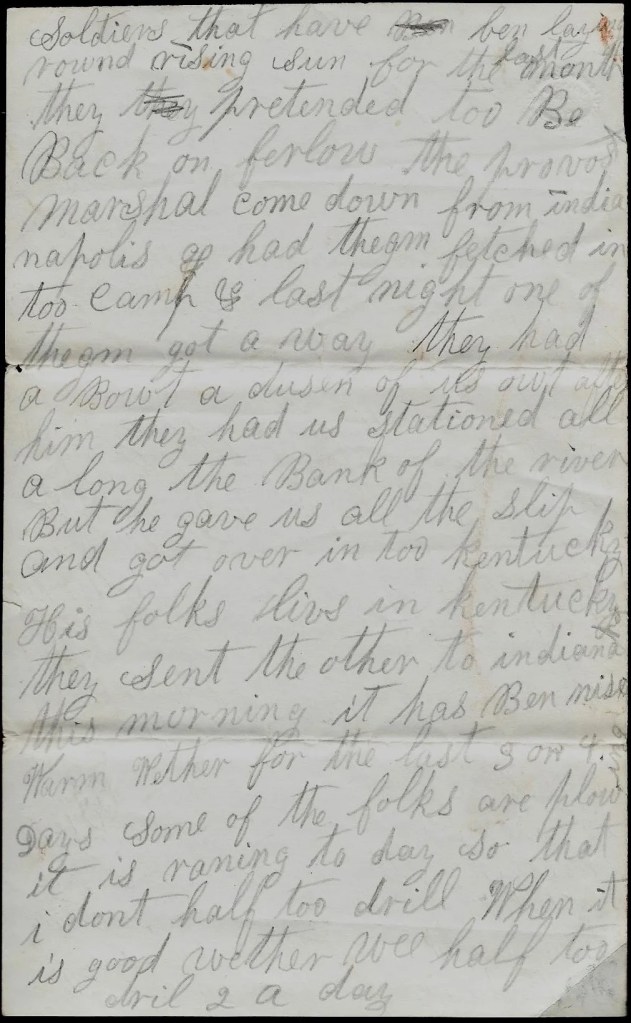
Well Jim, I was on picket guard last night for the first time. They sent out some of the boys yesterday & fetched in a couple of soldiers that have been laying around Rising Sun for the last month. They pretended to be back on furlough. The Provost Marshal came down from Indianapolis & had them fetched in to camp & last night one of them got away. They had about a dozen of us stationed all along the bank of the river but he gave us all the slip and got over into Kentucky. His folks live in Kentucky. They sent the other to Indiana this morning.
It has been nice warm weather for the last 3 or 4 days. Some of the folks are plowing. It is raining today so that I don’t have to drill. When it is good weather, we have to drill twice a day.
Letter 4
Camp Chase, Ohio
May the 22, 1865
Mr. John,
It has been over a year since I have took a pen to try to write. I thought I wouldn’t write at all but I wanted to hear from home so bad that I couldn’t wait any longer, so I thought I would write. I don’t know whether they will discharge me here or give me a furlough. I may not have to stay here more than a week and I may have to stay three months. This military is rather uncertain business.
I landed here Saturday the 20th and who should I find but Jim Marsh and Frank Parmer. You can’t think how much good it done me to them and to hear from home. They say you all thought I had done up the spout. But thank the Lord, I am in the land of the living and able to eat my rations yet.
I was paroled and got through to our lines the 28th of April. Come into our lines at Jacksonville, Florida. That was the happiest day of my life. I staid in Andersonville, Georgia, last winter. Was sent to Jacksonville, to Annapolis, Maryland, and there I drew 9 months ration money—the hardest earned money that ever I got in my life. I drew 67 dollars and a half, the first money that I have had in a year. Jim Marsh says that [my brothers] Wat 1 and Jim have both enlisted and gone soldiering. I hope they may never have the misfortune to fall into the rebels hands. If they ever do, I hope they will fare better than I did.
Well John, it has been so long since I wrote that I can’t write. Write as soon as you get this and write all about everybody and everything. Write what regiment they belong to and how Uncle Henry’s folks get along and all about it.
From Willard Smith
to Brother John & all the rest of the folks.
1 Waterman J. Smith (1832-1901) was Willard’s older brother. “Wat” served in Co. D, 23rd Indiana Infantry.


 Spared & Shared 23