
The following letter was written by Devillo Wheeler (1846-1863) who enlisted in August 1862 and mustered into Co. I, 154th New York Infantry as a private on 25 September 1862. Devillo was described as a grey-eyed, brown-haired farmer who stood just north of 5 feet tall. He claimed to be 18 years old but genealogical records reveal that he was born on 4 October 1846 so in actuality he wasn’t even 16 yet. The home of his parents, William and Rebecca (Lindsley) Wheeler was located in Allegany, Cattaraugus county, New York.
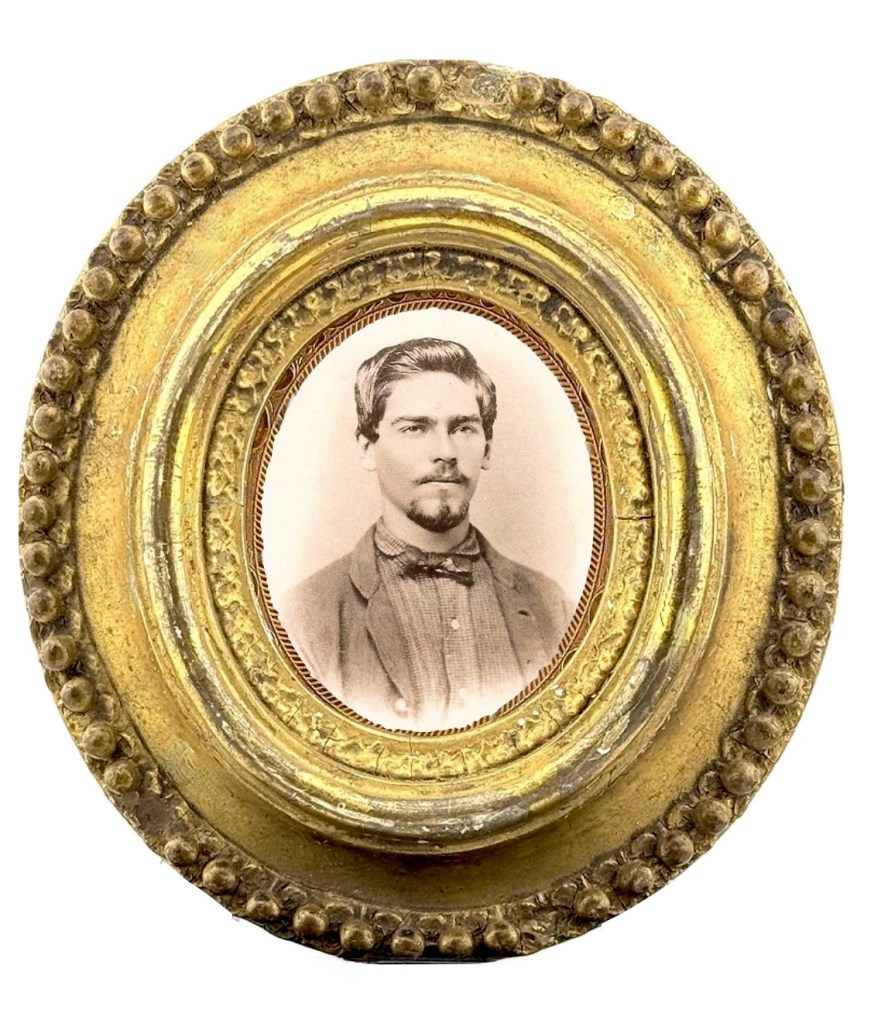
Mark H. Dunkleman, author and historian, has studied the 154th New York Regiment extensively. He informs us that, “When the regiment arrived in Virginia, Devillo quickly became homesick. “Old Allegany is the place for me,” he wrote on a print of Camp Seward he sent home to his parents. “Let it be ever so humble there is no place like home,” he wrote on another occasion. “When I hear the brass band play ‘Home Sweet Home’ in the evening it makes me think of home.” 1 Dunkleman went on to explain that, “The 154th was a green regiment. Raised in the summer of 1862 in response to President Abraham Lincoln’s call for 300,000 three-year volunteers, eight of the regiment’s companies were recruited in Cattaraugus County, the remaining two in neighboring Chautauqua. Since its muster-in in September 1862, the regiment had journeyed by rail to Washington, D.C., been assigned to its brigade at Fairfax Court House, Virginia, made an inconsequential move to Thoroughfare Gap and back, marched to Falmouth and slogged along on the infamous Mud March, and occupied winter quarters in Falmouth and the camp near Stafford, named Camp John Manley after a civilian benefactor. After seven months of service, the soldiers of the 154th had yet to fire their Enfield rifled muskets in combat.” 2
Though Devillo survived the baptism of fire at Chancellorsville, he with many others of his regiment “was captured at Gettysburg. Confined on Belle Island in the James River opposite Richmond, he was sent to Hospital 21 in the city on November 3, 1863. It’s likely he died there, but he is listed as having “no further record.” Assuming he died in Richmond, his remains would have eventually been reinterred in the Richmond National Cemetery in an unmarked grave.” 3 In 2012, Ed Havers of Olean, New York, obtained a headstone from the Veterans Administration to honor his granduncle, Pvt. Devillo Wheeler of Co. I. Devillo.
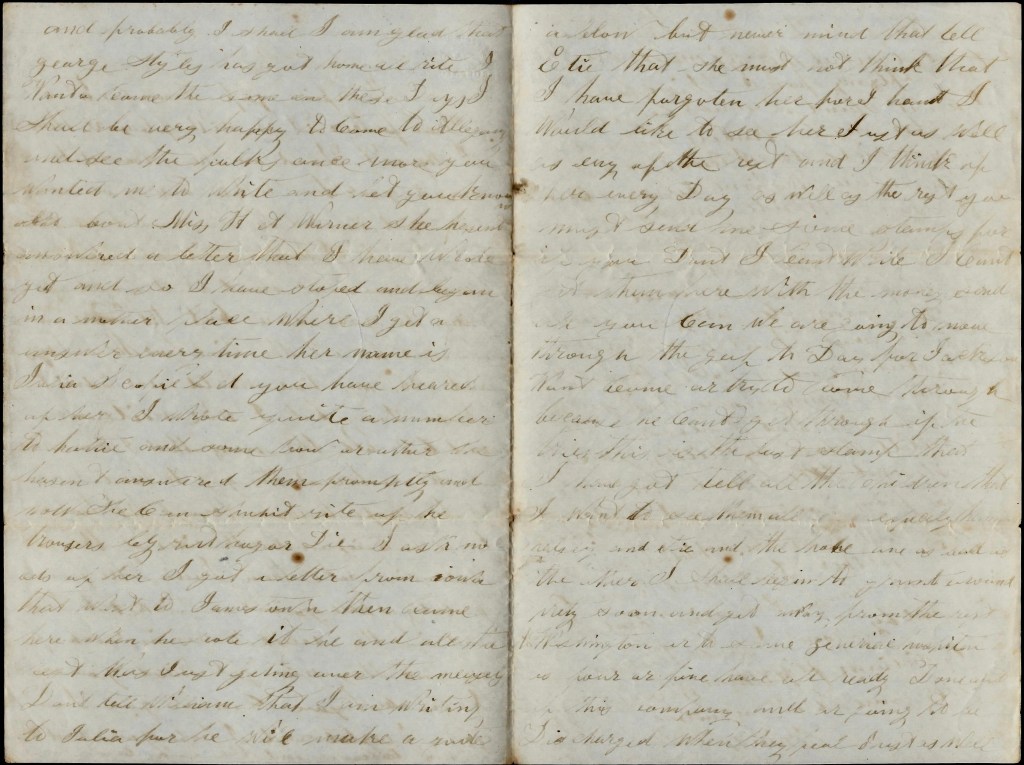
Transcription
Thoroughfare Gap
November 10, 1862
Dear Father,
It is with pleasure that I squat down on the ground to answer your two letters you sent the [ ] in and the one you told about the [ ]. I hope you won’t get drafted because you can’t stand it. I would of written to you before but we have been on the march all the time for three days and so my time would not admit of so doing but I will write now and tell all the news that I can think of.
We are here at this Gap to head Jackson [off] if he attempts to come through. We have got large batteries on both sides of the Gap that will rake them down like fun. I probably shall go out on picket today and if the secesh comes in reach of my gun, they will get killed.
You must do the best you can if you don’t get drafted and I hope you won’t. I want to [ ] and the folks before long and probably I shall. I am glad that George Stiles has got home all right. I want to come the same one of these days. I shall be very happy to come to Allegany and see the folks once more. You wanted me to write and let you know all about Miss H. A. Warner. She hasn’t answered a letter that I have wrote yet and so I have stopped and began in another place where I get a answer every time. Her name is Julia Scofield. You have heard of her. I wrote quite a number to Hattie and somehow or other she hasn’t answered them promptly and now she can [ ] right up her trousers leg root hog or die. I ask no acts of her.
I got a letter from [Rowan?] that went to Jamestown, then came here. When he wrote it, he and all the rest was just getting over the measles. Don’t tell William that I am writing to Julia for he will make quite a blow, but never mind that. Tell Ettie that she must not think that I have forgotten her for I hant. I would like to see her just as well as any of the rest and I think of her every day as well as the rest. You must send me some stamps for if you don’t, I can’t write. I can’t get them here with the money. Send all you can.
We are going to move through the gap today for Jackson won’t come or try to come through because we can’t get through if he tries. This is the stamp that I have got. Tell all the children that I want to see them all—especially [ ] and the [ ]. I shall begin to [ ] around very soon and get away from the regiment to Washington or to some general inspection as four or five have already [ ] of this company will or going to be discharged when they [ ] just as well as they ever did. More than one hundred out of the regiment are there now applying for a discharge and I can’t stand it much longer anyhow for my toe troubles me and my side too. I can’t go but a little while at a time before stopping.
I shant write much more this time for the paper is [illegible]…Don’t read this to anybody but our own folks. Don’t let William Johnson see it. If you do, he will blab it all over. I will close by telling you to write and tell all the news. This from your son, — Devillo Wheeler
My love to all the children and you and mother. Don’t forget to send some stamps. I am [in] usual health. Goodbye from Devillo Wheeler
to William Wheeler
1 February 2012, Mark H. Dunkelman, Hardtack Regiment News
3 Hardtack Regiment News (op. sit.)
4 Hattie A. Warner (b. 1845) was the daughter of Daniel Warner (1809-1861) and Mary Ford Mason (b. 1815) of Allegany, Cattaraugus county, New York. In the 1860 US Census, she was identified as a 14 year-old seamstress.
5 Julia Scofield may have been the daughter of Amos Schofield (1809-1869) and Ruth Lines (1811-1880). Julia married Dudley Phelps in 1865.

 Spared & Shared 23