

The following letter was sent to me for transcription by my friend Gina Denham. It was extracted from the pension file of British-born George Morecraft (1840-1913), who made his way to the United States around 1859. On 19 February 1861, as Gina’s thorough research reveals, George enlisted in Co. M, 2nd US Artillery, stating his previous occupation as “miller” and his birthplace as Winslow, Buckinghamshire. Just over a year later, on 10 March 1862, George deserted the army, and the subsequent month, he volunteered for the US Navy using the alias, Eugene Howard. While he claimed in the letter that he adopted the alias to keep his enlistment a secret from his parents, the desertion record implies a deeper motivation. And it didn’t stop there. It led to marital desertions as well.
After he was discharged from the US Navy, George stayed on in Baltimore until April 1900 when he returned to London. He began the process of filing for a pension in 1905 and in 1908 he married Matilda Harriett Phipps, a widow half his age. They had two children together when he was in his sixties. Gina also uncovered the fact that wile living in the United States, George had married a woman named Letitia White—twice! The first wedding took place in May 1865 under the name George Eugene Howard; their union producing two children, Estrella and Harry. Having the roving spirit of a sailor, however, George was not content to stay put and it wasn’t long before Letitia had to place the following advertisement in a Baltimore paper, “Left Suddenly, October 1st, 1868, GEORGE EUGENE HOWARD, of Baltimore, aged 30 years, 5 feet f inches high, light hair, cut short, fair complexion, stout built, Englishman by birth, talks fast. Any information of his whereabouts will be thankfully received by his sorrowing wife—Letitia Howard.” George returned to Baltimore and revealed to Letitia (and her parents) that he had married her under a false name and they were married once again under his given name in September 1869. Three more children were born to the couple following this date, George, Cora, and Carolina. But George would once again abandon Letitia and live with another woman for a time before returning to England. In 1910, the Pension Bureau received a claim from Lydia seeking a pension for George’s service in the Civil War. When the Bureau contacted George to validate her claim, George admitted freely that he had been married to her and that they had never divorced because he believed her to be dead.
Transcription
Name—George Morecraft, alias Eugene Howard—Reason of alias—For family reasons, not wishing parents, &c. to know that I had joined “U.S. Navy.” Now known by George Morecraft.
Ships number—Don’t remember numbers—only on board two (2) ships—Flagship Hartford and Winona No. 2.
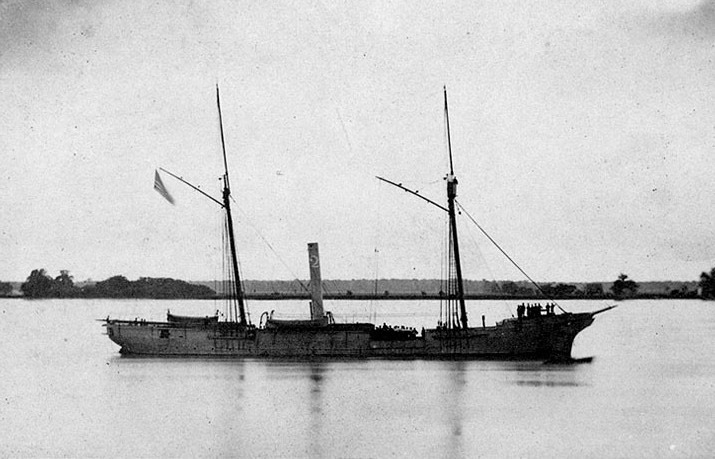
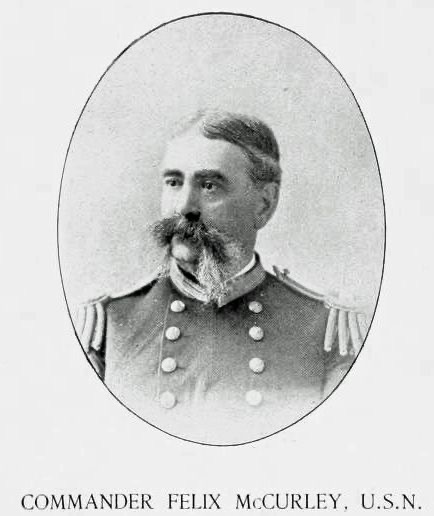
Names & Ranks of Officers: Captain W. H. Dana, Executive Officer W. S. [Winfield Scott] or S. W. Schley (now Admiral); Sailing Master Phelise [Felix] McCurley; Doctor Mr. Little; Purser Mr. Dixson; Chief Engineer Mr. Purdy; Asst. Engineer’s Lewis Warmling, Charles Warmling, Montgomery P. Griffiths; Doctors Steward, Albert, Ritter’ Master-at-Arms James Palmer; Firemen John Cane or Kane; John Kearns, Cranky Burns, and Edward Burnett; Quarter Masters James Smith, Edward Parker, James Whitly or Whitely; Landsmen John Kincart or Kinkart; John Wheeler, James Stubs; Barney Hagan was Boatswain and Captain of 11-inch gun.
Disabilities—None in Service.
Present application—Failing eyesight, old age, and general disability. Original to 52.717.
Transferred to U. S. Flagship Hartford, Admiral D. G. Farragut (Western Gulf Blockading Squadron). Was appointed Yeoman by Admiral Farragut, [on] Sunday (either June or July 1862) between 10-11 a.m. Confederate Ram Arkansas or Arkinsau came out of Yazoo river (rear of Vicksburg, Miss.), steamed down the river, firing several shots. Some taken effect on the Hospital boat, &c. Fleet not having steam up, impossible to slip cables. Confederate Ram came to anchor under the guns of Vicksburg some three (3) miles below. Flagship signaled fleet to get under way and proceed down river; ordered to “Ram and sink the Rebel ram if possible.” When abreast of batteries, the various vessels poured a terrific fire. Admiral Farragut (stationed in Mizzen rigging)—“Damn them, let them have it!;” We could hear the rebels crying for mercy. 7:30 p.m. [we] anchored some three (3) miles below Vicksburg, each vessel giving three (3) cheers. About 9 or 10 killed and wounded. I was stationed No. 11 gun (port side). 1
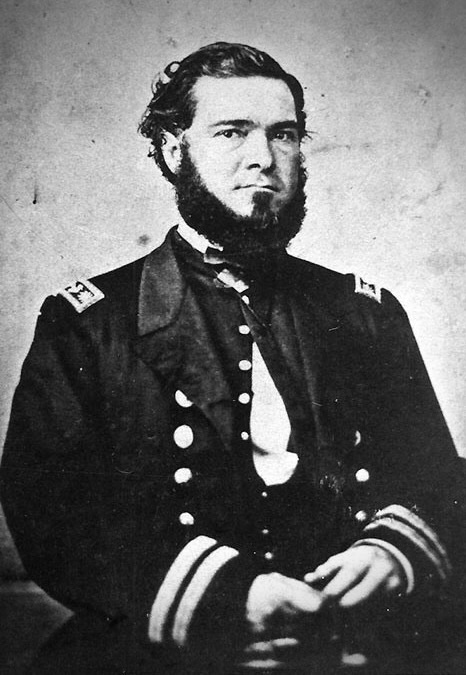
I was then transferred to Winona No. 2 with Captain [James Shepard] Thornton. Flagship steamed to Pensacola Navy Yard, Florida, Winona in company. [In late August 1862, the] Winona was ordered on blockade off Mobile to intercept blockade runner Oreto [later renamed Florida]—cargo valued at 1,000,000 pounds. Captain Thornton having D. T.’s [delirium tremens], was ordered to Washington D. C. 2 Lieut. Commander [Winfield Scott Schley] from the Flag took temporary command.
Winona received orders to proceed up Mississippi river [in early December 1862], lying below Port Hudson in company with Iron Clad SX [Essex]. On a Sunday morning [28 June 1863], Lieut. Colonel Green’s Confederate battery opened fire on the Winona. She received twenty-one (21) shots in her side, One (1) officer was wounded in the right thigh. As far as I can remember, his name was Wainwright. The following morning dispatches came for the Winona to proceed at once to Donaldsonville to bombard the above town. After firing several shells, the enemy surrendered. We took 126 prisoners, 50 of which was taken on board Winona, Lieut. Colonel Green being one of them. I was ordered to assist Master-at-Arms to put them in irons, &c. Afterwards the prisoners were sent to Fort Tortuga.
Winona‘s condenser being out of order was repaired. Winona was ordered [on 30 July 1863 to return] to Baltimore, Maryland, to be overhauled, &c., USS Kineo No. 3, taking us in tow (called in Key West for coal) [17 August 1863]. 3 Then the Winona was towed to Henderson’s Wharf [Baltimore] to undergo final examination with engines, &c. Winona having received crew on board, &c. was ordered to Admiral John A. Dahlgreen, for duty (South Atlantic Blockading Squadron). Was sent to Assabau [Ossabaw] Sounds (south of Charleston). Through Gunner Barney Hagan putting his revolver belt &c. on the breech of 11-inch gun, wind blowing a gale, caused belt to flap, revolver going off, the contents of which entered a man named McGlochlin. He expired in a few minutes. Same week were ordered to Ogeechee river. Blockade runner New London was up river some time. Same night a volunteer crew (Phelise [Felix] McCurley in command) went to capture the New London but failed to succeed, returning on board Winona. 4
President Lincoln’s term of office having expired and his reelection being contested by Gen. George B. McClellan, I was called down in cabin in presence of Captain W. H. Dana &c. and asked for my vote. I voted for Abraham Lincoln. Winona was ordered to George’s Creek, north of Charleston, S. C. about the latter end of March or beginning of April 1865. My term of service having expired on or about the 19th or 21st of April 1865, was put on board dispatch boat Acacia, landed in Philadelphia, Pa., on Saturday 29 or 30 April 1865. Received my discharge onboard the USS Princeton, receiving ship.
— George Morecraft, alias Eugene Howard
1 “Once above Vicksburg, Winona and her colleagues settled into a more or less routine schedule supporting the first Vicksburg campaign and attempting to blockade the Confederate ironclad, Arkansas, in the Yazoo River. On 15 July, however, the Southern warship bested a three-gunboat expedition sent up the Yazoo River after her, disabling USS Carondelet in the river and chasing USS Queen of the West and USS Tyler back down the river. Arkansas continued out of the Yazoo and into the Mississippi River to begin a bold dash through the 33-ship Union fleet of which Winona remained a unit. Firing as she went, the Confederate warship hurtled through the startled Northern squadron, briefly engaging Winona as she raced past her. Winona responded briefly, but the Confederate ship passed through the gauntlet safely and moored under the protection of the Vicksburg batteries. Soon thereafter, Winona, undertow of USS Wissahickon, re-passed Vicksburg with the rest of Farragut’s force and went back to New Orleans.” [Wikipedia, USS Winona]
2 According to the diary of Montgomery P. Griffis who served on the USS Winona at this time, “Capt. Thornton started on a ‘bust’ all to himself on leaving Pensacola which culminated in a fit of delirium tremens on the 21st [September 1862]. We had to station a man at the cabin door to keep him from coming on deck as he would probably have fallen overboard if he had.” (p. 72, “This Jolly Little Gunboat, Edited by Patrick E. Purcell, 2014)
3 The Kineo left the Mississippi river on 16 August 1863 and reached Baltimore on the 25th.
4 According to U. S. Naval Records, Felix McCurley (1834-1896), a native of Baltimore, Md., had served in the merchant marine service before he enlisted in the US Navy in November 1861. He was appointed as Acting Master, Nov. 13, 1861; ordered to Winona; attached to W. G. Squadron, 1861-62; engaged in the attacks on Forts Jackson and St. Philip, April 24, 1862; in the attack and passage of Vicksburg batteries, June 28, 1862; engagement with ironclad Arkansas, above Vicksburg; attack and passage of Vicksburg batteries, July 15, 1862; skirmishes on Mississippi river; 1863-64, attached to steam sloop Lackawanna; attack and passage of Forts Morgan and Gaines; engagement in Mobile Bay with the ironclad Tennessee and other vessels of the Confederate fleet; promoted Acting Vol. Lieutenant, Nov. 9, 1864; attached to Chocura, W. G. Squadron, 1865; continued in regular service, and subsequently commissioned as Lieutenant, Lieut.-Commander and Commander.

Purcell, Patrick E. (ed.) This Jolly Little Gunboat: The USS Winona On the Gulf Coast and Mississippi River, 1861-1863. Iowa City IA: Camp Pope Bookshop Press, 2014. 190 pp.
 Spared & Shared 23