

These letters came to me for transcription attributed to an assistant surgeon in the 16th New Hampshire Infantry—a 9-months regiment—but it became obvious to me rather quickly that the “Moses” who signed all of them and addressed them to his “cousin Lydia” was someone else. The content convinced me that the soldier served in Co. H of the 16th New Hampshire and there were only two men with the name of Moses; they were Moses D. Sargeant and Moses J. Seavey, both of Warner in Merrimack county. Sargeant’s muster rolls indicated that he deserted during his term of service so I doubt it was him. I’m going to attribute these letters to Moses Seavey (1841-1863), the son of Andrew Seavey (1817-1901) and Lydia Johnson (1817-1879).
It’s clear from Moses’ letter that he was ill the entire time he wrote to his cousin from January through June 1863. The last of these four letters was written in early June in which he claimed, “I am once more on the gain for I have got so that I can sit up most of the time and hobble about the room some for I have nearly lost the use of my left arm and leg.” Unfortunately for Moses, like many others in his regiment, he never made it home. He died while in passage to Cairo on a Mississippi river steamer on 3 August 1863. He was buried at Natchez, Mississippi.
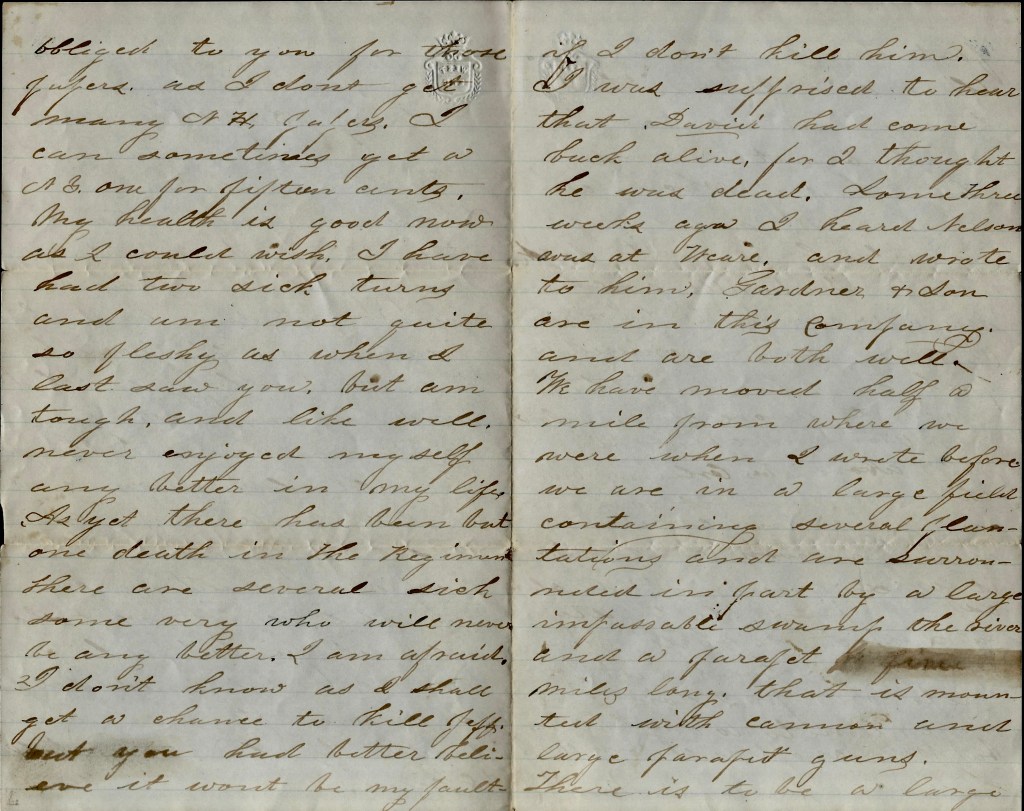
Letter 1
Camp Parapet, Carrollton, La.
January 27, 1863
Dear cousin Lydia,
I received your letter of the 12th last night. Also three papers. I was on guard yesterday and when I cane in a t 4 o’clock, tired and sleepy as I had not had any rest for 36 hours, I thought I would lay down and take a fine nap. As I sat my gun back, I espied something on my shelf and what should it be but a letter and paper. I immediately sat down to read and forgot to leave off till 8 o’clock. I am greatly obliged to you for those papers as I don’t get many New Hampshire papers. I can sometimes get a New York one for fifteen cents.
My health is good now as I could wish. I have had two sick turns and am not quite so fleshy as when I last saw you but am tough and like well, never enjoyed myself any better in my life. As yet there has been but one death in the regiment. There are several sick—some very who will never be any better. I am afraid I don’t know as I shall get a chance to kill Jeff [Davis] but you had better believe it won’t be my fault if I don’t kill him. I was surprised to hear that Davis had come back alive for I thought he was dead. Some three weeks ago I heard Nelson was at Weare and wrote to him. Gardner & son are in this company and are both well.
We have moved half a mile from where we were when I wrote before. We are in a large field containing several plantations and are surrounded in part by a large impassable swamp, the river and a parapet five miles long that is mounted with cannon and large parapet of guns. There is to be a large fort built here soon. There are to be three thousand negroes to work on it, several hundred of whom are here now, and it frequently looks quite dark. The contrabands are coming into camp in flocks.
Yesterday we were ordered to pack and be ready this morning to move down below Carrollton and about five miles above New Orleans, but this morning it was raining hard and continued all the forenoon, and now it is so muddy it is almost impossible to step. But I expect we shall move before long. Don’t wait for me to write for I don’t have much time to do anything but write as often as you can. From your cousin, — Moses

Letter 2
New Orleans, La.
U. S. Marine Hospital
April 1st 1863
Dear cousin,
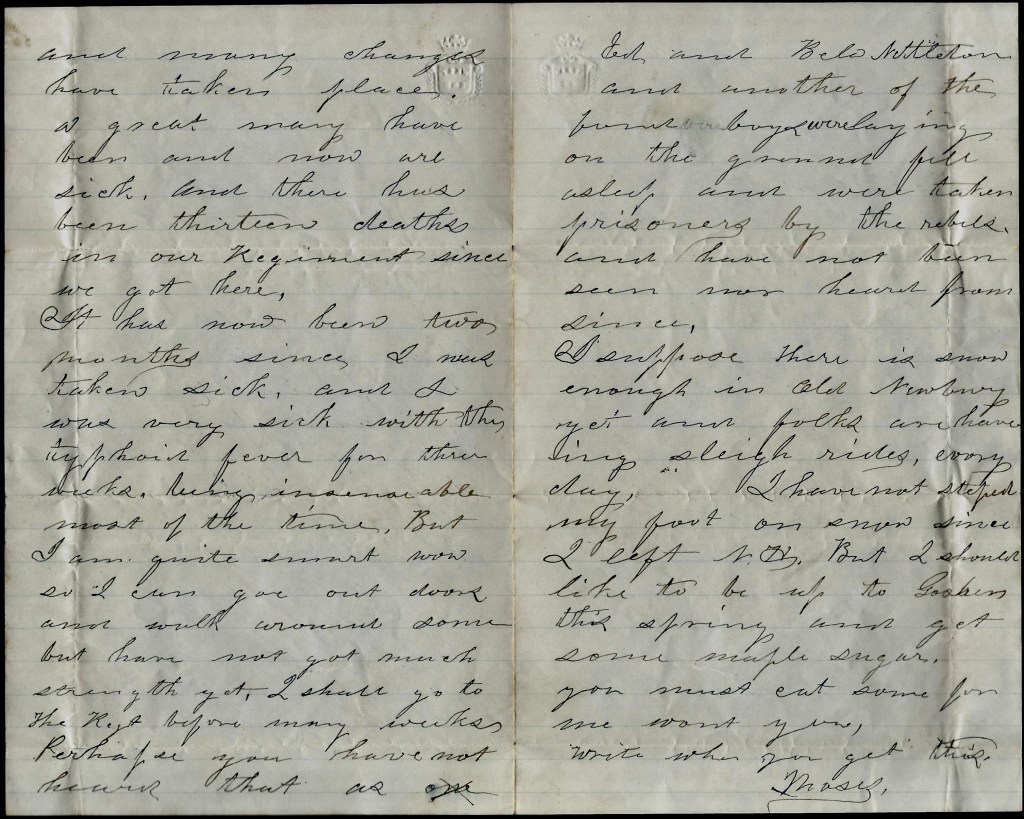
Yesterday I received your letter of February 22nd but have not got those papers yet but they are in the city and I expect to get them in a few days. The regiment is at Baton Rouge and our mail goes there and the Chaplain sent down a large bundle of mail which we have not got. It has been a long time since I wrote to you and many changes have taken place. A great many have been and now are sick, and there has been thirteen deaths in our regiment since we got here.
It has now been two months since I was taken sick and I was very sick with the typhoid fever for three weeks, being insensible most of the time. But I am quite smart now so I can go out doors and walk around some but have not got much strength yet. I shall go to the regiment before many weeks. Perhaps you have not heard that as Ed[win Hardy] and Bela Nettleton 1 and another of the band boys were laying on the ground fell asleep and were taken prisoners by the rebels and have not been seen nor heard from since.
I suppose there is snow enough in Old Newbury yet and folks are having sleigh rides every day. I have not stepped my foot on snow since I left New Hampshire but I should like to be up to Goshen this spring and get some maple sugar. You must cut some for me, won’t you?
Write when you get this. — Moses
1 Edwin R. Hardy, a musician in Co. H, (from Warner, N. H.) was Bela Nettleton, a musician in Co. F, was taken prison on 17 March 1863 near Port Hudson, La. Paroled on 4 April 1863.

Letter 3
Marine Hospital, New Orleans, La.
April 20th 1863
Dear Cousin Lydia,
It has been a long time since I have written to you because I have felt too lazy and shiftless to write much to anyone. But I will try and write a few lines this morning.
Last night I was very much pleased on receiving a letter from Newbury saying that you were all well as usual. I should like to be with you sugar off. 1 I’ll bet I would enjoy myself eating sugar and molasses with a little bread on it. You know that is the [favorite] I eat.
I am glad to be able to inform you that I am feeling nearly as well as I did before I was taken sick but have not got full strength yet—and never shall if I stay here. But I shall go to my regiment this week but shall not go on duty just yet. The regiment is doing garrison duty at Brashear City up eighty miles from here. Our troops are sweeping everything before them in this state. At last accounts, they had destroyed several gunboats and one entire fleet, [taken] from two to three thousand prisoners, twelve hundred of whom are in this city, and one wounded rebel is in this hospital. From your affectionate cousin, – Moses
Please excuse my short letter this time.
1 Sugar Off – This signals the end of the sugaring season. The weather has warmed enough, causing the sap to stop flowing and the boiling to come to an end.


Letter 4
Marine Hospital [New Orleans, La.]
June 4th, 1863
Dear cousin,
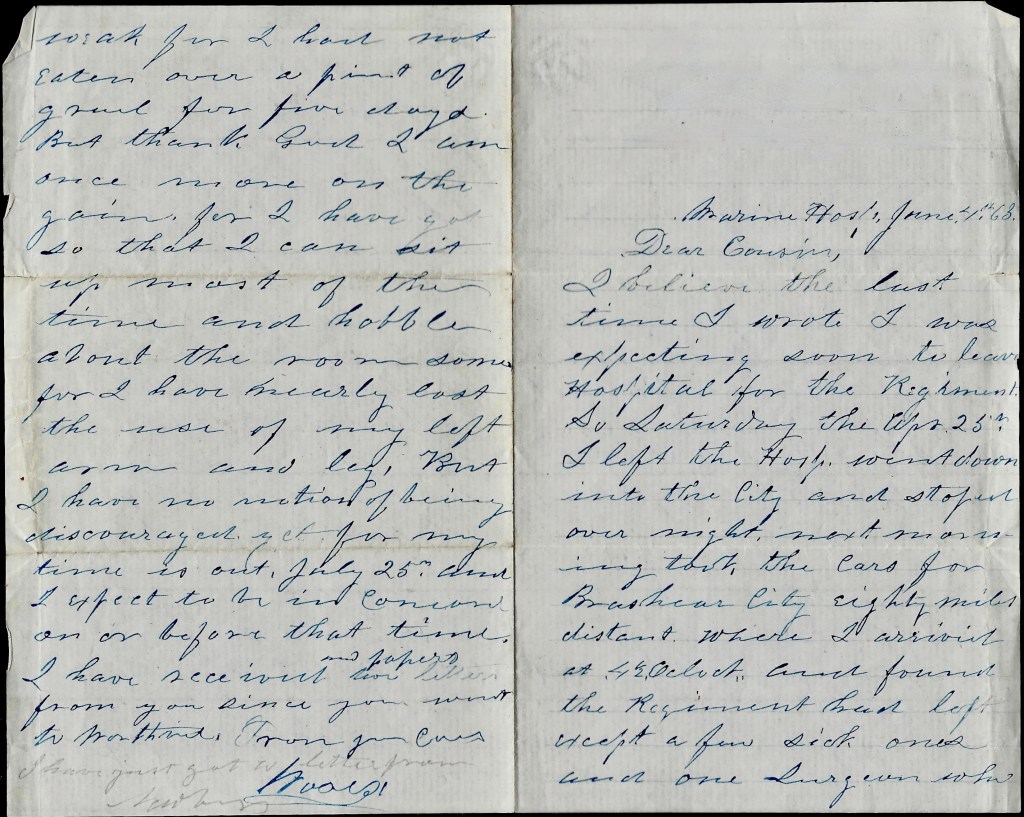
I believe the last time I wrote I was expecting soon to leave hospital for the regiment. So Saturday, April 25th, I left the hospital, went down into the city and stopped over night. Next morning took the cars for Brashear City eighty miles distant where I arrived at 4:30 o’clock and found the regiment had left except a few sick ones and one surgeon who told me to stay there a few days and get used to being out in the sun.
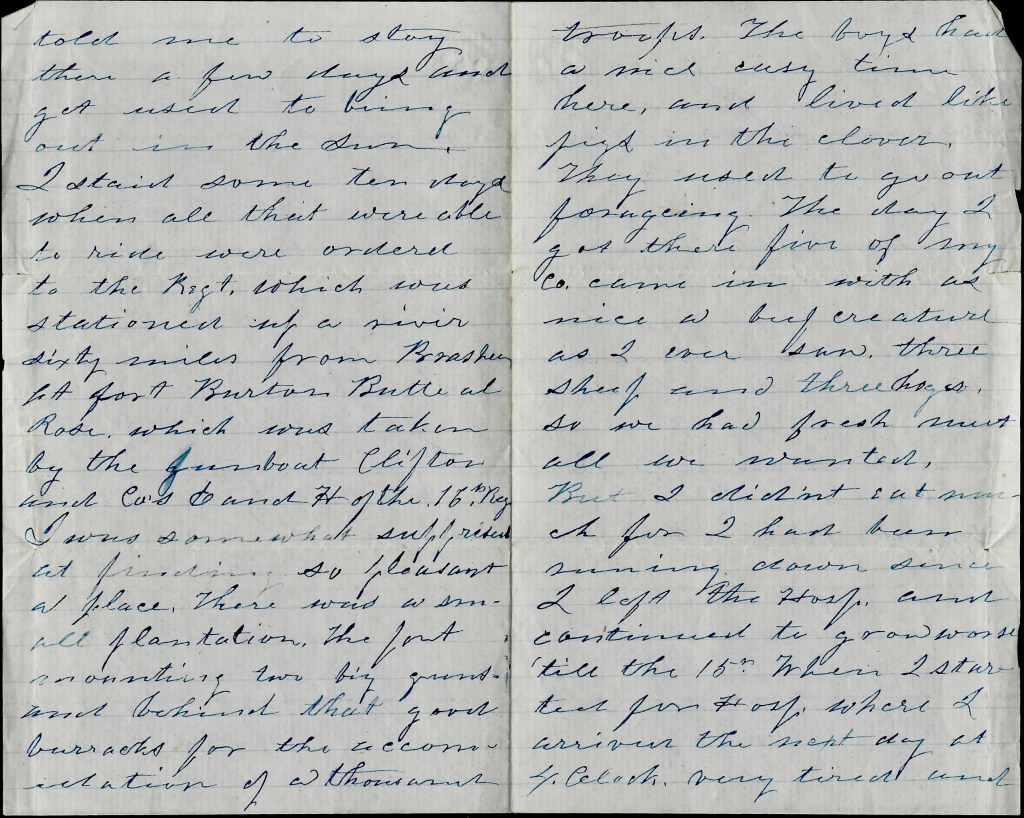
I stayed some ten days when all that were able to ride were ordered to the regiment which was stationed up a river sixty miles from Brashear at Fort Burton at Butte a la Rose, which was taken by the gunboat Clifton and Cos. E and H of the 16th Regiment. 1 I was somewhat surprised at finding so pleasant a place. There was a small plantation. The fort, mounting two big guns, and behind that good barracks for the accommodation of a thousand troops. The boys had a nice, cosy time here and lived like pigs in the clover. They used to go out foraging. The day I got there, five of my company came in with as nice a beef creature as I ever saw, three sheep, and three hogs. So we had fresh meat all we wanted. But I didn’t eat much for I had been running down since I left the hospital and continued to grow worse till the 15th when I started for the hospital where I arrived the next day at 4 o’clock, very tired and weak for I had not eaten over a pint of gruel for five days.
But thank God, I am once more on the gain for I have got so that I can sit up most of the time and hobble about the room some for I have nearly lost the use of my left arm and leg. But I have no notion of being discouraged yet for my time is out July 25th and I expect to be in Concord on or before that time. I have received two letters and papers from you since you went to Worth___. From your cousin, — Moses
1 “Sickness and death plagued the 16th New Hampshire at Fort Burton over the next six weeks, and by the time of their return home at the expiration of their nine-month enlistments in August, disease had claimed the lives of one-quarter of the Union men. Many Civil War regiments suffered grievous casualties in battle. But for the 16th New Hampshire, who saw little action and did not lose a man to Confederate bullets, the invisible enemy of disease defined their service in the Civil War.” [Our Deaths on the Battle Field Were Not Many: Disease in the 16th New Hampshire, National Museum of Civl War Medicine, 22 October 2020, by Nathan A. Marzoli]
 Spared & Shared 23