

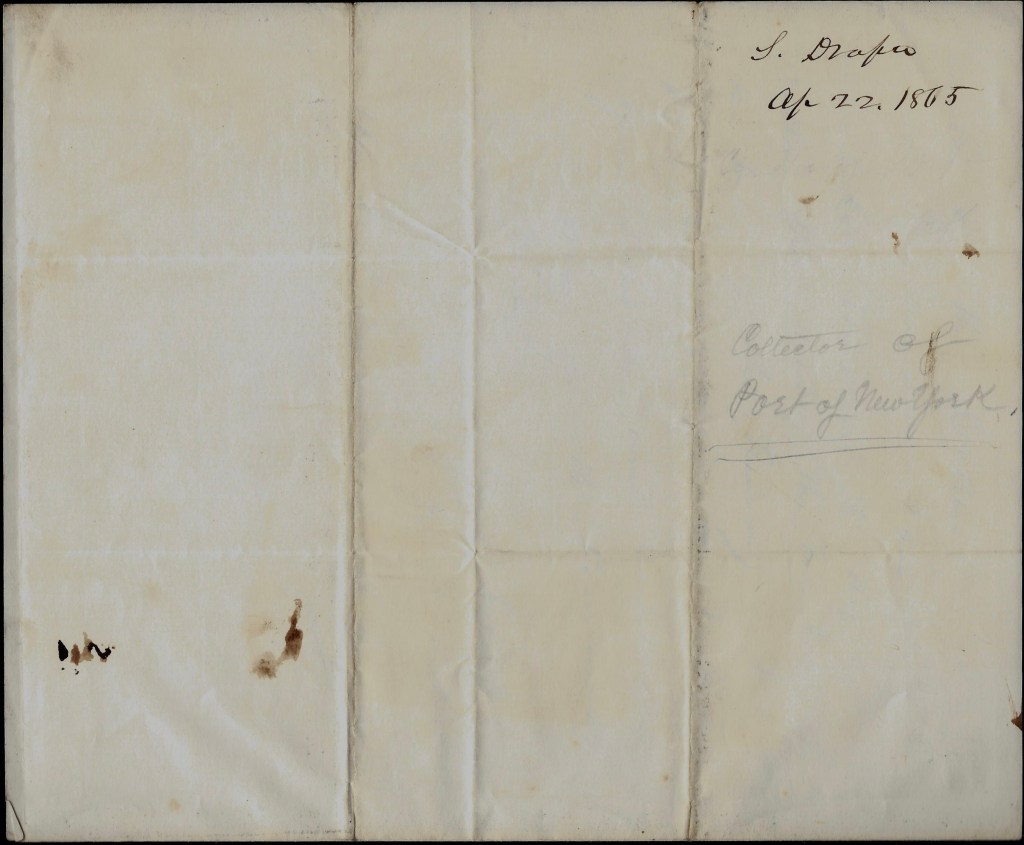
The following letter, bordered in black, was written by Simeon Draper (1806-1866), the Collector of Customs at New York, a week after the assassination of Abraham Lincoln. He wrote the letter to the Hon. William Pitt Fessenden, who as Secretary of the Treasury in the Lincoln Administration had been instrumental in securing Draper the coveted patronage post in 1864. As a successful businessman and the former chairman of the New York State Republican Party, Draper enjoyed the support of Secretary of State Seward and was at the center of New York’s business, political, and social scene. Not everyone in Lincoln’s cabinet thought favorably of Draper, however. Gideon Wells believed him to be swindler and in fact, a post-war investigation revealed that Draper was guilty of diverting some of the proceeds of the confiscated cotton from the U.S. Treasury to his personal use. It’s believed that when Lincoln wished to remove Draper from the post, Seward “wouldn’t let the President do it.” Draper was finally replaced as the Collector in August 1865 by Preston King—the “intimate friend and constant companion” of Andrew Johnson.
Fessenden was named Lincoln’s Secretary of the Treasury upon the resignation of Salmon P. Chase in 1864. He held the post for only eight months and then returned to the United States Senate. Though he disliked Andrew Johnson, he disliked the idea of impeachment and was one of the few Republicans who voted for Johnson’s acquittal—a position that alienated him from the party he had helped to form in the 1850s.
Transcription
New York
April 22, 1865
My Dear Sir,
I have not had a moment to write you since I came home and now have nothing to say worthy of your attention. The dreadful event which band my paper in black has upset all one’s thoughts and left us in contemplation of the great and uncertain passages which mortals are called to explore. I have in more moments than I can tell you thought of you with grateful feelings and zealous devotion. I have often wished I could see you that I might talk over matters and learn from you whether I have the power to serve you or yours. I will by & bye take a run otherwise Portland and see you. Perhaps you will take a little sea air in July or August in one of the cutters.
I am going to Charleston tomorrow to dig out the cotton there under the donation of the Secretary of the Treasury. I hope, pray, and intend to vindicate your kindness and confidence and pray you to command me freely.
Your grateful friend and servant, — S. Draper
[to] Hon. W. P. Fessenden, Portland, Maine


 Spared & Shared 23