
The letters presented herein were composed by William B. Ireland (1848-1911), the son of John Ireland (1801-1899) and Catherine Jeffery (1802-1882) of Monmouth County, New Jersey. William participated in two distinct regiments during the American Civil War. He initially enlisted at the tender age of 15 in Company H, 24th New Jersey Infantry, a nine-month unit, in September 1862, and mustered out in late June 1863 after engaging in the Battles of Fredericksburg and Chancellorsville. Subsequently, he enlisted in Company F, 38th New Jersey Infantry, in mid-September 1864 and mustered out at City Point at the conclusion of June 1865. During his service with the 38th New Jersey, at the time these letters were written, William was assigned to garrison duty at Fort Pocahontas, formerly known as Wilson’s Landing, situated on the James River in Virginia.
I was unable to locate a biographical sketch for William B. Ireland; however, an obituary clearly indicates that he upheld his religious convictions throughout his life, conducting religious meetings in his residence. He was affiliated with the Masons and served as the principal of public schools in Tenlytown, near Washington D.C., in the early 1900s, where he died unmarried in 1911. He had been engaged in teaching at primary schools in Long Branch, New Jersey, at least as early as 1882. His remains were returned to Monmouth County, New Jersey, for burial alongside his family. His Find-A-Grave biography notes that he “was the principal of the Asbury Park high school 25 years ago” (as written in 1912), and that he was born in Oakhurst and was a graduate of Eatontown Seminary. [Note: His headstone gives his DOB as January 1847 but the 1900 Census gives it at January 1848. Either way, he was under age when he first enlisted in 1862.]

Letter 1
Wilson’s Landing
December 1st 1864
Hello Belick,
How are you. Do you mean to write to me or don’t you. Henett has written to me twice and told you were going to write but I have [not] seen anything in the shape of a letter from you yet. You must write to me soon and relieve my anxiety. How do I know but what you have went a fishing and caught a whale and he has swallowed you?
I am well and I hope you are the same. If you “ain’t, you on to be.” But enough of this foolishness. Now I will tell you some news.
Accounts of the bravery of Private William Ireland—the courageous manner in which he defended his country in the recent battle of Fort Pocahontas on the James, Wednesday November 30, 1864.
At about 12 o’clock yesterday as I was eating my dinner, I was startled by hearing someone say the Fort is attacked by the Johnnies. I seized my gun and equipments and hastened out of my tent. The bugle sounded the call to arms and the drums beat the long roll. Orders were given for us to fall in immediately. We all fell in and were marched out to the parade ground and drawn up in line if battle. After the column was formed, the Major said one company must stay inside the fort for a reserve. The Adjutant General said we were the best company in the regiment so we were ordered to stack arms and wait until we were sent for. The remainder of the battalion marched out to reinforce the pickets. We laid on our arms until about 7 o’clock in the evening when the other companies returned from the scene of conflict with the same number they departed with less two. Our loss was 1 man and 1 horse killed and the same number. It seems when the rebels saw our men coming, they were firing at our pickets, but they retreated before we got to them, Our men pushed them for about six miles through the woods but could not bring them to any engagement. We do not know whether we killed any of them or not. If we did, they carried them with them.
Everything is now quiet in camp. I do not think they will be likely to attack us again. Give my love to Henett and the children. With love to you. Courageous coward, — Will Ireland
Write soon.


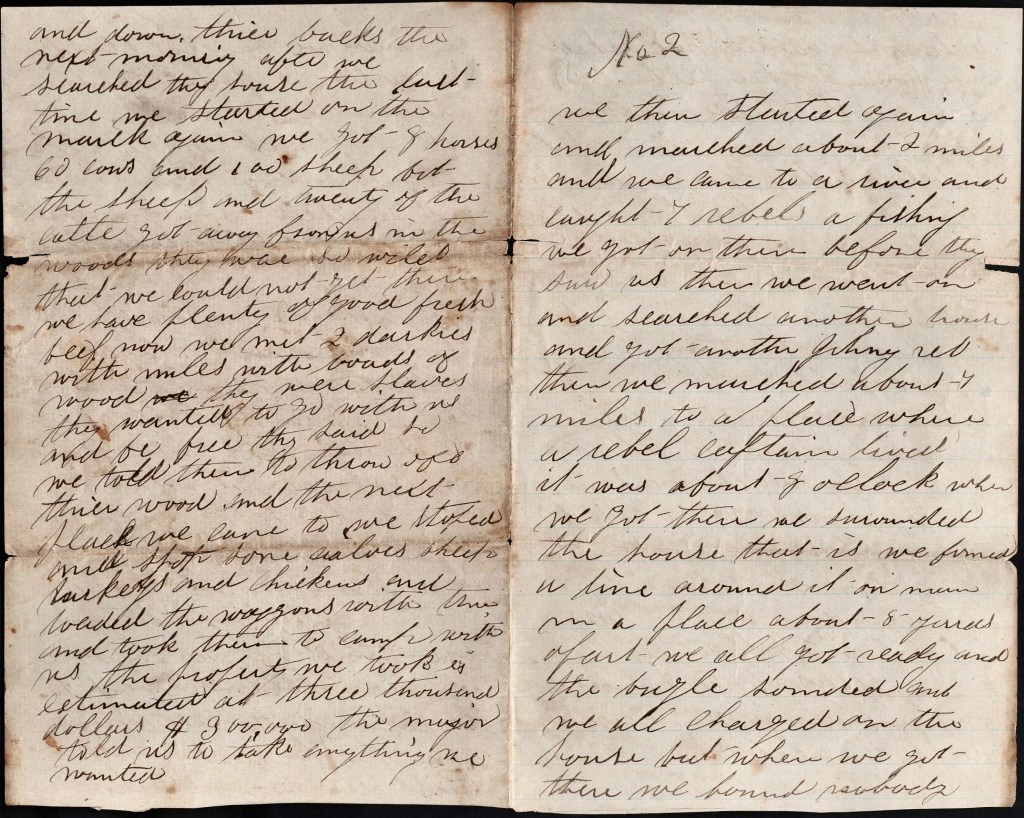
Letter 2
[Partial letter written to his sibling; The date is uncertain but I suspect it was in the spring of 1865. Appears to have been an expedition led by Major Tantum of the 38th New Jersey to root out guerrillas that were harassing the pickets at Fort Pocahontas, which was located at Wilson’s Landing on the north bank of the James river in Charles City County, Virginia.]
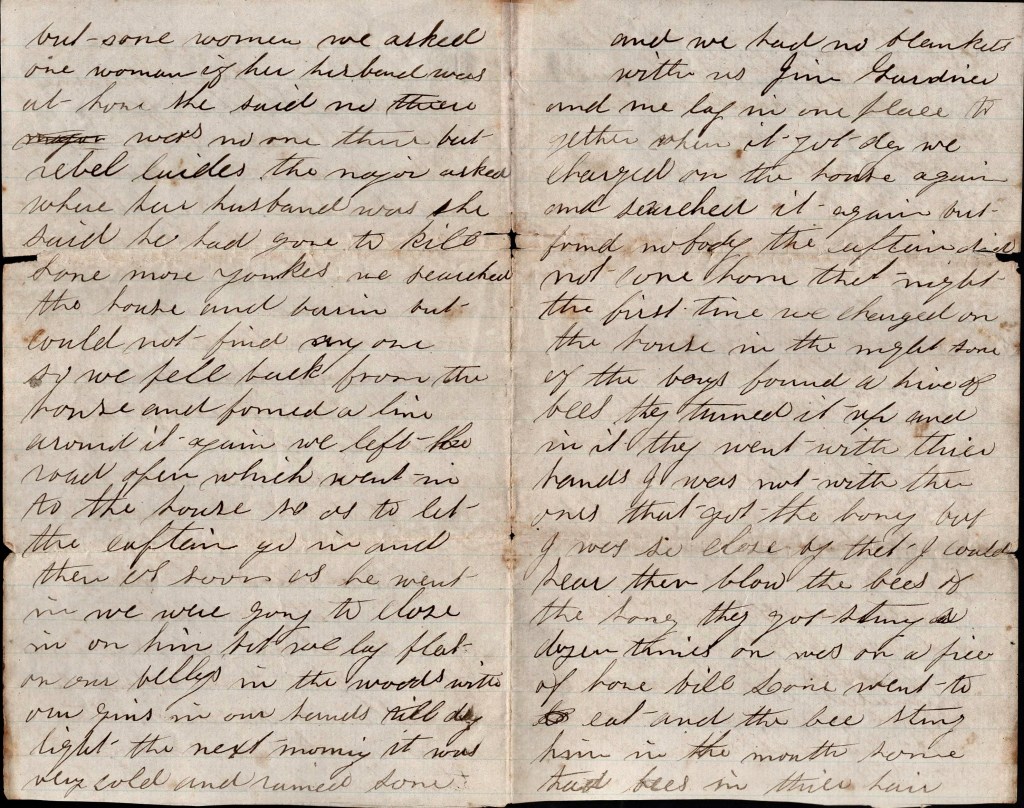
…We then started again and marched about 2 miles and we came to a river and caught 7 rebels a fishing. We got on them before they saw us. Then we went on and searched another house and got another Johnny Reb. Then we marched about 7 miles to a place where a rebel captain lived. It was about 8 o’clock when we got there. We surrounded the house—that is, we formed a line around it, one man in a place about 8 yards apart. We all got ready and the bugle sounded and we all charged on the house but when we got there, we found nobody but some women. We asked one woman if her husband was at home. She said there was no one there but rebel ladies. The Major [William H. Tantum] asked where her husband was. She said he had gone to kill some more Yankees. We searched the house and barn but could not find anyone so we fell back from the house and formed a line around it again. We left the road open which went into the house so as to let the captain go in and then as soon as he went in we were going to close in on him. We lay flat on our bellies in the woods with our guns in our hands till light the next morning. It was very cold and rained some and we had no blankets with us. Jim Gardiner and me lay in one place together. When it got day, we charged on the house again and searched it again but found nobody. The captain did not come home that night.
The first time we charged on the house in the night, some of the boys found a hive of bees. They turned it up and in it they went with their hands. I was not with the ones that got the honey but I was so close by that I could hear them blow the bees off the honey. They got stung a dozen times. [ ] went to eat and the bee stung him in the mouth. Some had bees in their hair and down their backs.
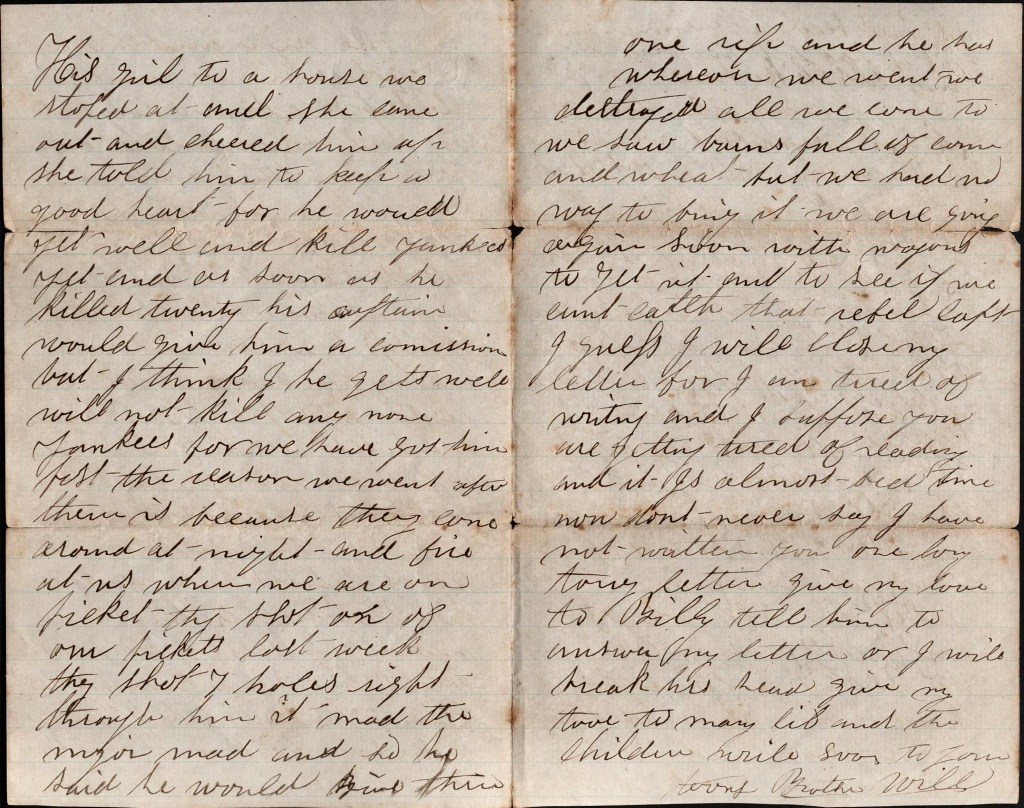
The next morning after we searched the house the last time, we started on the march again. We got 8 horses, 60 cows, and 100 sheep but the sheep and twenty of the cattle got away from us in the woods. They was so wild that we could not get them. We have plenty of good fresh beef now. We met two darkies with mules with loads of wood. They were slaves. They wanted to go with us and be free, they said, so we told them to throw off their wood and the next place we came to we stopped and shot some calves, sheep, turkeys and chickens and loaded the wagons with them and took them to camp with us. The property we took is estimated at three thousand dollars. The Major told us to take anything we wanted but we had enough to do to carry ourselves. Some threw away their boots and overcoats, they were so tired, but I stuck to mine. I never was so tired in my life. My feet were blistered, the bottoms of them all over, and my toes and ankles were all raw. I don’t think I could have went a mile further but I had to keep up with the rest or get catched by the rebs for the woods is full of them. But I am rested now and feel first rate.
We marched 60 miles in less than two days without resting an hour. The first rebel we shot will die, I think, for the bullet is in his side yet. We saw his girl to a house we stopped at and she came out and cheered him up. She told him to keep a good heart for he would get well and kill Yankees yet, and as soon as he killed twenty, his captain would give him a commission. But I think if he gets well, [he] will not kill any more Yankees for we have got him fast. The reason we went after them is because they come around at night and fire at us when we are on picket. They shot one of our pickets last week. They shot 7 holes right through him. It made the Major mad and so he said he would give them one rip and he has, whereon we went [and] we destroyed all we come to. We saw barns full of corn and wheat but we had no way to bring it. We are going again soon with wagons to get it and to see if we can’t catch that rebel captain.
I guess I will close my letter for I was tired of writing and I suppose you are getting tired of reading adn it is almost bed time now. Don’t never say I have not written you one long letter. Give my love to Billy, Tell him to answer my letter or I will break his head. Give my love to Mary, Lib, and the children. Write soon to your loving brother, — Will
It has been like summer until but it has set in very cold and looks like snow. But wood is plenty and when we are in our tents, we can keep warm enough. But it is very cold on picket. There is no danger but I will get things if they choose to send them…. — Will Ireland, the great lady killer

Letter 3
Fort Pocahontas
May 6th 1865
Dear Mother,
I received two letters from you on Thursday last but I have not ha time to answer them until now for I got them Thursday night and I went on picket Friday morning and came off this morning. It is evening now. I have been cleaning up for inspection tomorrow morning.
The weather is very warm here today. It is the hottest day we have had this spring. The sun is hot enough to almost waste anyone. I am well. My health never was better than it is now and I hope through the blessing of God that it will keep good while I stay down here.
We had a pretty hard shower while I was on picket yesterday but it did not last long. My eyes does not hurt me any except when it lightens and they seem to be as strong as ever. The prospect of our getting home soon seems very good and I think we will be getting along before a great while longer.
I feel the love of God very precious to my soul tonight and I fel that I have great reason to praise and bless His hold name for His many mercies to me. For every day of my life he adds some new blessing to the many He is continually giving me. I feel myself to be unworthy of His many blessings ad I know I am not as thankful as I should be. But I try to do that which is right and well pleasing in His sight, and to depend entirely upon Him fr strength….
Your loving son, — Will Ireland, Co. F, 38th New Jersey


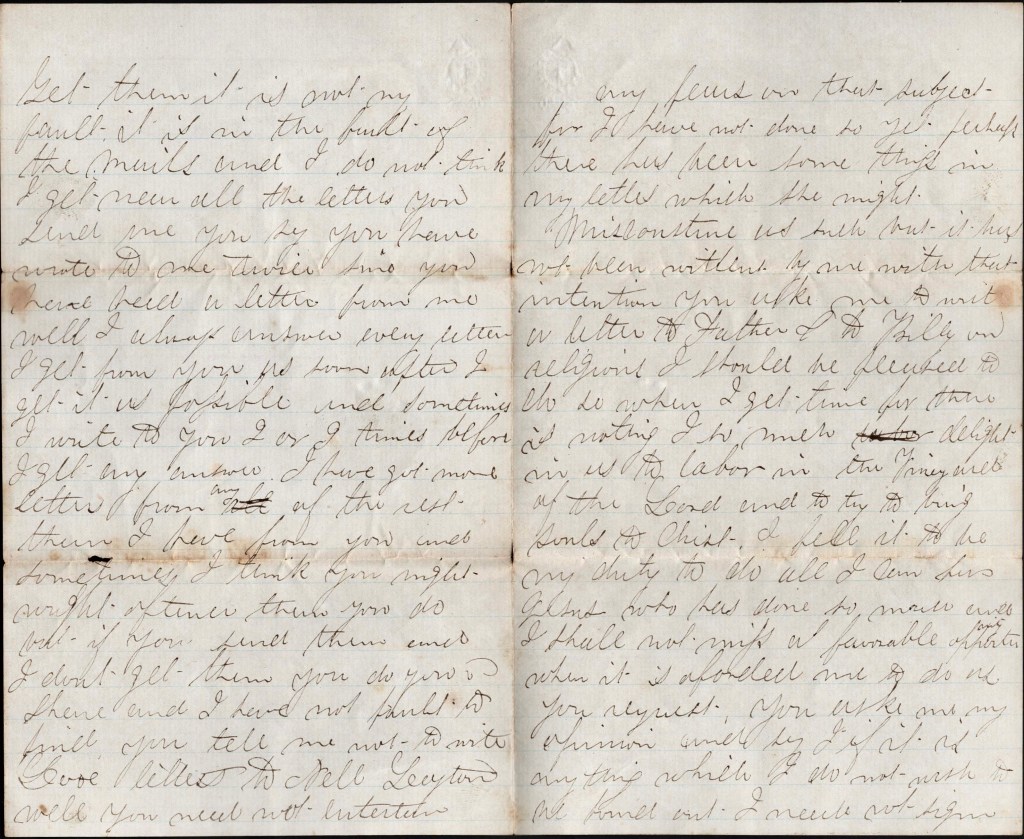
Letter 4
Fort Pocahontas
Sabbath afternoon, May 7th 1865
Dear Sister,
Your kind and ever welcome letter came duly to hand last night and I was much gratified to learn that you was well. I am well and I sincerely hope these lines may find you the same….
You asked me my opinion [on the President’s assassination] and if it is anything which I do not wish to be found out, I need not sign my name to it. Well, I will tell you my opinion and I will put my name at the bottom of it for I am not afraid for anyone to know what I think of it. I think it was the most malignant and wicked crime that has ever been committed in America, and a crime at which all good and just persons must shudder at, and must entertain the utmost contempt and loathing for the perpetrator of such a crime, and for any person who would sanction the commission of such a deed. Although I did not favor the politics of President Lincoln, still to have him removed in such a manner is awful to think of and I should much rather he would have continued in the Presidential chair for 20 years. [rest of letter missing]

 Spared & Shared 23