

This letter was written by Samuel H. Huntington (1765-1817), son of Rev. Joseph Huntington and Hannah Devotion of Coventry, Connecticut. Orphaned young, he was adopted by his uncle, one of the signers of the Declaration of Independence. He graduated from Yale in 1785 and, after studying law, was admitted to the bar in 1793. Huntington practiced law in Connecticut until 1800, then moved to the Northwest Territory in 1801, briefly living in Youngstown before resettling in Cleveland. Samuel dated this letter from Youngstown in October 1801.
Samuel was later appointed by Territorial Governor Arthur St. Clair as Lieutenant Colonel of state militia troops in the Western Reserve, which became northeast Ohio. He also served as Justice of the Peace and was a delegate at the Ohio State Constitutional Convention in 1802. When Ohio became a state in 1803, he was elected to the State Senate and became Speaker for a few months before being appointed an Associate Justice of the Ohio Supreme Court in April 1803. He became Chief Justice in 1804 upon Return J. Meigs, Jr. resigning and was elected as Ohio’s 3rd Governor in 1808. His administration dealt with issues like war with Great Britain and Ohio’s “Blue Laws.” Not seeking reelection in 1810, he ran unsuccessfully for the United States Senate against Thomas Worthington, then purchased a grist mill in Newburgh and later helped found Fairport in 1812. In 1813, General William Henry Harrison appointed him as a Paymaster and Colonel in the Army. Huntington also presided as Grand Master of the Grand Lodge of Ohio. He was killed in 1817 while supervising road construction to his estate in Painesville, Ohio.
Transcription
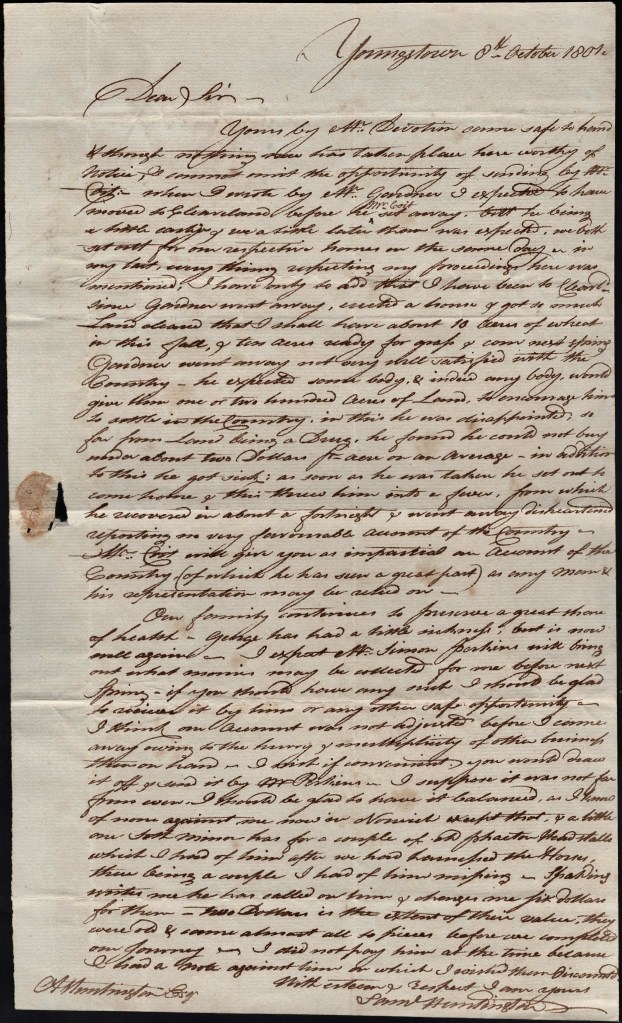
Youngstown [Northwest Territory]
8 October 1801
Dear Sir,
Yours by Mr. Devotion came safe to hand & though nothing new has taken place here worthy of notice, I cannot omit the opportunity of sending by Mr. D. When I wrote by Mr. Gardner I expected to have moved to Cleveland before he (Mr. Coit) set away, but he being a little [ ] a little later than was expected. We both set out for our respective home on the same day. In my last, everything respecting my proceedings here was mentioned. I have only to add that I have been to Cleveland since Gardner went away, erected a home 1 & got so much land cleared that I shall have about 10 acres of wheat in this fall, & ten acres ready for grass & corn next spring. Gardner went away not very well satisfied with the country. He expected somebody & indeed anybody would give him one or two hundred acres of land to encourage him to settle in the country. In this he was disappointed, so fat from land being a [ ], he found he could not buy now about two dollars per acre or on average. In addition to this, he got sick; as soon as he was taken, he set out to come home & this threw him into a fever from which he recovered in about a fortnight & went away disheartened, reporting no very favorable account of the country.
Mr. Crit [Crittenden??] will give you as impartial an account of the country (of which he has seen a great part) as any man & his representation may be relied on.
Our family continues to preserve a great share of health. George has had a litle sickness but is now well again. I expect Mr. Simon Perkins will bring out what monies may be collected for me before next spring. If you would have any such, I should be glad to receive it by him or any other safe opportunity. I think our account was not adjusted before I came away owing to the hurry and multiplicity of other business then on hand. I wish if convenient you would draw it off & send it by Mr. Perkins. I suppose it was not far from even. I should be glad to have it balanced as I know of none against me now in Norwich except that, and a little one Seth Minor has for a couple of [ ] head stalls which I [ ] of him after we had harnessed the horses, there being a couple I had of him missing. Spalding writes me he has called on him & charges me six dollars for them. Ten dollars is the extent of their value. They were old and come almost to pieces before we completed our journey. I did not pay him at the time because I had a note against him for which I wished them discounted.
With esteem & respect, I am yours, – Samuel Huntington
A. Huntington, Esq.
1 According to Whittlesey’s The Early History of Cleveland, Samuel Huntington removed with his family to Youngstown early in the summer of 1801. He soon determined to establish himself at Cleveland, and contracted with Amos Spafford to superintend the erection of a well built block house, of considerable pretensions near the bluff south of Superior street, in rear of the site of the American House. Huntington was then about thirty-five years of age. He was the protégé and adopted heir of his uncle and name-sake, Governor Samuel Huntington, of Connecticut. His education was very complete for those times. It would appear from his correspondence with Frenchmen, his knowledge of the French language, and the polish of his manners. that he had spent some time in France. His family consisted of his wife, Miss Margaret Cobb, a companion and governess; and two sons, Julius C. and Colbert, who still survive. Huntington belonged to the more moderate republicans, and does not appear to have lost the confidence of the Federalists.
 Spared & Shared 23