
This letter was written by John M. Tures although he was carried on the Roster of the 70th New York Infantry as John M. Touris, Tours, or Turse. John enlisted on 24 April 1861, at Paterson, N. J., when he was 21 years old to serve three years in Co. I. He mustered in as private, and was later promoted to corporal. He was captured in action on 2 May 1863, at Chancellorsville and paroled five months later. He was seriously wounded in the battle of Spottsylvania Court House on 14 May 1864 and was mustered out on 1 July 1864, at New York city.

John wrote the letter to William Oland Bourne (1819-1901), editor of The Soldier’s Friend, who sponsored a contest in 1865-1866 in which Union soldiers and sailors who lost their right arms by disability or amputation during the Civil War were invited to submit samples of their penmanship using their left hands. The contest, which awarded a total of $1,000 in prizes for the winning entries, was followed in 1867 by a second contest, which awarded $500 in prizes. A very large number of letters were submitted to Bourne which are now housed in the Library of Congress along with some photographs on the contestants. Most likely the following letter was a personal copy (or first draft) of the letter that John submitted. It’s also possible that John never sent the letter or missed the deadline for submission. See Wm. Oland Bourne Papers. Readers hoping to learn more about “The Left Armed Corps” can listen to Episode 1932 of Civil War Talk Radio wherein Allison M. Johnson is interviewed by Gerry Prokopowicz regarding her book on the subject.
[Note: This letter is from the personal collection of Greg Herr and was offered for transcribed and publication on Spared & shared by express consent.]
Transcription
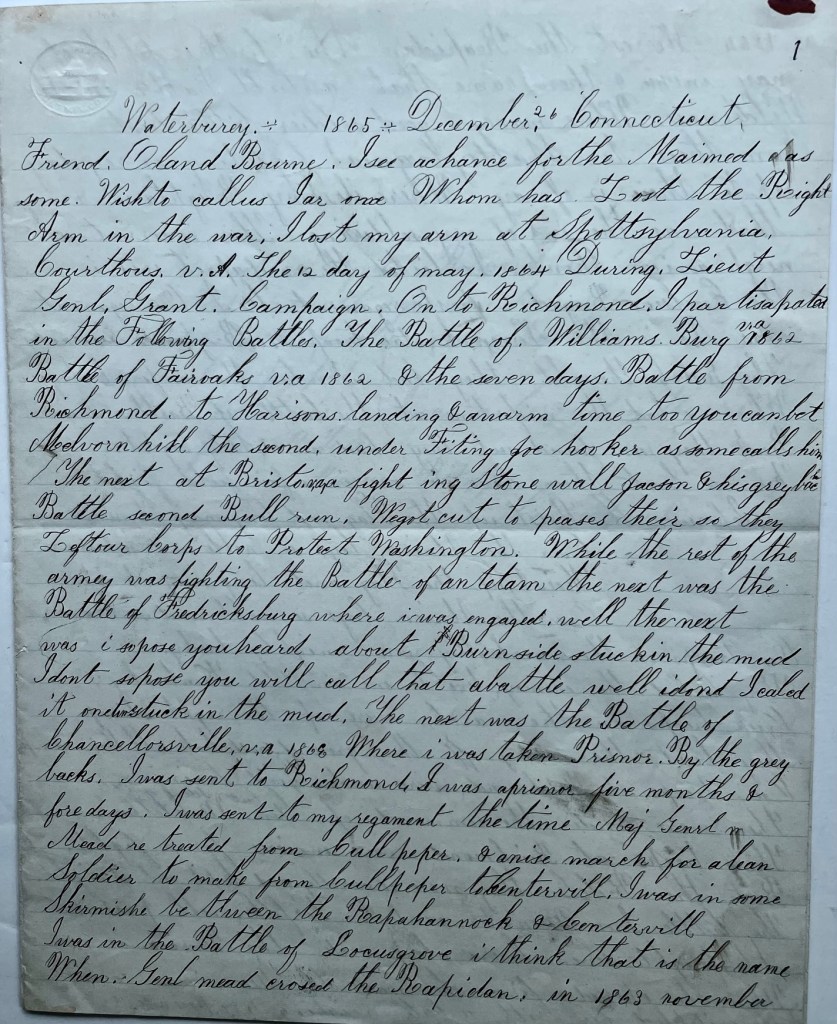
Waterbury [Connecticut]
December 26, 1865
Friend Oland Bourne,
I see a chance for the “maimed” as some wish to call us. I are one whom has lost the right arm in the war. I lost my arm at Spottsylvania Court House, Va., the 12th day of May 1864 during Lieut. Gen. Grant’s Campaign on to Richmond. I participated in the following battles. The Battle of Williamsburg, Va. 1862; the Battle of Fair Oaks, Va., 1862; and the Seven Days Battle from Richmond to Harrison’s Landing, and a warm time too, you can bet. Malvern Hill the second under Fighting Joe Hooker as some calls him. The next at Bristoe, Va., fighting Stonewall Jackson & his grey backs; Battle of Second Bull Run—we got cut to pieces there so they left our trooops to protect Washington while the rest of the army was fighting the Battle of Antietam. The next was the Battle of Fredericksburg where I was engaged. Well, the next was I suppose you heard about Burnside stuck in the mud. I don’t suppose you will call that a battle. Well I don’t. I called it one time stuck in the mud.
The next was the Battle of Chancellorsville, Va. 1863 where I was taken prisoner by the grey backs. I was sent to Richmond. I was a prisoner five months & four days. I was sent to my regiment the time Maj. General Meade retreated from Culpeper & a nice march for a lean soldier to make from Culpeper to Centreville. I was in some skirmishes between the Rappahannock & Centreville. I was in the Battle of Locust Grove—I think that is the name, when Gen. Meade crossed the Rapidan in 1863 November.
We crossed the Rapidan the fourth or fifth of May in 1864 and then came that awful Battle in the Wilderness where many a good soldier but the dust. From there to Spottsylvania, fighting every day up to the 12th of May where I lost my right arm & that was the end of my soldiering. This is correct as nigh as I can think. I enlisted the 26th of April 1861 in the Excelsior Brigade, 1st Regiment, Co. I. Our regiment was numbered in the New York State Troops, 70th Regiment.
The rebels thought they had us when the war first begun
When we had the misfortune at the battle of Bull’s Run;
But they soon found out they had no earthly sight
For we beat them two to one in a fair, field fight.
Chorus:
Hoist up the Flag and long may it wave
Over the Union, boys, so noble and so brave;
Hoist up the Flag and long may it wave
Over he Union boys so noble and so brave.
Our troops on the march they were mighty lucky,
They licked the enemy, two to one in Old Kentucky;
Our troops on the march were of the right stamp
They beat the enemy off the ground, and took all their camp
Our troops at Richmond 1 were under good training
They were under the command of Gen. McClellan (but I don’t see it)
The troops at Richmond 1 were anxious for a fight
But the rebels they were cowardly and kept out of sight.
The little Iron Monitor went to Norfolk, well packed,
She fought seven hours along side the Merrimac
When she opened fire she made the Merrimac sound
She crippled her with a ball weighing 480 pounds.
I did not see your reward until about a month ago so I have not had much practice and practice makes perfect. I was a corporal in the 7-th New York Vols., Co. I
My address is John M. Tures, Mianus Post Office, Connecticut
1 I think John must have meant Washington here, not Richmond. This poem appears to be original. I can’t find any evidence that it was copied from published sources.


 Spared & Shared 23