

The following letter came to me for transcription, author unknown. It was signed by a soldier named “Charles” and addressed to his mother. We know that he arrived with his regiment at the confederate stronghold of Columbus, Kentucky, in early December 1861 and that they had traveled up the Mississippi river on the steamer Scotland—a slow journey that took them ten days.
In the Memphis Daily Appeal of 3 December 1861, I was able to find a letter published by Zanoni (undoubtedly a pen name) that read:
“On board the steamer Scotland
December 1, 1861
Here we are, bag and baggage, arms, men and all. The entire force and equipment of the 3d Mississippi regiment of volunteers, on our way to Columbus. We left New Orleans on Saturday night, November 24th, and making allowance for fogs, broken wheel, and requisite stoppages to provision the soldiers, have made fair progress. Our last landing below Memphis was on the Arkansas shore, at a place called Laconia, and while wooding the boat, and drilling the men, we had another instance of the womanly spirit of the South; Mrs. L. P. and C. H. Blackburn, Mrs. Johnson and Mrs. Flournoy, with some other ladies, who names I did not learn, finding we had some few invalids, and needed fresh provisions, sent to the boat a variety of meats, vegetables and delicacies, and extended a hospitable welcome to all (men and officers) who visited their residences. That young lady who so deftly touched her piano to amuse a few “soldier boys” moistened more eyes than perhaps she was aware of, for roam where we may, the needle of memory will vibrate toward the home magnet, and a familiar tune conjures up the figures of those we love. May the performer live to strike triumphant strains over invaders. defeat. [sic] God bless the women! was the general exclamation as we swung from the shore...”
According to the regimental history, the 3rd Mississippi was only briefly stationed in Columbus, Kentucky. They were summoned by a request from Confederate General Leonidas Polk following the Battle of Belmont (7 November 1861). As this letter confirms, Polk anticipated a battle at Columbus that would be “larger than Manassas.” The defenses at Columbus were so formidable, however, that Union forces never intended to assault the “Gibraltar of the West” and it was ultimately abandoned by the Confederates in March 1862. The 3rd Mississippi returned to the coast near Biloxi in January 1862.
Unfortunately, with a name like “Charles” and few other clues, it would be a difficult task to identify the author. Perhaps additional correspondence will turn up.

Transcription
Columbus, Kentucky
December 6th 1861
Dear Mother,
After a long and tedious viyage of ten days we arrived here safely. We came on the steamer Scotland. She is a very slow craft. Our food was hard crackers and salt pork. Half the time we had no chance to cook the latter. This went on so for two or three days when Pat & I found our way to the kitchen where we messed until we landed. We stopped at all the principal towns on the river. While passing through Tennessee and Arkansas, the boat landed on the latter bank to wood and we all went ashore and found our way to a plantation which was situated near the river where we got pecans by the wholesale. They grow wild in that country. The proprietors of the plantation were very kind to us. They had coffee enough made to supply 500 made. There were several fine young ladies there.
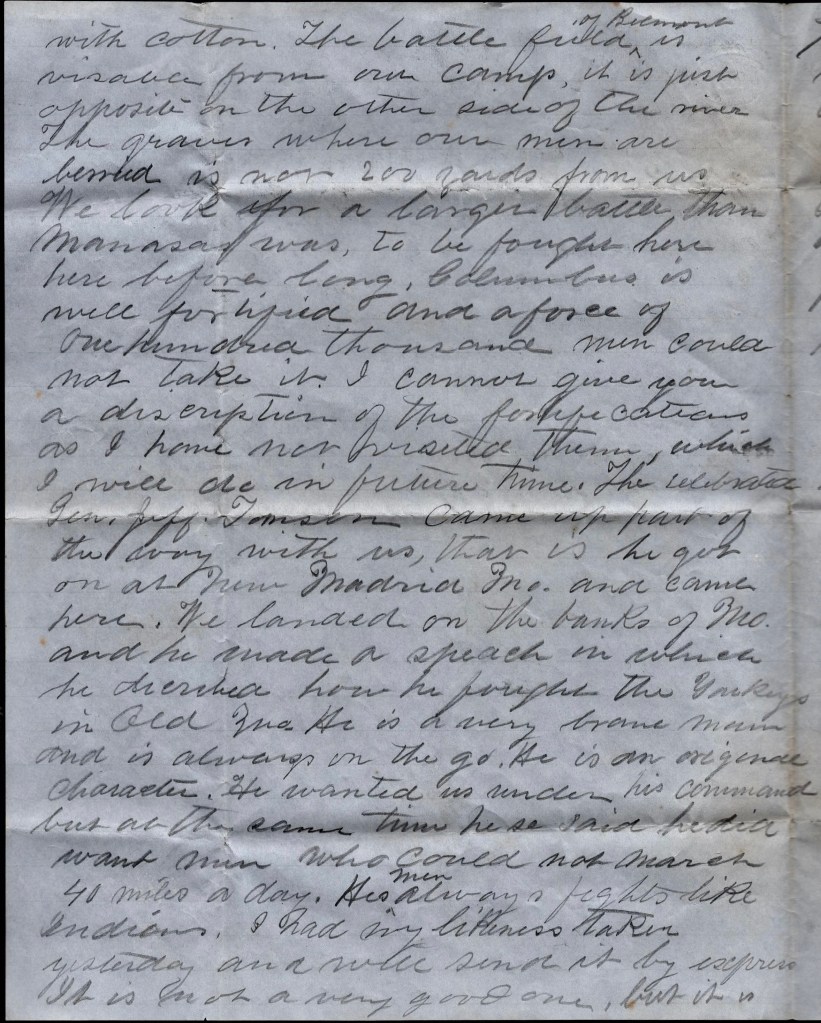
We had very cold weather on our way but weather is very pleasant here. It was beautiful to see the river banks covered with snow and the fields white with cotton.
The battlefield of Belmont is visible from our camp. It is just opposite on the other side of the river. The graves where our men are buried is not 200 yards from us. We look for a larger battle than Manassas was to be fought here before long. Columbus is well fortified and a force of one hundred thousand men could not take it. I cannot give you a description of the fortifications as I have not visited them, which I will do in future time.

The celebrated Gen. [Meriwether] Jeff T[h]om[p]son came up part of the way with us—that is, he got on at New Madrid, Mo., and came here. We landed on the banks of Missouri and he made a speech in which he described how he fougfht the Yankees in Old Mo. He is a very brave man and is always on the go. He is an original character. He wanted us under his command but at the same time he said he did [not] want men who could not march 40 miles a day. His men always fights like Indians.
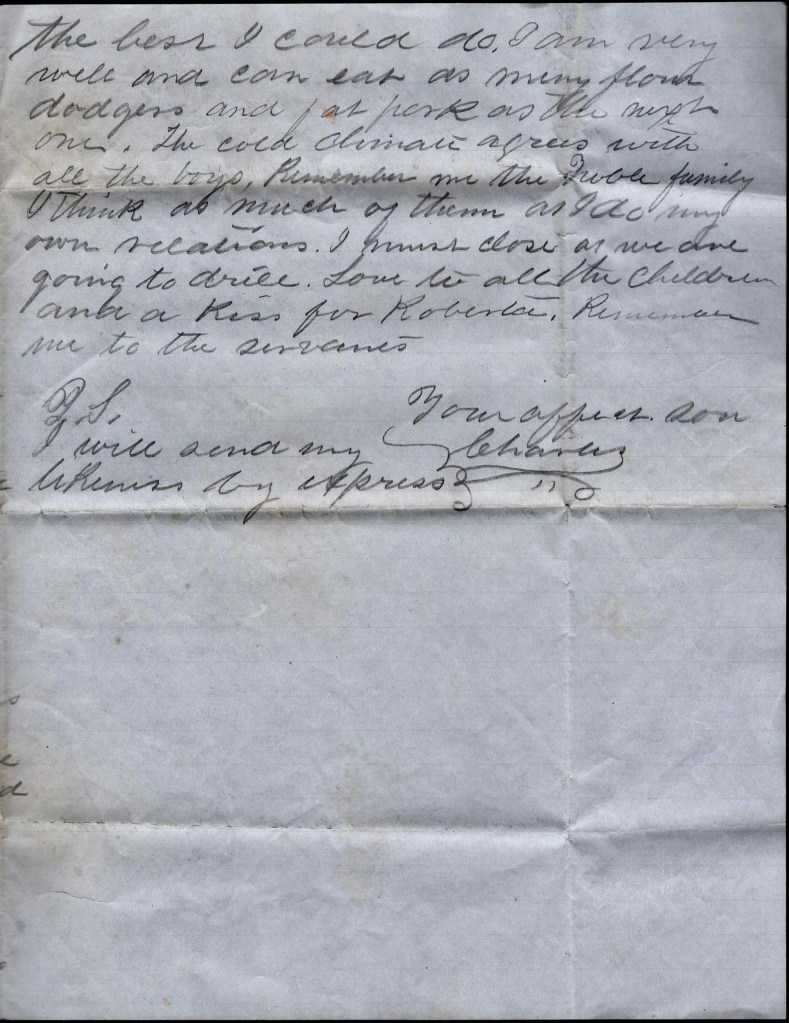
I had my likeness taken yesterday and will send it by express. It is not a very good one, but it is the best I could do. I am very well and can eat as many flour dodgers and fat pork as the next one. The cold climate agrees with all the boys. Remember me [to] the Noble family. I think as much of them as I do my own relations. I must close as we are going to drill. Love to all the children and a kiss for Roberta. Remember me to the servants.
Your affectionate son, — Charles
P. S. I will send my likeness by express.

 Spared & Shared 23