
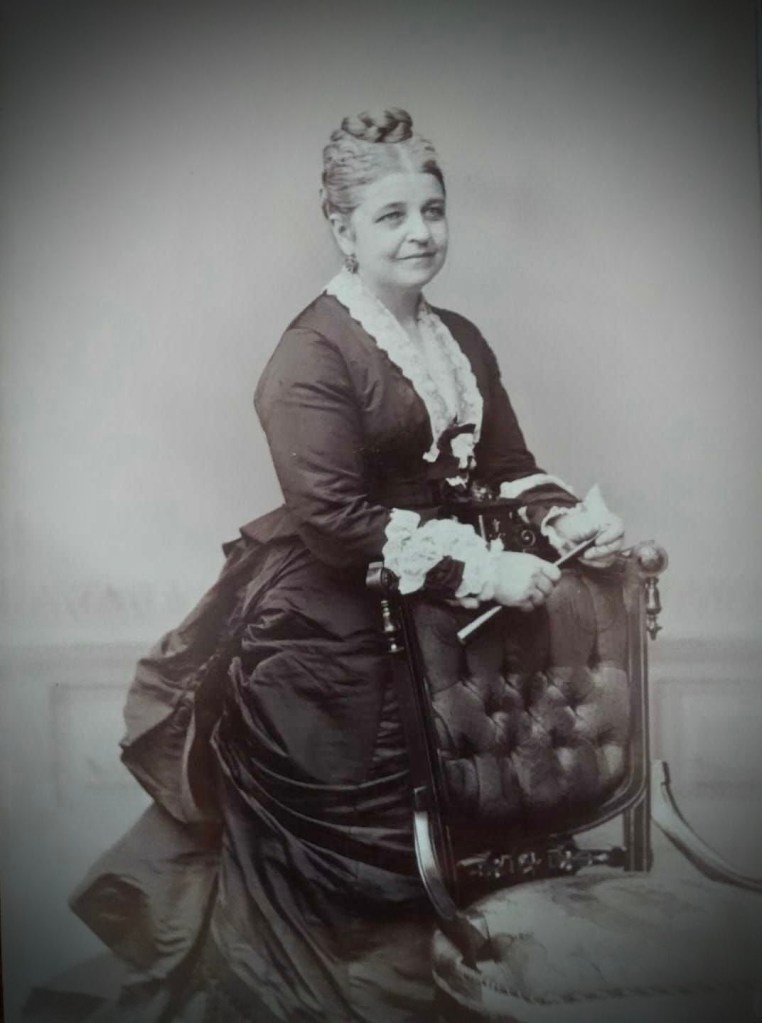
The following letter was written by Isabella (Batchelder) James (1819-1901), the daughter of cotton manufacturer Samuel Batchelder, Jr. (1784-1879) and Mary Montgomery (1790-1869) of New Ipswich, New Hampshire. Isabella married botanist and wholesale druggist Thomas Potts James (1803-1882) in December 1851. She became an outspoken abolitionist, and during the Civil War she offered her house in Philadelphia as a hospital to Massachusetts volunteers and worked in the hospitals and as laborer in the Sanitary Commission. At the Great Centennial Fair in Philadelphia in 1864, she was the head of the Department of Relics and Curiosities which raised money for wounded soldiers. It was during the gathering of these relics that she wrote the following letter in May 1864.
After the war, Isabella became the head of the Women’s Freedman’s Commission which sponsored teachers in the South.
Isabella wrote the letter to Benson J. Lossing (1813-1891), an engraver who “focused on creating pictorial histories that recorded history through firsthand accounts and drawings of people, artifacts, and the actual locations where the events occurred. In 1847, he began publishing works of history and biography, creating his own illustrations. Eventually, Lossing established a publishing company and oversaw authorship of all aspects – texts, sketches, and engravings. Among the most popular were his Pictorial Field-Book of the American Revolution and Pictorial Field-Book of the War of 1812. According to Gregory Pfitzer, in Picturing the Past: Illustrated Histories and the American Imagination, 1840 – 1900, Lossing’s specialty, field books, were “illustrated travelogues based on visits to scenes of historical importance.” In this genre, Lossing functioned as both historical observer and artistic interpreter. For Pictorial Field Book of the American Revolution (1850 to 1852), Lossing traveled more than 8,000 miles in the United States and Canada, collecting information and sketching scenes that he later made into wood block engravings. Published by Harper and Brothers, the field book sold tens of thousands of copies. Twenty-five years later, Publisher’s Weekly deemed the two-volume set remained the most “salable” work on the subject of the American Revolution.
During the next thirty-five years, Lossing worked tirelessly, publishing more than forty titles, of which he was either author or editor. From 1872 to 1874, Lossing edited the American Historical Record and Repertory of Notes and Queries. ”
To read about the fair, see The Great Central Fair for the U. S. Sanitary Commission.
Transcription
400 South 9th Street
Philadelphia [Pennsylvania]
May 4th 1864
Mr. Lossing
Dear Sir,
I received your letter & the parcel of engavings yesterday for which accept my thanks. Some of them will I think be of use. Lawson & Nicholson, the celebrated bookbinders here, are preparing the album under my direction. Lawson inlays most exquisitely & has already done the border of Sinclair’s coat of arms of the Washington’s family on a fresh white sheet for a title page, on which a gentleman friend will illuminate the lettering. Another set of the emblazoned arms will be bound in the volume.

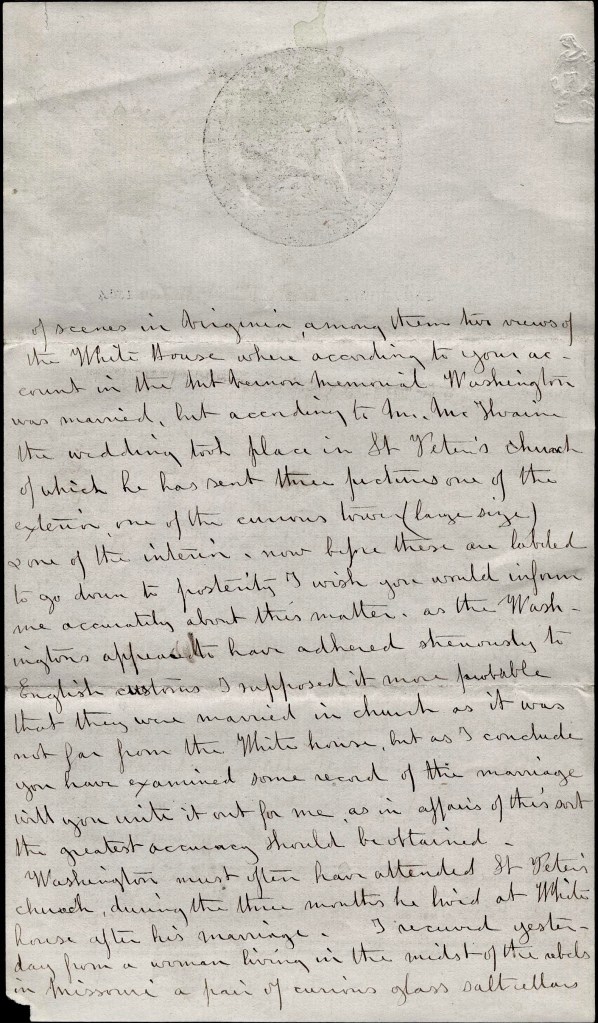
I have been fortunate in securing many fine Washington engravings from F[erdinand] J. Dreer, T. A. McAllister, Kline & others. Wm. McIlvaine, the artist, has painted thirteen beautiful water color sketches of scenes in Virginia, among them two views of the White House where according to your account in the Mt. Vernon Memorial, Washington was married, but according to Mr. McIlvaine, the wedding took place in St. Peters church of which he was sent three pictures—one of the exterior, one of the curious town (large size) and one of the interior. Now before these are labeled to go down to posterity, I wish you would inform me accurately about this matter as the Washington’s appear to a have adhered strenuously to English customs. I supposed it more probable that they were married in church as it was not far from the White house, but as I conclude you have examined some second record of the marriage, will you write it out for me, as in affairs of this sort the accuracy should be obtained. Washington must often have attended St. Peters church during the three months he lived at White house after his marriage.

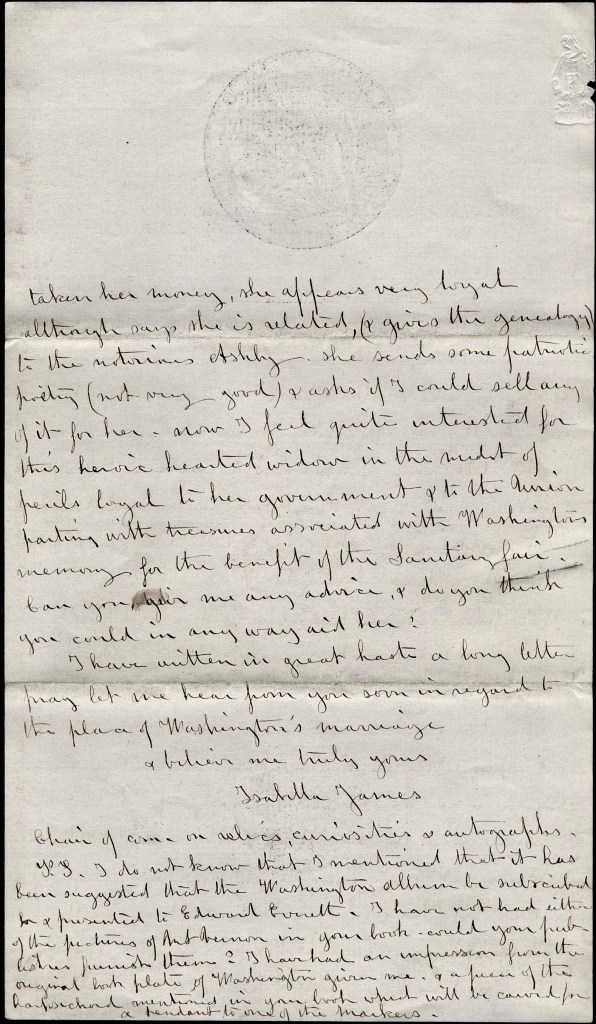
I received yesterday from a woman living in the midst of the rebels in Missouri a pair of curious glass salt cellars which she writes were presented to her grandmother on the occasion of her marriage in 1788, by Gen. Washington. I have no doubt they are from the manufactory of Ameburg mentioned in the 190# page of your Mt. Vernon. They are of heavy white glass, the bottom of an emerald green with gilding. As they are for sale, what do you think they should bring at the Fair? This poor woman has also sent a bed bed quilt pieced by her great grandmother at the house of Washington’s mother in 1777 [made] out of Mary & Martha Washington’s dresses & George Washington’s shirts. It bears intrinsic marks of authenticity. This woman—Mrs. Elizabeth Fray 1 of Philadelphia, Missouri, is in the midst of Rebels & has had her children taken from her by her Rebel neighbors. She thinks if she could get money to go to the commanding officer of the district, she could obtain justice, but is too poor, for the Rebels have taken her money. She appears very loyal although says she is related (and gives the genealogy) to the notorious [Turner] Ashby. She sends some patriotic poetry (not very good) & asks if I could sell any of it for her. Now I feel quite interested for this heroic-hearted widow in the midst of perils loyal to her government & to the Union parting with treasures associated with Washington’s memory for the benefit of the Sanitary Fair. Can you give me any advice & do you think you could in any way aid her?
I have written in great haste a long letter. Pray let me hear from you soon in regard to the place of Washington’s marriage. And believe me truly yours, — Isabella James
Chair of Committee on relics, curiosities, and autographs.
P. S. I do not know that I mentioned that it has been suggested that the Washington album be subscribed & presented to Edward Everett. 2 I have not had either of the pictures of Mt. Vernon in your book. Could your publisher furnish them? I have had an impression from the original book place of Washington given me & a piece of the harpsichord mentioned in your book which will be carved a pendant to one of the markers.
1 Elizabeth Huldah (Hopwood) Fray appears in the 1860 US Census in Philadelphia, Marion county, Missouri, as a 42 year-old seamstress. She was married in Marion county to Reuben Fray in March 1852. In the 1890 Veterans Schedules, Elizabeth identified her deceased husband as having served as a Marine during the Civil War but she could not remember the name of the vessel he served on nor the dates (the recorder annotated her entry by saying, “I don’t believe her statement.”) A genealogical record gives her parents as James E. and Harriett Hopwood of Virginia.
2 It appears that the “Washington Album” was presented to Edward Everett in June 1864 for his work helping to preserve Mount Vernon.


 Spared & Shared 23