

This letter was written by Eugene Oscar Fechet (1846-1925), the son of Alfred Edmont Fechét (1817-1869) and Mary de Garmo Buel (1823-1905). At the start of the Civil War, Eugene’s father raised a unit that became Battery B, 1st Michigan Light Artillery. Eugene enlisted as a Corporal in the unit on 10 September 1861; his regiment departed to St. Louis, Missouri on 17 December 1861. Battery B performed duties in the District of West Tennessee till March 1862 until it was attached to General Stephen A. Hurlbut’s 4th Division, Grant’s Army of the Tennessee to April, 1862. The Regiment moved to Pittsburg Landing, Tenn. During the Battle of Shiloh on 6–7 April, the Battery was heavily engaged at the south end of Sarah Bell’s peach orchard and later at Wicker Field where they were surrounded and captured at about 5:30 p.m. by the 1st Mississippi Cavalry. Five of the six cannons were claimed by the Confederates and Eugene was one of the artillerists taken prisoner on April 6, 1862. The prisoners were later exchanged in November 1862.
From this letter we learn that Eugene was promoted to Sergeant prior to the Battle of Shiloh. He reenlisted in a Veteran Volunteer Regiment as a First Sergeant on 23 December 1863 until he was discharged on 10 April 1864 to attend the United States Military Academy at West Point (Class of 1868).
Though Eugene states he was in the “2nd Michigan Battery,” he was actually in Captain William H. Ross’ Battery B (or “Second Battery”), 1st Michigan Light Artillery
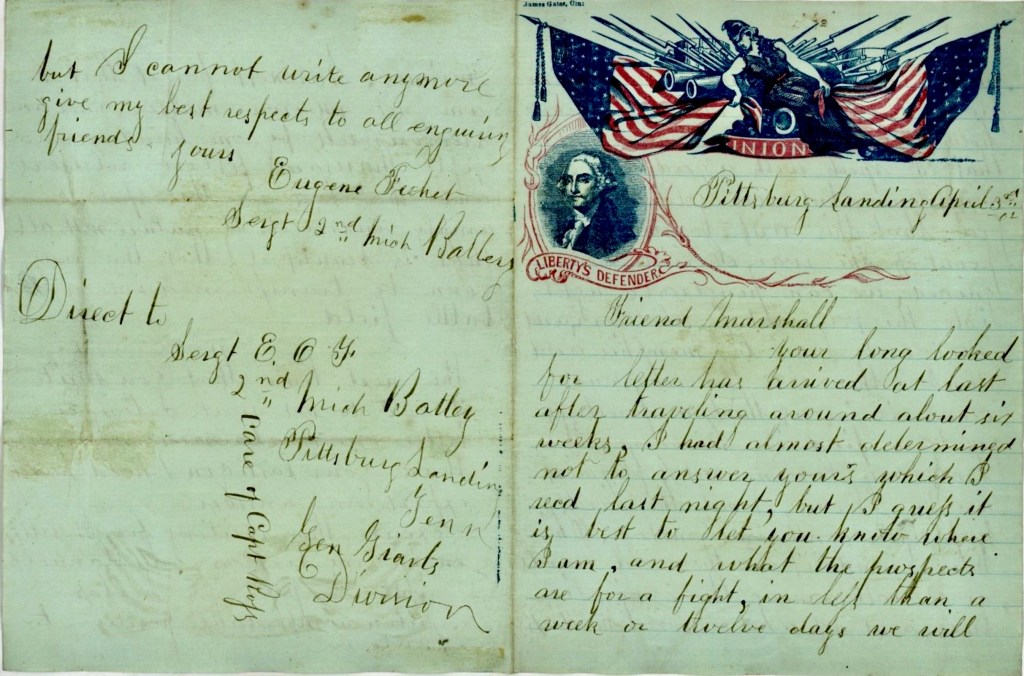
Transcription
Pittsburg Landing
April 3rd 1862
Friend Marshall,
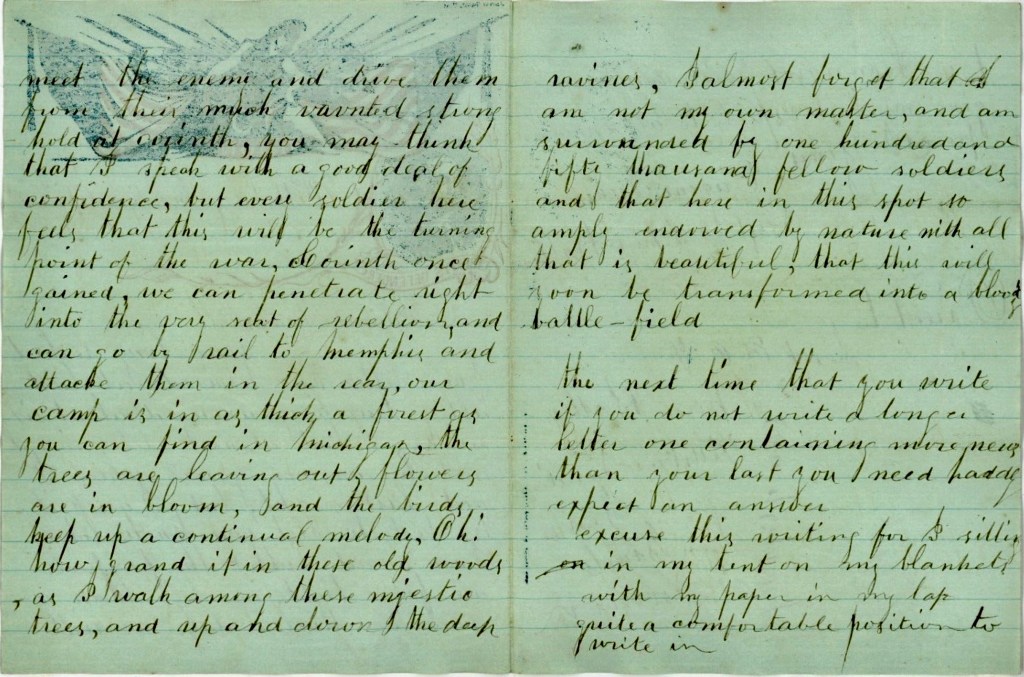
Your long looked for letter has arrived at last after traveling around about six weeks. I had almost determined not to answer yours which I received last night, but I guess it is best to let you know where I am, and what the prospects are for a fight. In less than a week or twelve days we will meet the enemy and drive them from their much vaunted stronghold at Corinth. You may think that I speak with a good deal of confidence, but every soldier here feels that this will be the turning point of the war. Corinth once gained, we can penetrate right into the very seat of rebellion, and can go by rail to Memphis and attack them in the rear.
Our camp is in as thick a forest as you can find in Michigan. The trees are leaving out, flowers are in bloom, and the birds keep up a continual melody. Oh! how grand it is in these old woods as I walk among these majestic trees and up and down the deep ravines. I almost forget that I am not my own master, and am surrounded by one hundred and fifty thousand fellow soldiers, and that here in this spot so amply endowed by nature with all that is beautiful, that this will soon be transformed into a bloody battlefield.
The next time that you write, if you do not write a longer letter—one containing more news than your last, you need hardly expect an answer. Excuse this writing for I [am] sitting in my tent on my blanket with my paper in my lap. Quite a comfortable position to write in. But I cannot write anymore. Give my best respects to all enquiring friends. Yours, — Eugene Fechet, Sergt. 2nd Michigan Battery
Direct to Sergt. E. O. F., 2nd Michigan Battery, Pittsburg Landing, Tennessee, General Grant’s Division. Care of Capt. [William H.] Ross
 Spared & Shared 23