

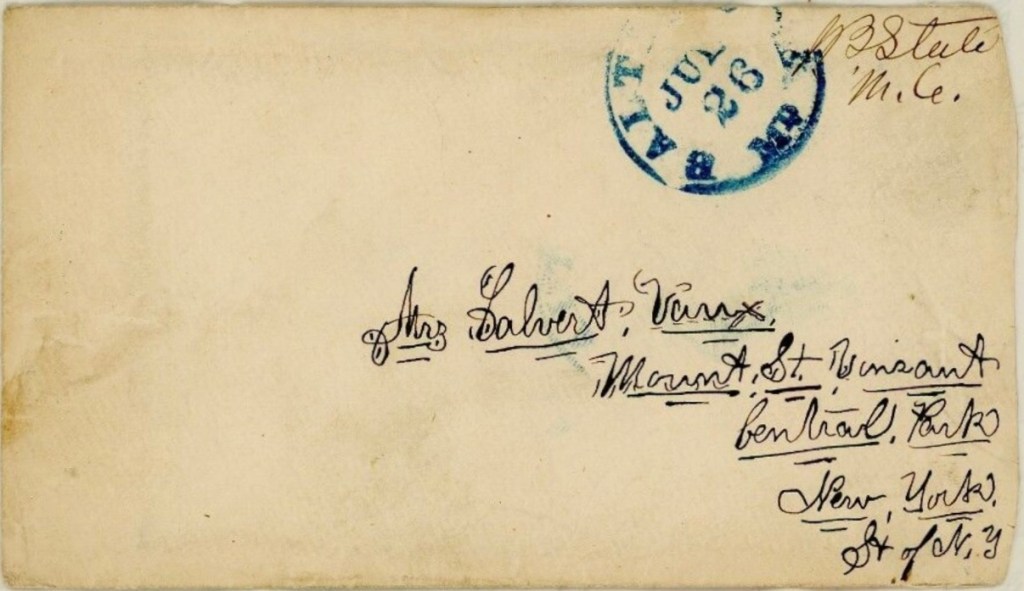
The following letter was written by Gerard Lindsley McEntee (1847-1913), the son of James Smith McEntee (1800-1887) and Sarah Jane Goetchius (1805-1883) of Kingston, Ulster county, New York. Gerard had several notable siblings—Jervis McEntee (1828-1891), a Hudson River School Landscape Artist; Mary Swan McEntee (1830-1892), the wife of Calvert Vaux, Landscape architect of NYC who worked with Frederick Law Olmstead in the design of NYC’s Central Park; Lt. Maurice Wurts McEntee (1836-1883), 20th NY State Militia, and later Acting Master in US Navy.
When he was only 13 years old, Gerard signed on as a drummer boy in Co. F of the 20th New York State Militia for three months. This was the same unit that his brother Maurice was in. This unit served from 23 April 1861 to 2 August 1861. Gerard’s letter was written just 10 days after the Battle of Bull Run—referred to as the “sad news” within the letter.
Transcription
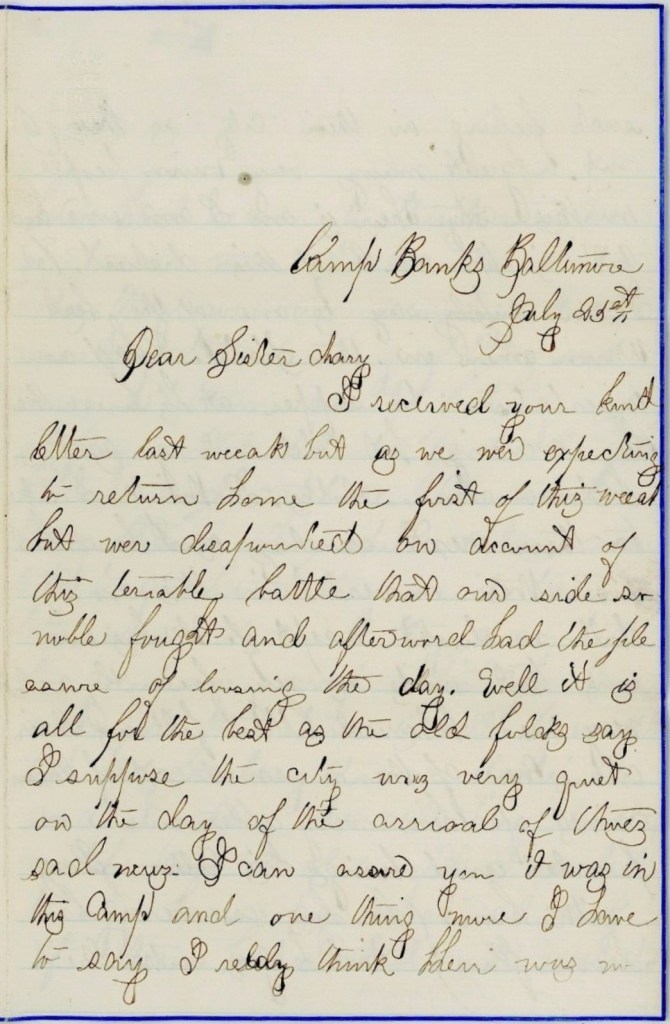
Camp Banks
Baltimore, [Maryland]
July 31st [1861]
Dear Sister Mary,
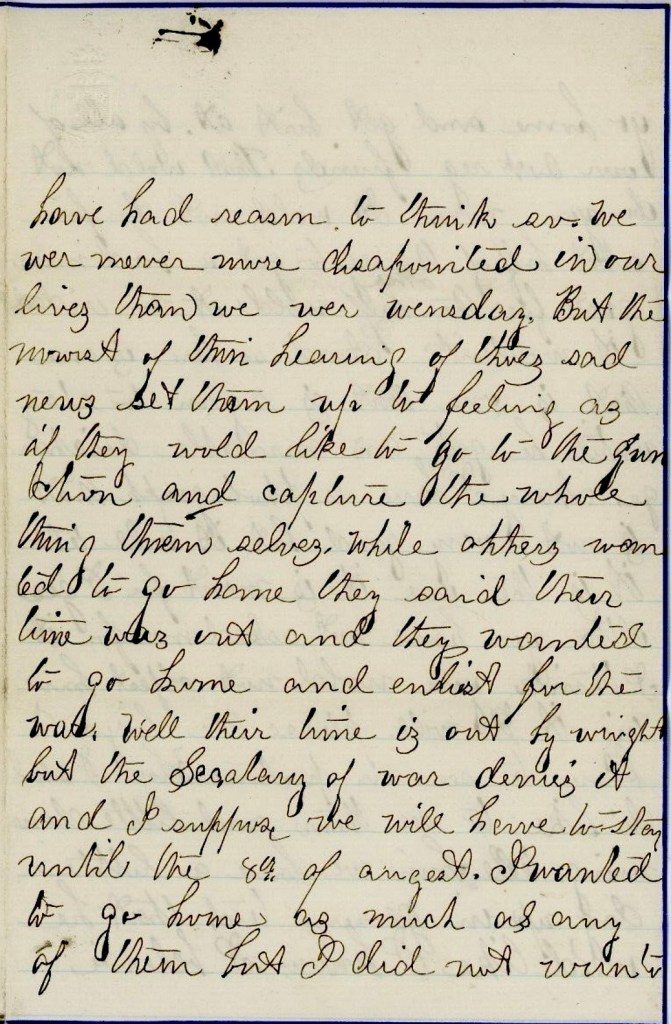
I received your kind letter last week but as we were expecting to return home the first of this week, but were disappointed on account of this terrible battle that our side so noble fought and afterward had the pleasure of losing the day. Well, it is all for the best as the old folks say, I suppose. The city was very quiet on the day of the arrival of the sad news, I can assure you. I was in the camp and one thing more I have to say, I really think there was no [page missing]….have had reason to think so. We were never more disappointed in our lives than we were Wednesday. But the worst of them, hearing of this sad news, set them up to feeling as if they would like to go to the [Manassas] Junction and capture the whole thing themselves while others wanted to go home. They said their time was out and they wanted to go home and enlist for the war. Well their time is out by right but the Secretary of War denies it and I suppose ew will have to stay until the 8th of August.

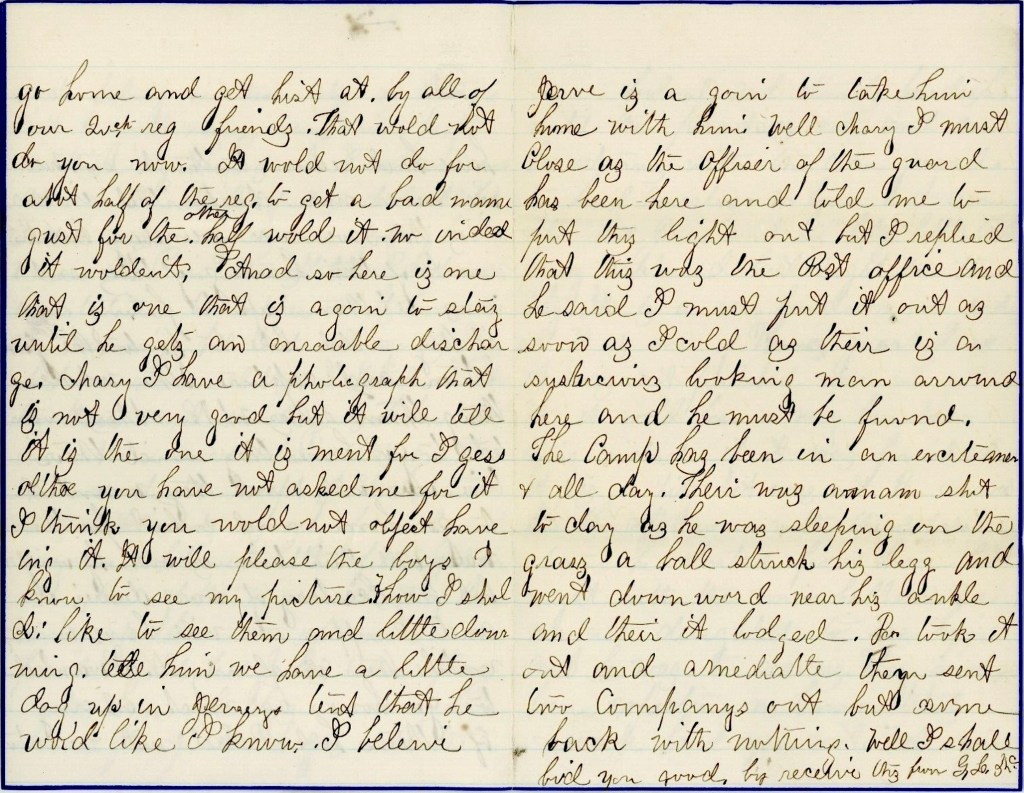
I wanted to go home as much as any of them but I did not want to go home and get hissed at by all of our 20th Regiment friends. That would not do, you know. It would not do for about half of the regiment to get a bad name just for the other half, would it? No indeed it wouldn’t. And so here is one that is a goin’ to stay until he gets an honorable discharge.
Mary, I have a photograph that is not very good but it will tell. It is the one it is meant for I guess. Although you have not asked me for it, I think you would not object having it. It will please the boys, I know, to see my picture. How I should like to see them and little Downing. 1 Tell him we have a little dog up in Jervy’s tent that he would like, I know. I believe Jerve is a going to take him home with him.
Well Mary, I must close as the officer of the guard has been here and told me to put this light out but I replied that this was the Post Office and he said I must put it out as soon as I could as there is a suspicious looking man around here and he must be found.
The camp has been in an excitement all day. There was a man shot today as he was sleeping on the grass. A ball struck his leg and went downward near his ankle and there it lodged. Dr. took it out and immediately they sent two companies out but came back with nothing. Well I shall bid you goodbye. This from G. L. Mc.
1 Downing Vaux was born in 1857. Downing’s brother Calvin was a couple years older.
 Spared & Shared 23