
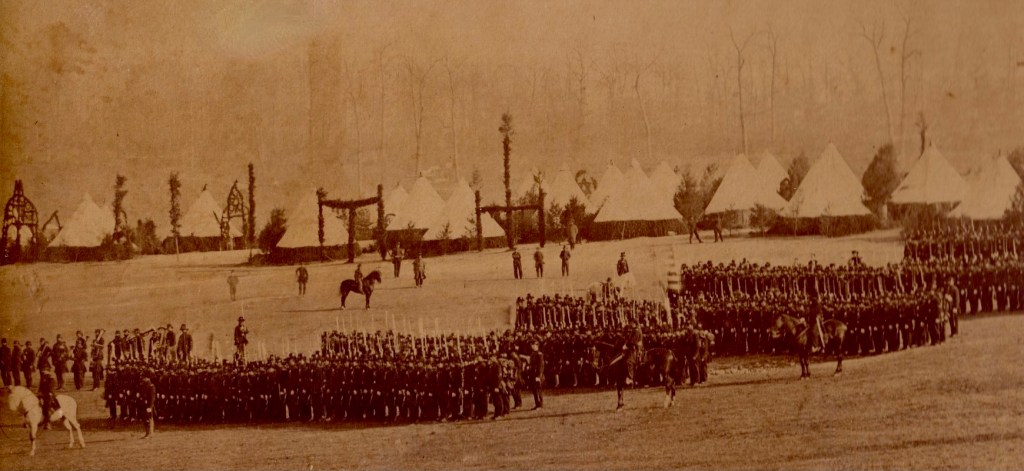
This letter was written by Andrew W. Perkins of Co. I, 17th New York Infantry. The 17th regiment — the “Westchester Chasseurs” — contained four companies from Westchester county, two from New York city, one from each of the counties of Rockland, Chenango, Wayne and Wyoming, and was mustered into the U. S. service at New York city, May 28, 1861, for a two years’ term. It went into camp at Camp Washington, Staten Island, until June 21, when it left for Washington and was stationed at Fort Ellsworth near Alexandria. With the 2nd brigade, 5th division, which was held in reserve, the regiment was present at Bull Run. In September it was posted at Fairfax seminary; in October was ordered to Hall’s hill, where it was assigned to Butterfield’s brigade, 1st division, 3d corps, and established permanent winter quarters.
Andrew was 35 years old when he enlisted on 10 May 1861 at Newark, Wayne county, New York. He was discharged for disability on 9 January 1862 after 8 months service. Andrew gave his residence as Sodus when he enlisted. Though it seems unlikely, since I was unable to find any record of Andrew after the Civil War, he may have been the same Andrew W. Perkins (same age) who enlisted on 1 March 1862 to serve in Co. A of the 11th Regular Army. This Andrew was later transferred to Co. E and during the fighting at Laurel Hill on 8 May 1864, was severely wounded. His left leg was amputated in an attempt to save his life but he died on 1 June 1864.
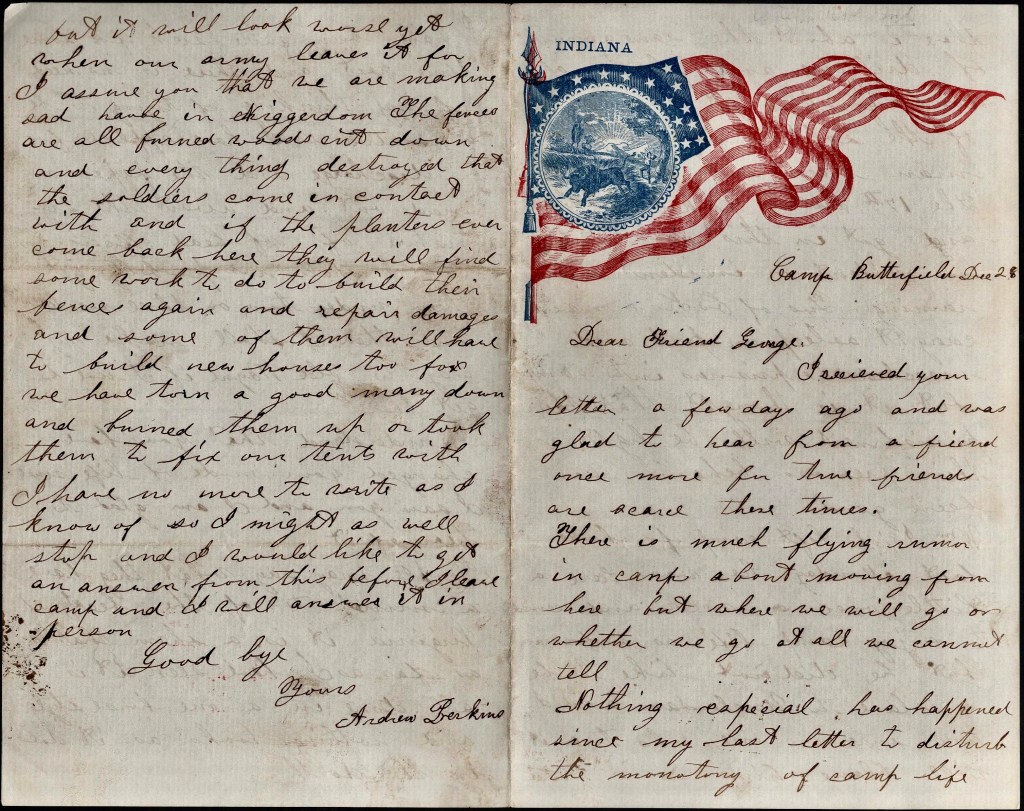
Note: Andrew’s letter was written on patriotic Indiana Stationery but of course had nothing to do with the State of Indiana.
Transcription
Camp Butterfield [Hall’s Hill, Virginia]
December 28 [1861]
Dear Friend George,
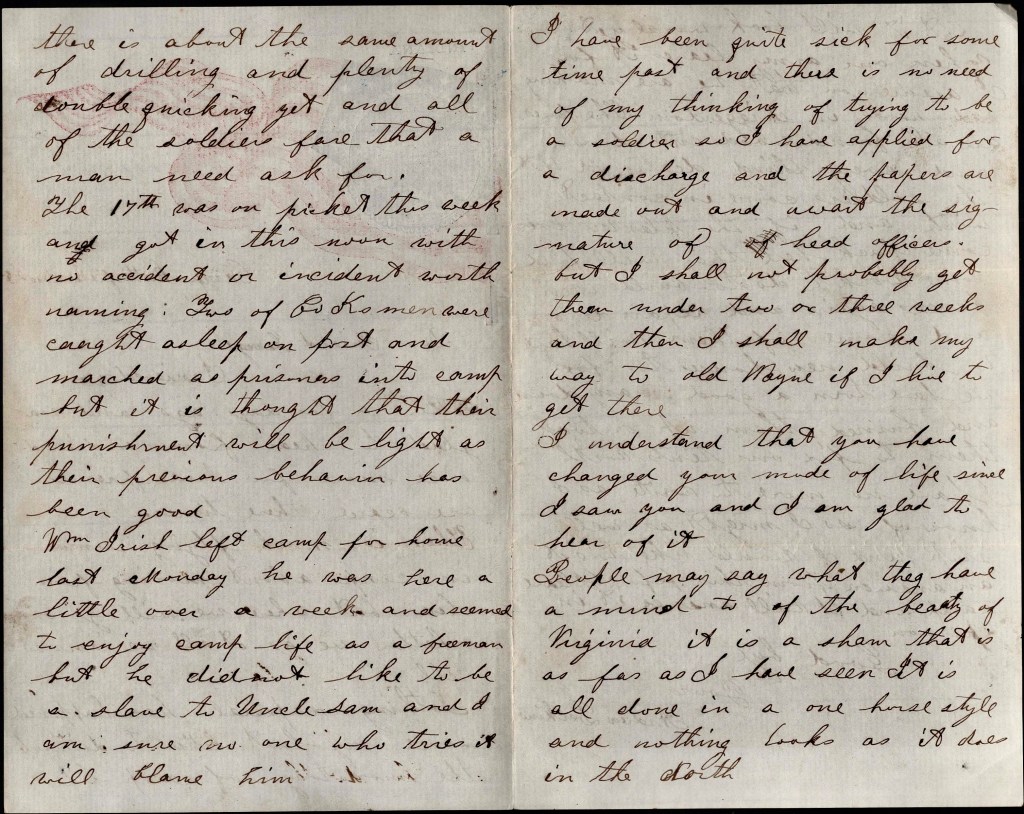
I received your letter a few days ago and was glad to hear from a friend once more for true friends are scarce these times. there is much flying rumor in camp about moving from here but where we will go or whether we go at all we cannot tell. Nothing especial has happened since my last letter to disturb the monotony of camp life. There is about the same amount of drilling and plenty of double quicking yet and all of the soldiers fare that a man need ask for.
The 17th was on picket this week and got in this noon with no accident or incident worth naming. Two of Co. K’s men were caught asleep on post and marched as prisoners into camp but it is thought that their punishment will be light as their previous behavior has been good.
William Irish left camp for home last Monday. He was here a little over a week and seemed to enjoy camp life as a free man but he did not like to be a slave to Uncle Sam and I am sure no one who tries it will blame him.
I have been quite sick for some time past and there is no need of my thinking of trying to be a soldier so I have applied for a discharge and the papers are made out and await the signature of head officers but I shall not probably get them under two or three weeks and then I shall make my way to Old Wayne if I live to get there.
I understand that you have changed your mode of life since I saw you and I am glad to hear of it.
People may say what they have a mind to of the beauty of Virginia. It is a sham—that is, as far as I have seen. It is all done in a one-horse style and nothing looks as it does in the North. But it will look worse yet when our army leaves it for I assure you that we are making sad havoc in Niggerdom. The fences are all burned, woods cut down, and everything destroyed that the soldiers come in contact with. And if the planters ever come back here, they will find some work to do to build their fences again and repair damages and some of them will have to build new houses too for we have torn a good many down and burned them up or took them to fix our tents with.
I have no more to write as I know of so I might as well stop and I would like to get an answer from this before I leave camp and I will answer it in person. Goodbye. Yours, — Andrew Perkins
 Spared & Shared 23