
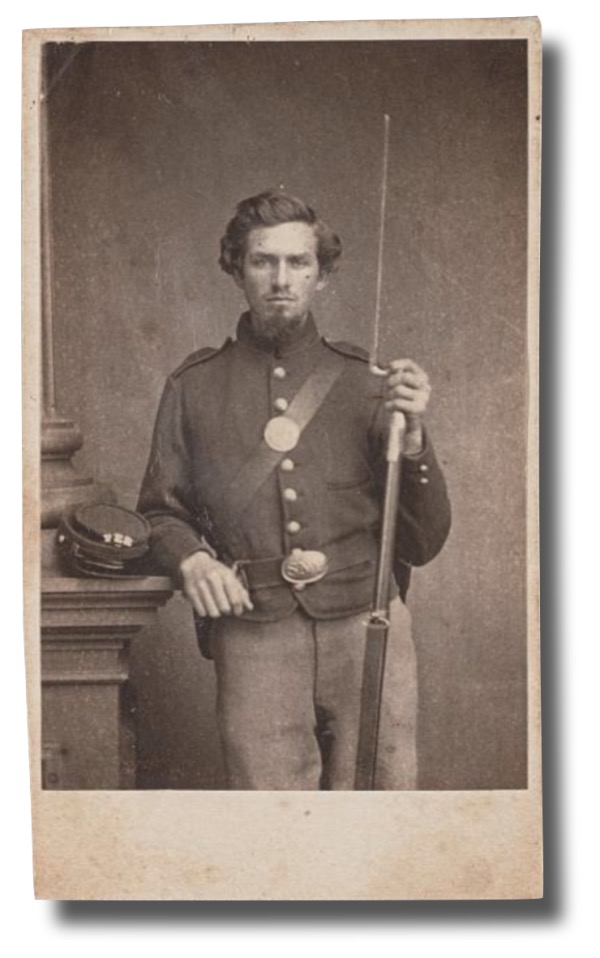
The following letter was written by William Eckerson, Jr. (1835-1864), the son of William Eckerson (1803-Aft1860) and Jeanette Miller (1818-1891) of Seward, Schoharie county, New York.
William enlisted as a private in Co. I, 44th New York Infantry in October 1861. During the 2nd Battle of Bull Run, William was taken prisoner on 30 August 1862. The date of his exchange is not given but later, during Grant’s Overland Campaign in 1864, after fighting at Cold Harbor, William was posted on picket on the night of 3 June and was killed instantly by a sniper’s bullet about 9 o’clock. He was buried on the battlefield by his comrades.
To read other letters I’ve transcribed by members of 44th New York Infantry and published on Spared & Shared, see:
Louis Ferrand, Co. A, 44th New York (1 Letter)
Louis Ferrand, Co. A, 44th New York (1 Letter)
Julian Knowlton, Co. A, 44th New York (1 Letter)
John Gurnsy Vanderzee, Co. A, 44th New York (1 Letter)
John T. Johnson, Co. C, 44th New York (2 Letters)
John H. Lewis, Co. D, 44th New York (1 Letter)
Peter Mersereau, Co. E, 44th New York (1 Letter)
Charles Robinson French, Co. E, 44th New York (1 Letter)
Anthony G. Graves, Co. F, G, H, 44th New York (38 Letters)
Isaac Bevier, Co. E., 44th New York (2 Letters)
Albert Nathaniel Husted, Co. E, 44th New York (1 Letter)
Wilber H. Merrill, Co. H, 44th New York (5 Letters)
Samuel R. Green, Co. I, 44th New York (6 Letters)
George W. Arnold, Co. K. 44th New York (1 Letter)
Transcription

44th New York Volunteers
Camp before Yorktown, Va.
April 26th 1862
Dear Cousin,
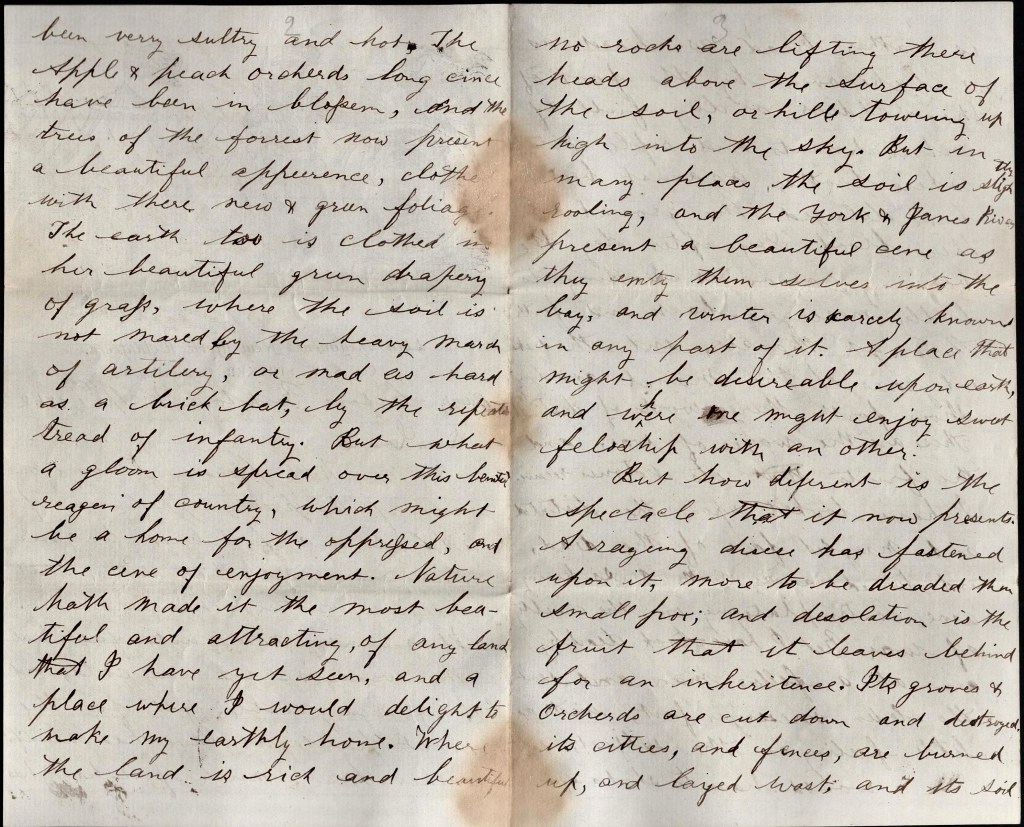
With pleasure I avail myself of the present opportunity of addressing a few lines to you, this being the third letter that I have written this morning. It is raining now quite fast and the wind is east and cold and very disagreeable. Yet for the most part, we have had beautiful weather here, much of which has been very sultry and hot. The apple and peach orchards long since have been in blossom and the trees of the forrest now present a beautiful appearance, clothed with their new and green foliage. The earth too is clothed in her beautiful green drapery of grass where the soil is not marred by the heavy march of artillery or made as hard as a brick bat by the repeated tread of infantry. But what a gloom is spread over this beautiful region of country which might be a home for the oppressed and the scene of enjoyment. Nature hath made it the most beautiful and attracting of any land that I have yet seen, and a place where I would delight to make my earthly home where the land is rich and beautiful. No rocks are lifting their heads above the surface of the soil or hill towering up high into the sky, but in many places the soil is slightly rolling and the York and James rivers present a beautiful scene as they empty themselves into the bays and winter is scarcely known in any part of iy—a place that might be desirable upon earth and where one might enjoy sweet fellowship with another.
But how different is the spectacle that it now presents. A raging disease has fastened upon it, more to be dreaded than small pox; and desolation is the fruit that it leaves behind for an inheritance. Its groves and orchards are cut down and destroyed, it cities and fences are burned up and laid waste; and its soil is either tread as hard as a bake oven by the foot of the soldier or dug full of entrenchments and rifle pits, where brother against brother have deluged the ground with their blood. Day after day the booming cannon is sending its deadly messengers back and forth through the air, and the shrieks and groans of the maimed and dying show forth their work of destruction. These are the wages of war, and the fruits that its victories receive.
I have looked upon the distorted and mangled face of the dead and turned away with a sickening awe, contemplating on the cruelty of war. Yet I have took deadly aim at a fellow man and sent the leaden messenger forth with as little feeling on the subject as one would have to shoot a squirrel. I have stood before the rattle of an enemy’s musketry and faced the mouth of the blazing cannon, when the bombs have burst and the pieces flew all around me, and the bullets whizzed past my head like hail, yet I felt nearly as secure from their harms as you do perhaps in your own peaceful dwellings. Yet when I have been alone and though on these things, I have wondered how it could be that one should be so fearless in the face of danger, and composed as it were right in the arms of the Angel of Death. Yet when I remember that God takes care of his creatures and that those that put trust in Him shall not be confounded, then I see how it is that a man can be fearless in the midst of danger, when the shafts of death are thrown around him.
I learned a few days ago that Emory A. Shaffer was dead! You can imagine the shock when the words fell on my ear. Thinks I, how can that be? Emra dead?! When we left Albany, none bid more fair to go through the war than he & I trusted that we should share the perils of war together, and one at least be left to tell the story over when the war should come to a close. Yet he has gone and that by the hand of disease, before he had a chance to fight his country’s battles, and I am left to go without him. He was a soldier beloved and respected as a man, and we trust that he has found a home in heaven—that land of peace where the weary are at rest. So dry your tears and live to meet him & dear old Aunt Rebecca in that better and heavenly land. We too must pass the chilling river, and perhaps it will be my lot very soon. Yet I shall rejoice in the hope of the glory of God. Be of good cheer for heavenly mansions await those that love our Lord, and He will comfort those that put their trust in Him. Were it not for this consolation, my life would be a dreary one, exposed daily to the shafts of the enemy.
I have seen many rough and tedious marches since we left Halls Hill and traveled many a day like this in the rain and mud. I have traveled over the fields of Centerville & Bulls Run, saw the smoke of Manassas as the rebels retreated from it and many other things which it would take me too long to narrate at this time, or merely hint at, for it would fill many sheets of paper. But I must skip over a long train of events till I come to the siege of Yorktown and then bring my letter to a close as I have already written more than I intended to when I commenced my first sheet. Yet I must write about a few things that happened though I shall have o commence on another sheet to get it all on.
While walking about the forts at Centerville, I saw a big log in one of the holes pointing to the place in which we came in, and made to represent a large cannon at a distance. Supposing perhaps that our artillery would fire at it and so waste their shots for naught before finding out the mistake. But it so happened that they marched right up into Centerville without firing a gun, and took some secesh prisoners who were unable to escape. They left us good quarters to go into which they in their haste to evacuate did not have time to destroy. The most sickening scene that I saw there was human skulls laying ever since the Bulls Run battle.
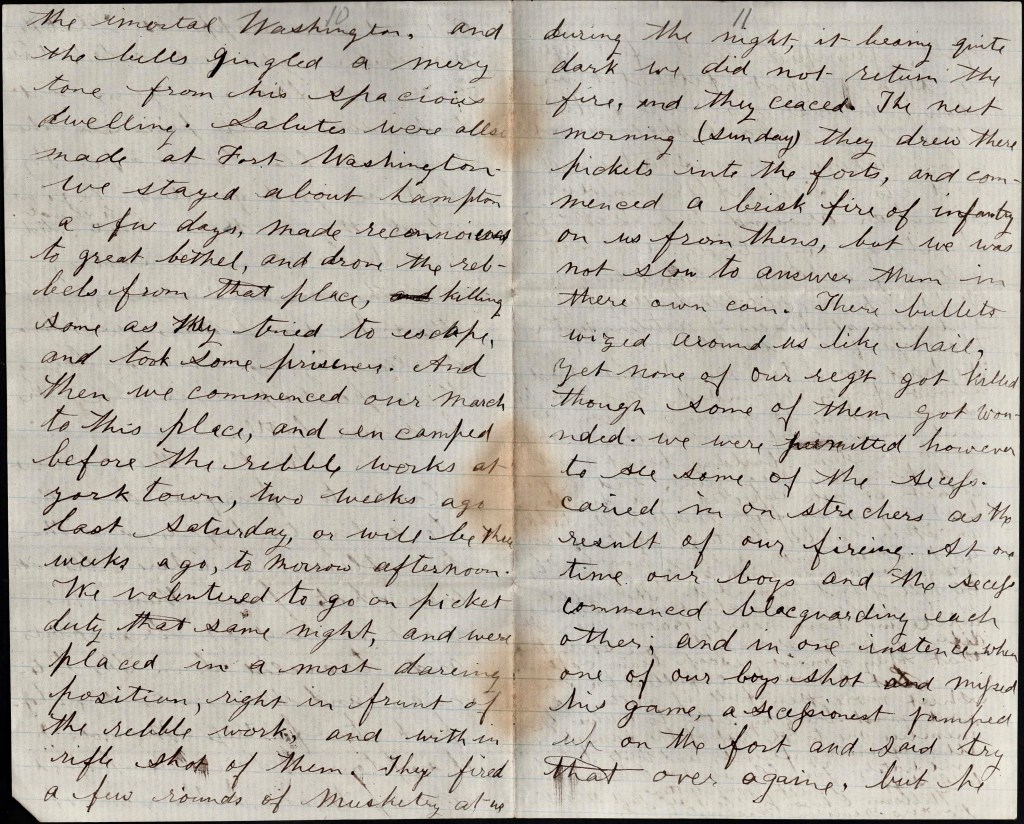
We then went back to Fairfax and then to Arlington Heights and then to Alexandria where Ellsworth was shot. From there we went on board of transports and traveled down the Potomac and then into the Chesapeake to Fortress Monroe & Hampton. When we passed Mount Vernon, I thought of the immortal Washington and the bells jingled a merry tone from his spacious dwelling. Salutes were also made at Fort Washington. We stayed about Hampton a few days, made reconnoissance’s to Great Bethel, and drove the rebels from that place, killing some as they tried to escape, and took some prisoners. And then we commenced our march to this place and encamped before the rebel works at Yorktown.
Two weeks ago last Saturday, or will be three weeks ago tomorrow afternoon, we volunteered to go on picket duty that same night and were placed in a most daring position, right in front of the rebel works and within rifle shot of them. They fired a few rounds of musketry at us during the night. It being quite dark, we did not return the fire and they ceased. The next morning (Sunday) they drew their pickets into the forts and commenced a brisk fire of infantry on us from them but we was not slow to answer them in their own coin. Their bullets whizzed around us like hail, yet none of our regiment got killed though some of them got wounded. We were permitted, however, to see some of the secesh carried in on stretchers as the result of the firing. At one time our boys and the secesh commenced blackguarding each other and in one instance when one of our boys shot and missed his game, a secessionist jumped up on the fort and said try that over again, but he fell, jumped and fell again. A second shot fetched him down to rise no more.
During this day, a bomb shell burst close where I was stationed and its missiles flew in every direction around me without hurting anybody. On Saturday all day a heavy cannonading was kept up, one rebel battery captured and several pieces of artillery with the loss of considerable many men. We had some ten men killed and about forty wounded. More or less skirmishing is going on every day and more or less men killed while we have been building breastworks and planting siege guns. And a grand attack is now expected in a few days. Last night the 5th Massachusetts Regt. took another rebel battery, captured some 40 prisoners with a large number of stands of arms, with a loss of about 50 killed and wounded. The rebels at this place are about 100,000 strong while we have nearly 180,000 men at different points around htem so we think they cannot escape being captured.
But I now have filled another sheet more than full and must bring my letter to a close. Remember me to the rest of the family & all enquiring friends and write to me immediately. Your cousin, –Wm. Eckerson, Jr. to C. Sheffer.
Direct your letters to William Eckerson, Jr., Co. I, 44th Regt. N. Y. V., Porter’s Division, Washington D. C.



 Spared & Shared 23