
The following letters were written by John W. McClain (1834-1863), a barely literate private in Co. E, 2nd Ohio Cavalry. He was the son of Edward McClain (1792-1857) and Flora Fish (1812-1887) of Trumbull county, Ohio. According to Find-A-Grave, John died of “sunstroke” on 9 August 1863 at Fort Scott, Kansas. John had two other brothers who died in the Civil War, Robert T. McClain (1841-1864) and Richard H. McClain (1843-1864).
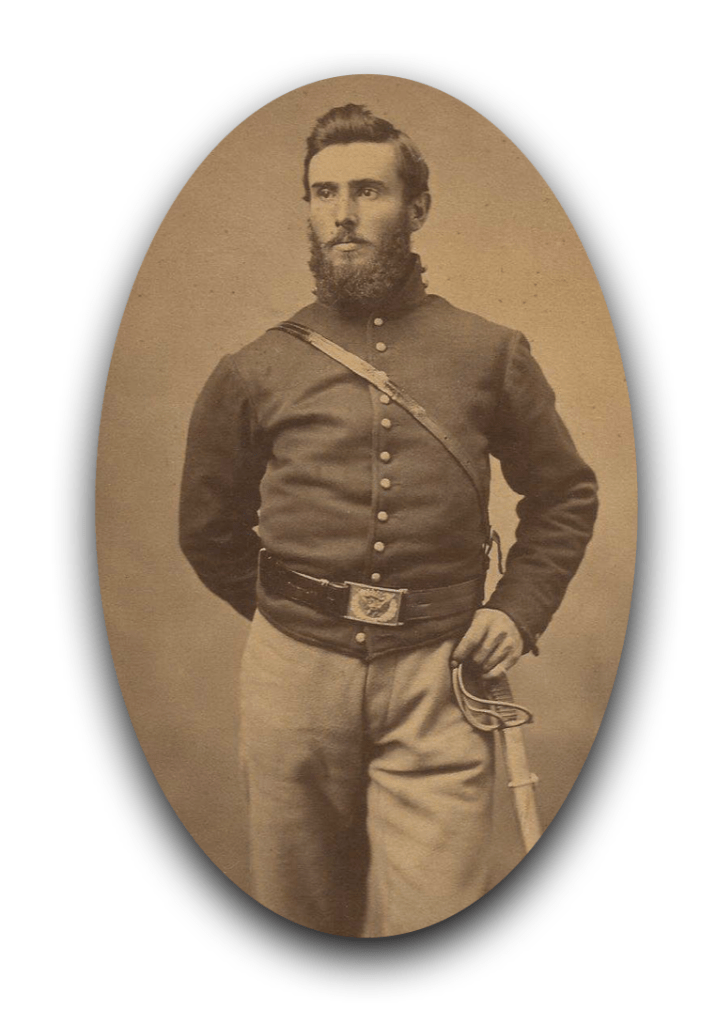
The soldiers of the 2nd Ohio Volunteer Cavalry Regiment came from Ashtabula, Columbiana, Cuyahoga, Geauga, Hamilton, Lake, Loraine, Mahoning, Medina, Portage, Richland (and neighboring counties), Summit, and Trumbull Counties. The 2nd O.V.C. was organized for three years’ service under Colonel Charles Doubleday, and afterwards commanded by Colonels Kautz, Nettleton, and Seward. Soldiers were mustered in from August to September of 1861 and trained at Camp Wade near Cleveland and Camp Dennison near Cincinnati. Nicknamed the “Wade and Hutchins Regiment” after Ohio Senators Ben Wade and John Hutchins who instigated the formation of the regiment, the 2nd O.V.C. moved to Missouri, scouting on the borders of Kansas, and in February 1862, drove the infamous bandit William Quantrill and his raiders from Independence, Missouri. In the summer, the 2nd O.V.C. served in Indian Territory, and in the fall joined General Blunt’s campaign in Arkansas and Missouri, fighting at Pea Ridge, Carthage, and other points. It moved to Kentucky, and four companies raided East Tennessee. It joined in the pursuit of Confederate General John Hunt Morgan and followed him twelve hundred miles until captured. In September, the Regiment again raided East Tennessee and operated on Longstreet’s flank at Knoxville, fighting continuously with severe loss. In April 1864, it was transferred to the Army of the Potomac with Ulysses S. Grant, and moved with Grant’s army towards Richmond, fighting with Sheridan’s Cavalry Corps around the flanks of the army. In August the Regiment moved to the Shenandoah Valley and engaged Early, fighting at Opequan, Front Royal, and Cedar Creek. In March 1865, it joined in the pursuit of Confederate General Robert E. Lee, and after the surrender was reviewed at Washington and mustered out September 11, 1865. The 2nd Ohio Volunteer Cavalry Regiment made one of the most brilliant records of any regiment in the service.
Letter 1

Fort Leavenworth
February 19, 1862
Dear brother,
I take this opportunity to inform you that I received your letter yesterday and was pleased to hear that you was all well and doing well for that is all that can be expected for that is my style every time. As I have wrote to you but a few days ago, I have but very little to write this time. All I have to write is that we are all well and doing well as we can. We arrived here last Saturday about three o’clock in the afternoon and found good quarters for our horses but none for ourselves until dark when we found a mess room where a company of Hunter’s bodyguards messed which was very comfortable for us. But perhaps it would not appear to be so to everyone as it would to us but we are now tented out in tents which are as handy as a pocket in a shirt. We have a stove in each tent which will keep them as warm as there is a need for. This is the coldest place ever I stuck my head in. The wind will cut a fellow’s throat if he should be compelled to face it.
We are waiting to get the orders to march but we know not where. We have been told by our officers that we was to move on to Fort Scott but we know not where we have to go but direct to this place and it will be all right. — J. W. McClain


Letter 2
Fort Leavenworth, [Kansas]
March 2, 1862
Dear friends,
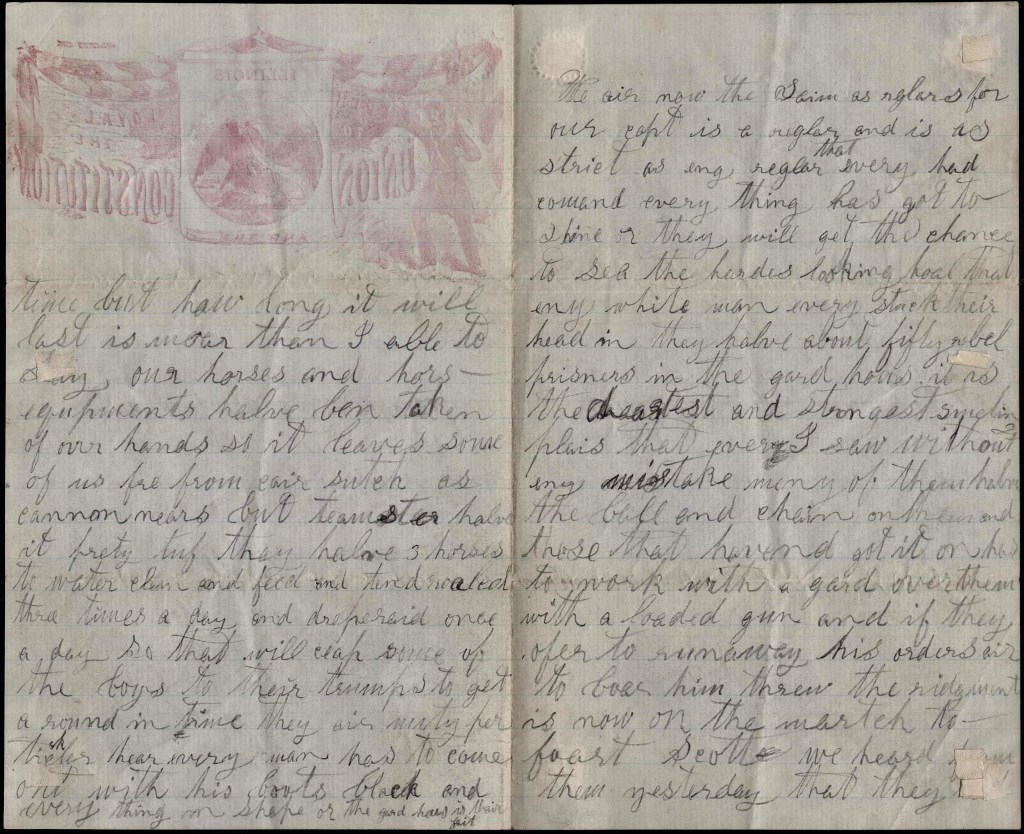
I take the opportunity to inform you that I am well and doing the best I can for the chance I have. I have changed my position since I last wrote to you. I suppose you have seen a detail made in the regiment to form a battery. There are twelve men taken from each company. We have the privilege to volunteer and if they couldn’t get volunteers in the Co., they should half to detail them. So rather than be detailed, I volunteered and we are quartered in nice barracks and are having a good time. But how long it will last is more than I [am] able to say. Our horses and horse equipments have been taken off our hands so it leaves some of us free from care, such as cannoneers, but teamsters have it pretty tough. They have three horses to water, clean and feed three times a day, attend roll three times a day, and dress parade once a day so that will keep some of the boys to their trumps to get around in time. They are mighty particular here. Every man has to come out with his boots black and everything in shape or the guard house is their fate.
The are now the same as regulars for our captain is a regular and is so strict as any regular that ever had command. Everything has got to shine or they will get the chance to see the hardest looking hole that any white man ever stuck their head in. They have about 50 rebel prisoners in the guard house. It is the dirtiest and strongest smellin’ place that ever I saw without any mistake. Many of them have the ball and chain on them and those that haven’t got it on has to work with a guard over them with a loaded gun and if they offer to runaway, his orders are to bore him through.
The regiment is now on the march to Fort Scott. We heard from them yesterday that they were in Kansas City last Thursday. This is all at present. I will send you a paper. Perhaps you would like to read one of the Kansas papers. When you write, direct to John W. McClain, Hollister Battery, Fort Leavenworth, Kansas

 Spared & Shared 23