
This letter was written by a member of the 11th Massachusetts Independent Light Artillery who signed his name “William” but left us with few other clues to his identity. He mentions a number of Charlestown, Massachusetts friends and an “Uncle Child” but little else. Some time ago I transcribed a couple of letters by a member of the regiment named William Hazen Flanders (1841-1905) and there is an outside chance that he authored this one as well but the handwriting varies too widely for me to safely conclude it was his. Thinking his correspondent might have been a future wife, I learned that Adeline (“Addie”) Augusta Fifield (1840-1909) was the daughter of Daniel Fifield (1809-1896) and Elizabeth Russell Locke (1816-1902) and that she lived with her parents in Charlestown, Massachusetts, where her father worked in the furniture business and she worked as a seamstress. But she never married and died in 1909.
The battery was reorganized during December 1863 to serve a new term of three years. Reenlisted members of the 11th Massachusetts Battery formed the core of the new iteration. They were joined by new recruits to fill out the ranks. Capt. Edward Jones again served as commanding officer. The members of the battery were mustered in on January 2, 1864, trained at Camp Meigs, and departed Massachusetts on February 5. Reaching Washington, the battery was attached to the Second Division (commanded by Major General Robert B. Potter) of the IX Corps, assigned to the Army of the Potomac. The battery took part in the major battles of the Overland Campaign, though they were not heavily engaged until moved to the front lines on June 19 during the start of the Siege of Petersburg. On August 21 and 22, the battery took part in the Battle of Weldon Railroad while temporarily attached to the II Corps. The battery was in action at various points on the siege line at Petersburg during the fall and winter. On March 25, 1865, the battery played an important role during the Battle of Fort Stedman. As Confederate troops overtook Fort Stedman and temporarily broke through Union siege lines, the 11th Massachusetts Battery, posted in nearby Fort Friend, rendered key service in pushing back the assault. When the Confederates abandoned Petersburg and retreated towards Appomattox Court House, the 11th Massachusetts Battery joined other elements of the Army of the Potomac in pursuit. They were present for the surrender at Appomattox and were detailed with other artillery units to take charge of surrendered Confederate cannons.
Transcription

Fort Howard
Near Weldon Railroad
September 25, 1864
Augusta,
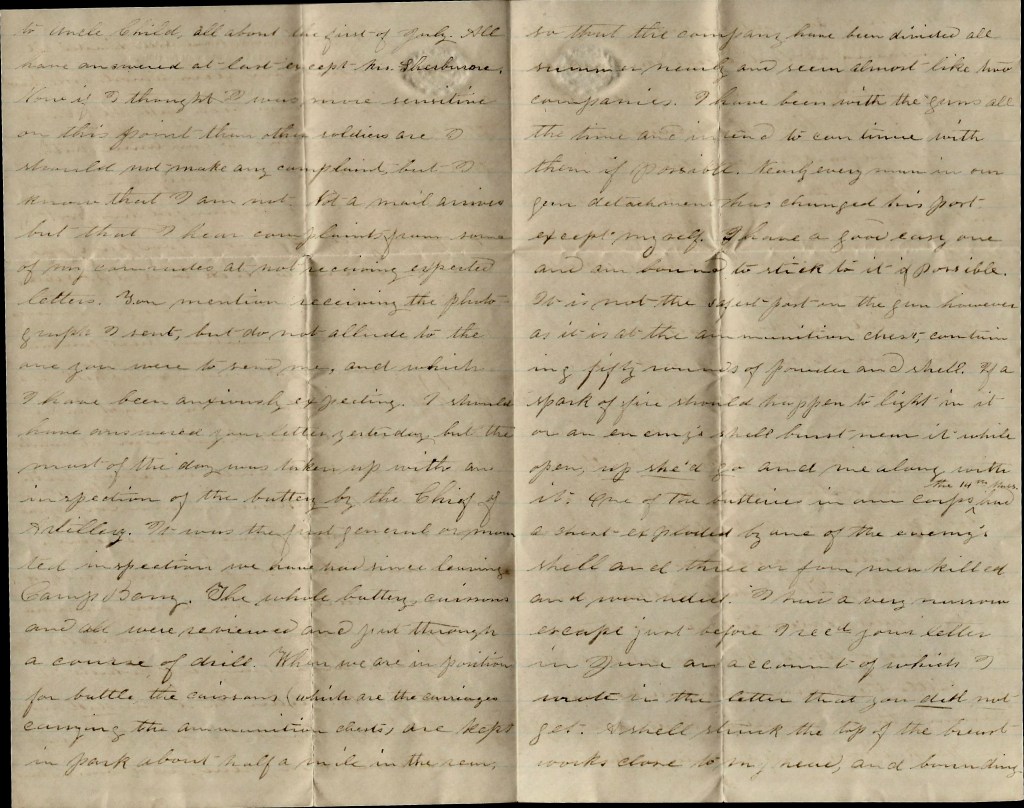
You long looked for and most welcome letter reached me yesterday morning. I thought it very strange that you did not write. Both your letters, written in April and June were received and answered, the last immediately after its receipt. I directed it as usual and it is strange that it did not reach you. I came to the conclusion that you had lost all interest in the army and those composing it. Indeed, I began to feel grieved at the seeming neglect of all the Charlestown folks to whom I had written, and had almost made up my mind to trouble them no more. I thought if friends were to be judged by their promptness in answering letters, I certainly had not many about Charlestown. I wrote to you, to John, to Sarah Jane, to Eliza Morse, and to Uncle Child, all about the first of July. All have answered at last except Mrs. Sherbourne. Now if I thought I was more sensitive on this point than other soldiers are, I should not make any complaint but I know that I am not. Not a mail arrives but that I hear complains from some of my comrades at not receiving expected letters. You mention receiving the photograph I sent, but do not allude to the one you were to send me, and which I have been anxiously expecting.
I should have answered your letter yesterday but the most of the day was taken up with an inspection of the battery by the Chief of Artillery. It was the first general or mounted inspection we have had since leaving Camp Barry. The whole battery, caissons and all, were reviewed and put through a course of drill. When we are in position of battle, the caissons (which are the carriages carrying the ammunition chests) are kept in park about half a mile in the rear so that the company have been divided all summer nearly and seem almost like two companies. I have been with the guns all the time and intend to continue with them if possible. Nearly every man in our detachment has changed his post except myself. I have a good easy one and am bound to stick to it if possible. It is not the safest post on the gun, however, as it is at the ammunition chest containing fifty rounds of powder and shell. If a spark of fire should happen to light in it or the enemy’s shell burst near it while open, up she’d go and me along with it. One of the batteries in our Corps—the 14th Massachusetts—had a chest exploded by one of the enemy’s shell and three or four men killed and wounded.
I had a very narrow escape just before I received your letter in June an account of which I wrote in the letter that you did not get. A shell struck the top of the breastworks close to my head and bounding up, burst nearly over me, the pieces flying in every direction. You had better believe we were glad enough to get away from our position there which we held forty-five days under a constant fire of pickets, and mortar shelling. But we had wonderful good fortune and lost but two killed and seven wounded. Compare our losses with some of the infantry regiments and see how much cause we have to be thankful for our preservation of life and limb.
The 56th, 56th, 58th, and 59th [Massachusetts] Regiments entered the campaign with us with nearly 1,000 men apiece. They cannot muster 150 men now. The 58th which is in our [Potter’s] division has only 125 for duty. They have many in the hospital sick, however, and so have we. Six of our men have died of disease, one deserted, two enlisted men and one Lieutenant have been discharged for disability, and we have a dozen or fifteen sick in the hospital so that in all we have lost thirty or thirty-five, many of whom will probably come back.
We had divine service this forenoon. We were addressed by the Rev. Mr. Stark, Chaplain of the 58th Regiment. We have had Sunday services but three or four times since we left Camp Barry. I wish I had some news to write but as I have written twice to John within as many weeks, and as you have probably seen both letters, I can think of nothing that will interest you. It is said there is a fight going on up on the right and heavy cannonading has been heard all day & some of the infantry are preparing to march, and in anticipation of orders I must bid you goodbye and close my letter. Please write soon. Your friend as ever, — William

 Spared & Shared 23