
The following letter was written by Jacob J. Burnett (1829-Aft1900) of Co. C, 7th Indiana Infantry. The 7th Indiana was organized at Indianapolis and mustered in on 13 September 1861. It was ordered to Cheat Mountain, West Virginia in September, 1861 and first saw action at Greenbrier on 3-4 October 1861 where Union Gen. Joseph Reynolds advanced from Cheat Mountain with two brigades and attack the Confederate camp at Greenbrier River. After sporadic fighting and an abortive attempt to turn the enemy’s right flank, Reynolds withdrew to Cheat Mountain. In his letter, Burnett describes his company’s efforts to support a Union Battery in that artillery duel. There were less than 100 casualties total in the engagement. The engagement is sometimes referred to as the Battle of Camp Bartow.
According to muster records, Jacob was discharged for disability on 24 March 1863 after one and a half years of service. Jacob wrote the letter to his wife, Mary (Purdy) Burnett (1837-1875).
Four years ago today I transcribed account of the Battle of Camp Bartow by another member of the 7th Indiana Infantry named George Washington Sefton. His account was written in a letter dated 21 October 1861 which reads:
“I suppose you have heard that the 7th Regiment has been in one battle. If you ain’t, I will give you a description of it. The 3rd day of this month we was in a battle at Greenbriar about thirty miles from our camp. We started Wednesday evening. We marched till sundown and stopped for the night and at twelve o’clock we had orders to gather up and march in order to get there in the morning. It rained on us considerable that [night] but we did not care for that. About 9 in the morning we reached their camp. When we was [with]in about three miles of the camp, we double quicked from there to [the] battleground. The firing was kept up for three long hours. Their camp laid in the valley. It extended about 80 rods (~450 yards) in width and about the same in length. Their masked battery was on the side of the mountain. We marched up in the front of them. We undertook to flank them on the left of them under their fire which appeared to me like they might have cut us all to pieces. We was right in front of their cannons. The grapeshot just hailed round. It got so heavy that our old Colonel [Ebenezer Dumont] ordered us to take to the bushes for shelter which we obeyed. We stayed on the side of the side of the mountain for a half an hour. We being not drilled very well, we got scattered right smart but rallied and retreated under the fire without the loss of any man so that is all the particulars at the present.”
Transcription
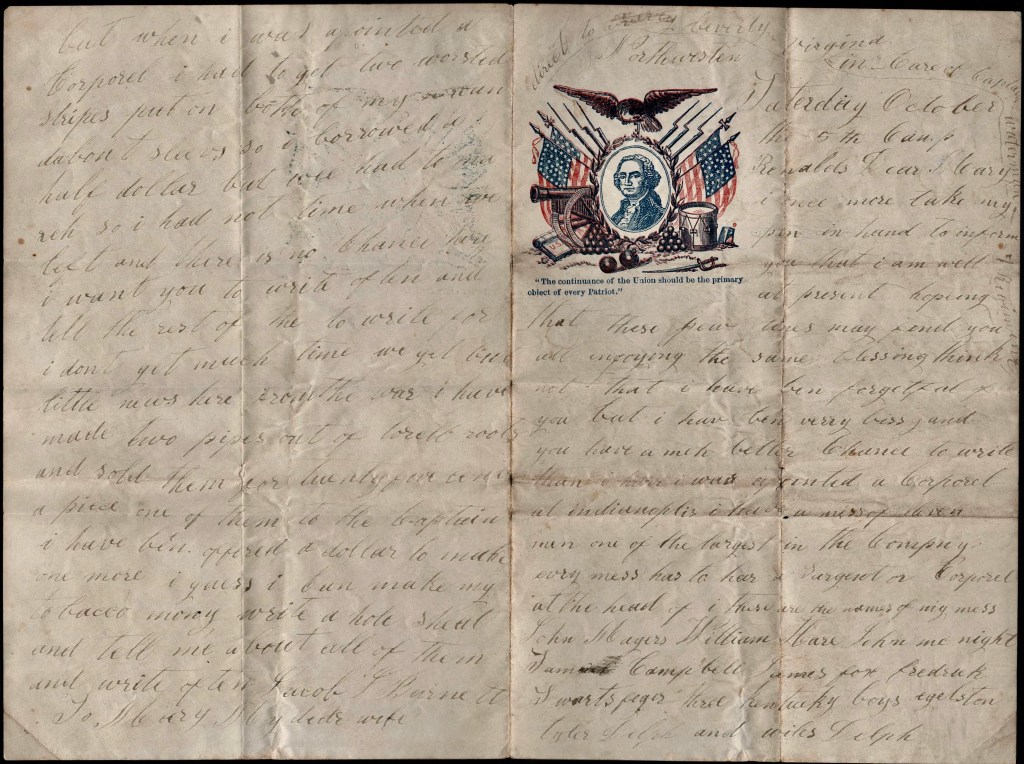
Camp Reynolds
Saturday, October the 5th [1861]
Dear Mary,
I once more take my pen in hand to inform you that I am well at present, hoping that these few lines may find you all enjoying the same blessing. Think not that I have been forgetful of you but I have been very busy and you have a much better chance to write than I have. I was appointed a corporal at Indianapolis. I have a mess of eleven men—one of the largest in the company. Every mess has to have a sergeant or corporal at the head of it. These are the names of my mess: John Magors, William Hare, John McKnight, Tom Campbell, James Fox, Frederick Schwertzfeger, three Kentucky boys—[Aaron] Eggleston, [Jonas] Tyler Delph and Willis Delph.
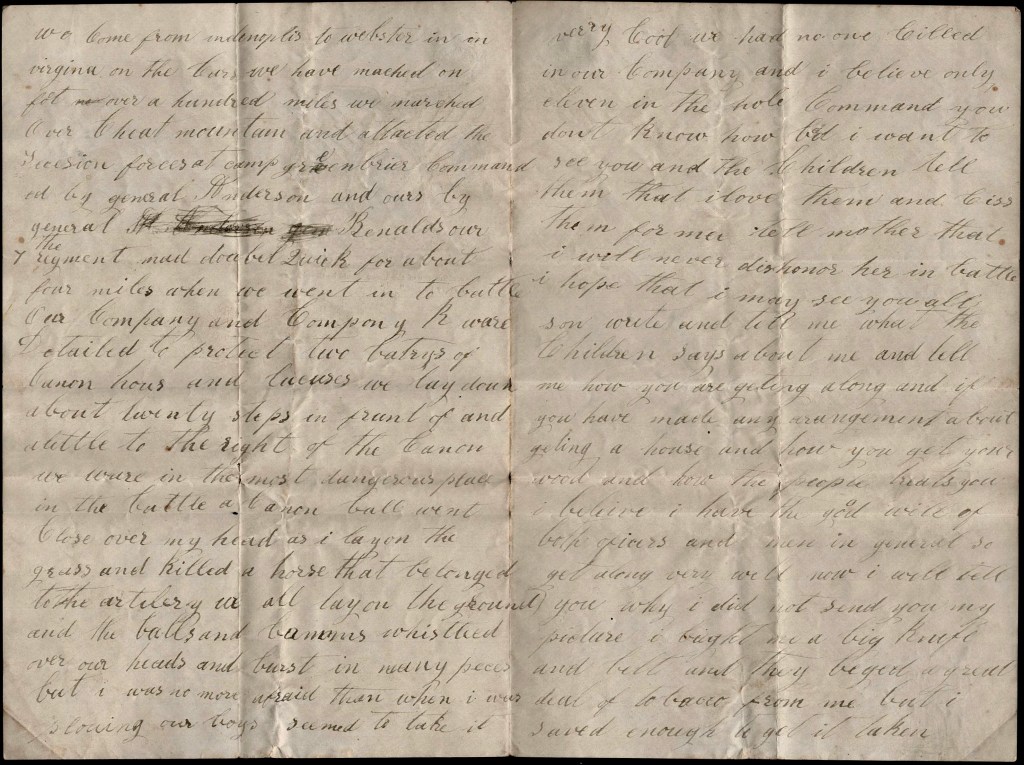
We come from Indianapolis to Webster in Virginia on the cars. We have marched on foot over a hundred miles. We marched over Cheat Mountain and attacked the secession forces at Camp Greenbrier commanded by General Anderson and ours by General [Joseph] Reynolds. Our 7th [Indiana] Regiment made double quick for about four miles when we went into battle. Our company and Co. K were detailed to protect two batteries of cannon—Howe’s and Lucas’ [Loomis’]. We lay down about twenty steps in front of and a little to the right of the cannon. We were in the most dangerous place in the battle. A cannon ball went close over my head as I lay on the grass and killed a horse that belonged to the artillery. We all lay on the ground and the balls and cannons whistled over our heads and burst in many pieces but I was no more afraid than when I was plowing. Our boys seemed to take it very cool. We had no one killed in our company and I believe only eleven in the whole command.
You don’t know how bad I want to see you and the children. Tell them that I love them and kiss them for me. Tell mother that I will never dishonor her in battle. I hope that I may see you all soon. Write and tell me what the children says about me and tell me how you are getting along and if you have made any arrangement about getting a house and how you get your wood and how the people treats you.
I believe I have the good will of both officers and men in general so get along very well. Now I will tell you why I did not send you my picture. I bought me a big knife and belt and they begged a great deal of tobacco from me but I saved enough to get it taken but when I was appointed corporal, I had to get two worsted stripes put on both of my roundabout sleeves so I borrowed a half dollar but we had to march so I had not time when we left and there is no chance here.
I want you to write often and tell the rest of them to write for I don’t get much time. We get but little news here from the war, I have made two pipes out of laurel roots and sold them for twenty-five cents apiece—one of them to the Captain. I have been offered a dollar to make one more. I guess I can make my tobacco money.
Write a whole sheet and tell me about all of them and write often. — Jacob J. Barnett
To Mary, my dear wife.
Direct to Beverly, Northwestern Virginia in care of Captain [Solomon] Waterman, 7th [Indiana] Regiment.
 Spared & Shared 23