
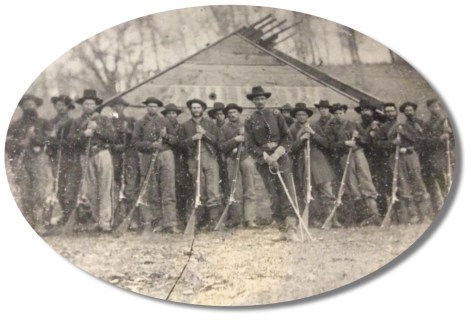
The following letter was written by Lemuel F. Mathews (184o-1889), an 1860 graduate of Knox College in Illinois, who enlisted at Cambridge, Illinois, on 12 August 1862 to serve three years in Co. D, 112th Illinois Infantry. The regiment was organized at Peoria in September 1862 and garrisoned places in Kentucky until Spring 1863. Beginning in April 1863, the regiment served as mounted infantry during the Knoxville campaign, before being dismounted in February 1864. Subsequently, it served in the Atlanta campaign, the Franklin-Nashville campaign, and the Carolinas campaign as part of the XXIII Corps. The regiment was mustered out on June 20, 1865. Lemuel was wounded, however and discharged on 26 August 1864.
In 1860, 19 year-old Lemuel was enumerated on his father’s farm in West Jersey, Stark county, Illinois. His parents were Newton Mathews (1808-1874) and Mary D. Wycoff (1809-1880). Lemuel wrote the letter to his wife, Lucretia Trickly (1843-1910). The couple had been married on 26 August 1862, following Lemuel’s enlistment, but before they had left camp in Illinois.
Transcription
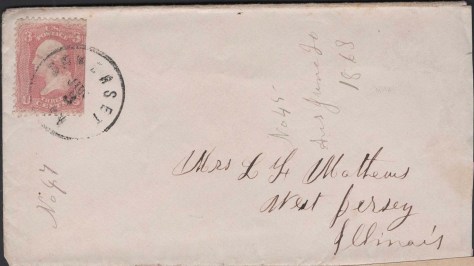
Somerset [Kentucky]
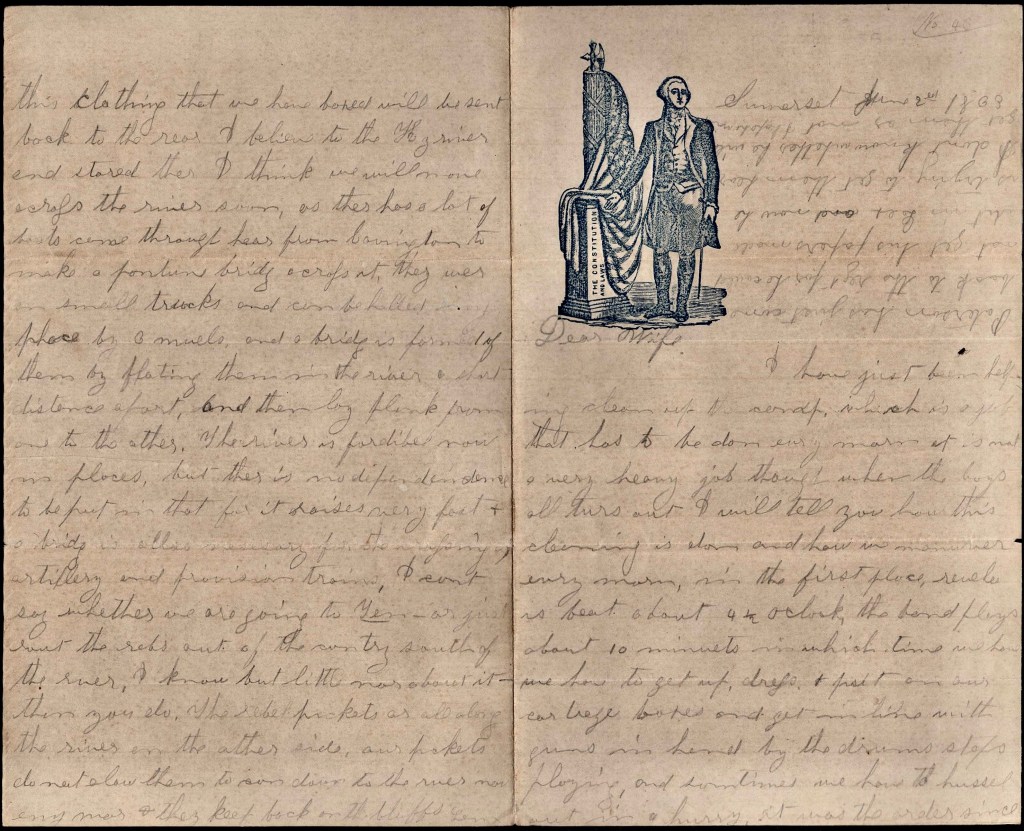
June 2nd 1863
Dear wife,
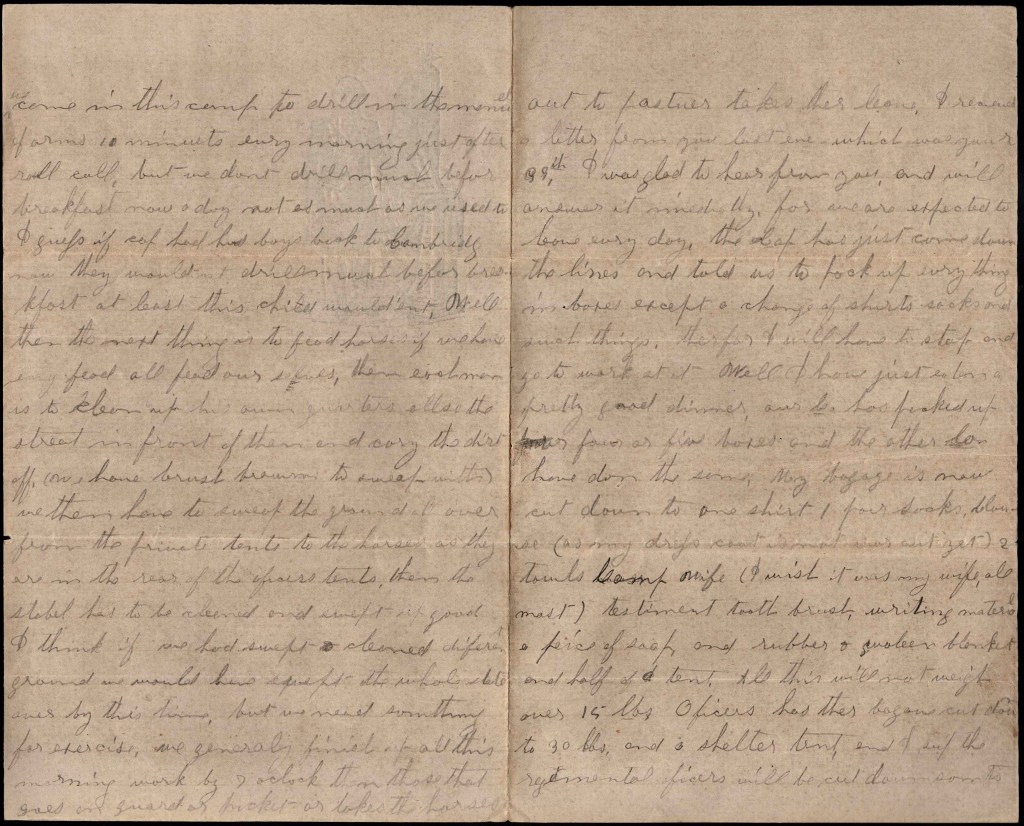
I have just been helping clean up the camp which is a job that has to be done every morn, It is not a very heavy job though when the boys all turn out. I will tell you how this cleaning is done and how the manner every morn. In the first place, reveille is beat about 4:30 o’clock, the band plays about ten minutes in which time we have to get up, dress and out on our cartridge boxes and get in line with guns in hand by [the time] the drums stop playing and sometimes we have to hustle out in a hurry. It was the orders since we came in this camp to drill in the manual of arms ten minutes every morning just after roll call, but we don’t drill much before breakfast now-a-day—not as much as we used to. I guess if Cap[tain] had his boys back to Cambridge now, they wouldn’t drill much before breakfast—at least this child wouldn’t.
Well then the next thing is to feed horses if we have any, all feed ourselves, then each man is to clean up his own quarters. Also the street in front and carry the dirt off. (we have brush brooms to sweep with.) We then have to sweep the ground all over from the private tents to the horses as they are in the rear of the officer’s tents. Then the stable has to be cleaned and swept up good. I think if we had swept and cleaned different ground, we would have swept the whole state over by this time, but we need something for exercise. We generally finish up all this morning work by 7 o’clock. Then those that goes on guard or picket or takes the horses out to pasture takes their leave.
I received a letter from you last eve which was your 49th & was glad to hear from you, and will answer it immediately for we are expected to leave every day. The Cap has just come down the lines and told us to pack up everything in boxes except a change of shirts, socks, and such things. Therefore, I will have to stop and go to work at it.
Well, I have just eaten a pretty good dinner. Our company has packed up four or five boxes and the other company have done the same. My baggage is now cut down to one shirt, 1 pair of socks, blouse (as my dress coat is not worn out yet), towels, camp wife 1 (I wish it was my wife almost), testament, tooth brush, writing materials, a piece of soap, and rubber & woolen blanket and half of a tent. All this will not weigh over 15 lbs. Officers has there baggage cut down to 30 lbs. and a shelter tent, and I suppose the regimental officers will be cut down some too. This clothing that we have boxed will be sent back to the rear—I believe to the Kentucky River—and stored there. I think we will love across the river soon as there has a lot of boats come through here from Covington to make a pontoon bridge across it. They were on small trucks and can be hauled anyplace by six mules, and a bridge is formed of them by floating them in the river a short distance apart, and then by plank from one to the other. The river is fordable now in places but there is no dependence to be put in that for it rains very fast & a bridge is always necessary for the crossing of artillery and provision trains. I can’t say whether we are going to Tennessee or just rout the rebels out of the country south of the river. I know but little nor about it than you do.

The rebel pickets are all along the river on the other side. Our pickets do not allow them to come down to the river now anymore and they keep back on the bluffs.
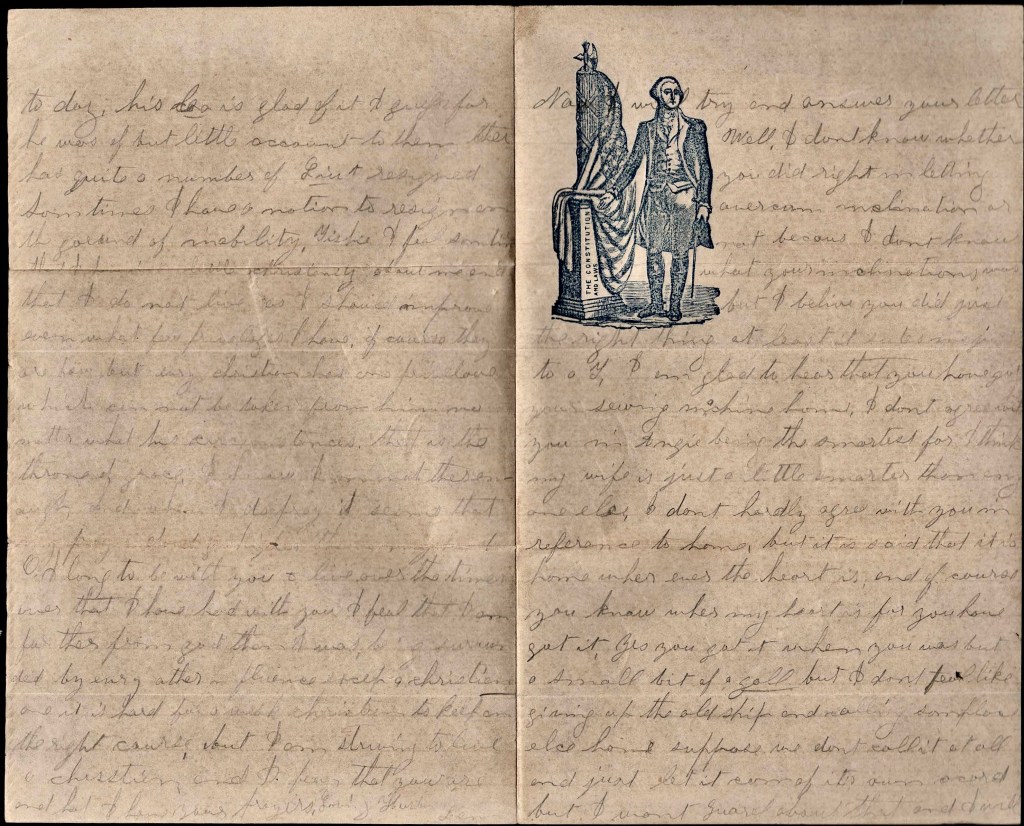
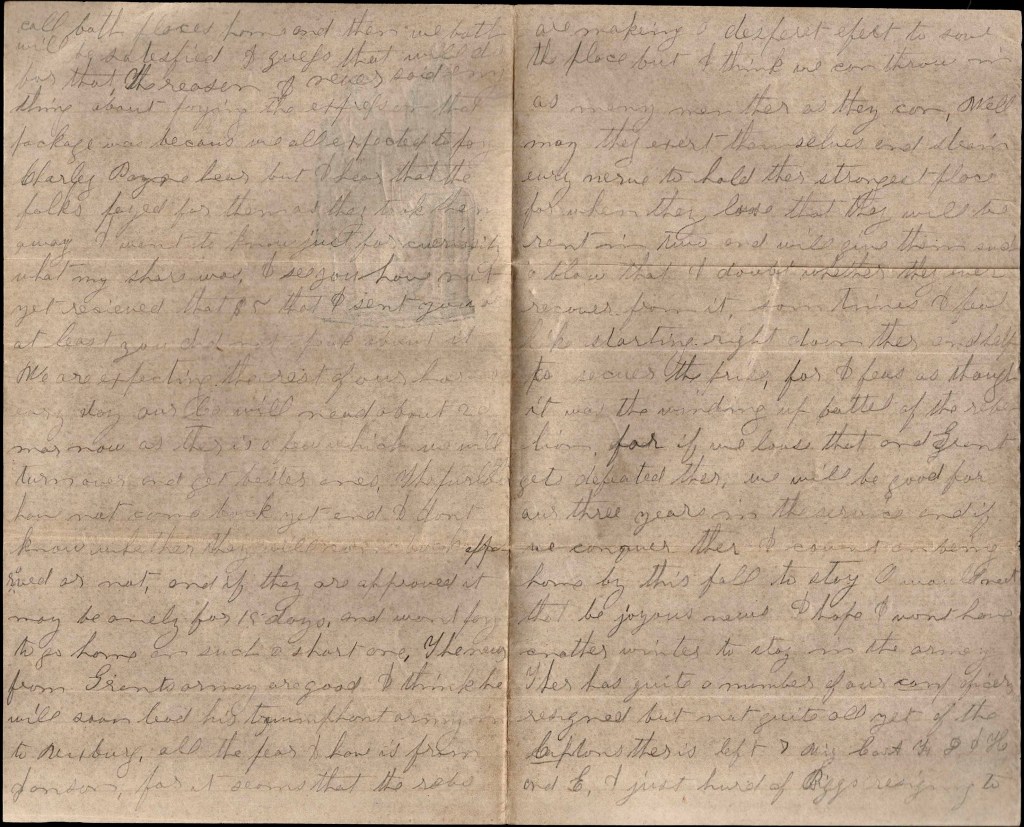
Now I will try and answer your letter. Well, I don’t know whether you did right in letting overcome inclination or not because I don’t know what your inclinations was but I believe you did just the right thing—at least it suits me just to a T. I am glad to hear that you have got your sewing machine home. I don’t agree with you in Angie being the smartest for I think my wife is just a little smarter than anyone else. I don’t hardly agree with you in reference to home, but it is said that it is home wherever the heart is, and of course you know where my heart is for you have got it. Yes, you got it when you was but a small bit of a gall but I don’t feel like giving up the old ship and calling someplace else home. Suppose we don’t call it at all and just let it come of its own accord. But I won’t quarrel about that and I will call both places home and then we both will be satisfied. I guess that will do for that. The reason I never said anything about paying the express on that package was because we all expected to pay Charley Payne here, but I hear that the folks paid for them as they took them away. I want to know just for curiosity what my share was. I see you have not yet received the $5 that I sent you, or at least you did not speak about it.
We are expecting the rest of our horses every day. Our company will need about 20 more now as there is a few which we will turn over and get better ones. The furlough [requests] have not come back yet and I don’t know whether they will come back approved or not, and [even] if they are approved, it may be only for 15 days and won’t pay to go home on such a short one.
The news from Gen. Grant’s army are good. I think he will soon lead his triumphant army into Vicksburg. All the fear I have is from Johnston for it seems that the rebs are making a desperate effort to save the place. But I think we can throw in as many men there as they can. Well, may they exert themselves and strain every nerve to hold their strongest place for when they lose that, they will be rent in two and will give them such a blow that I doubt whether they ever recover from it. Sometimes I feel like starting right down there and help to secure the prize for I fear as though it was the winding up battle of the rebellion, for if we lose that and Grant gets defeated there, we will be good for our three years in the service. And [yet] if we conquer there, I count on being home by this fall to stay. Oh wouldn’t that be joyous news. I hope I won’t have another winter to stay in the army.
There has quite a number of our company officers resigned but not quite all yet of the captains. There is left 7; viz: Co. A, F, D, I, H, and E. I just heard of [John J.] Biggs of Co. C resigning too today. His company is glad of it, I guess, for he was of but little account to them. There has quite a number of Lieutenants resigned. Sometimes I have a notion to resign on the ground of inability [pencil faint and difficult to read]. I long to be with you to live over the times that I have lived with you. I feel that I am further from God than I was, being surrounded by every other influence except a Christian one. It is hard for a weak Christian to keep on the right course, but I am striving to live a Christian and I pray that you are and that I have your prayers, your loving husband, — Lem
1 “Camp Wife” probably refers to what most soldiers called the “Housewife” which was a small, compact sewing kit that soldiers carried with them to mend their uniforms. The kits were often homemade by a soldier’s wife, mother, or girlfriend.
 Spared & Shared 23