
The following letter was written by a commissioned officer aboard the USS Thomas Freeborn in May 1864. He signed his name “George” and gave us few clues except that his letter suggests he was Baltimore, Maryland, and that he had a brother named “Gus”—probably Augustus. We know he was an officer because he mentions the possibility of tendering his resignation if the war did not end soon.
After reviewing Census and Naval Records, I’m inclined to attribute this letter to George William Yoe who enlisted in May 1861 as a Landsman, but was commissioned an Acting 3rd Assistant Engineer as of 8 August 1863. His naval record suggests he may have served on two or three ships before being assigned to the Thomas Freeborn.
In his letter, George relates an accident that occurred to the Thomas Freeborn while ascending the Rappahannock river toward Fredericksburg on a mission to clear the river of torpedos and infernal machines. While en route, the pressurized cylinder of the steamboat’s engine ruptured with a loud noise and spewed hot steam into the vessel, causing injuries to the crew and disabling her.
I thought I might be able to confirm George’s identity beyond a doubt by finding his brother Gus in the naval records or census records but I could not. The explosion of the USS Gunboat Commodore Jones on which Gus served was so absolute, that the Navy did not have a list of the sailors that survived for weeks as the few survivors were picked up and hauled off on other vessels.

Transcription
U. S. Steamer Freeborn
Naval Station, Potomac River
May 21st 1864
Dear George!
Your kind and welcome letter of the 12th reached me this morning or rather reached the vessel, for I was not aboard at the time it came, having had big stroll over the country all day, visiting all the country taverns in St. Mary’s county engaged in filling ourselves with beer to our heart’s content. I am so damned tired now that I am hardly able to move, for I think that I travelled at least 30 miles during the last 12 hours, and I am not used to walking much anyhow.
We are laying at a place called St. Inigoes, St. Mary’s county, Maryland, in a “smashed” condition, and I will give you the circumstances of the accident. On the morning of the 7th instant, we received orders from Washington to proceed to the St. Inigoes “Navy Yard” (a small concern) and get a torpedo catcher. Well and good so far. We arrived there on the 9th and started on the same day again to the station we came from—that is, the Rappahannock river. We got there safe with the torpedo catcher. The “dirty work” was to commence now.
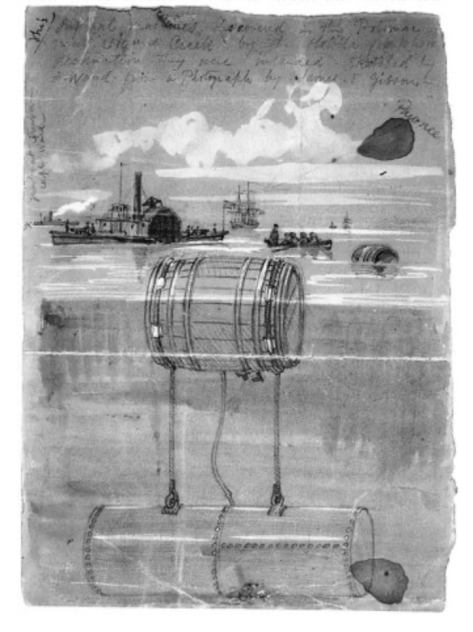
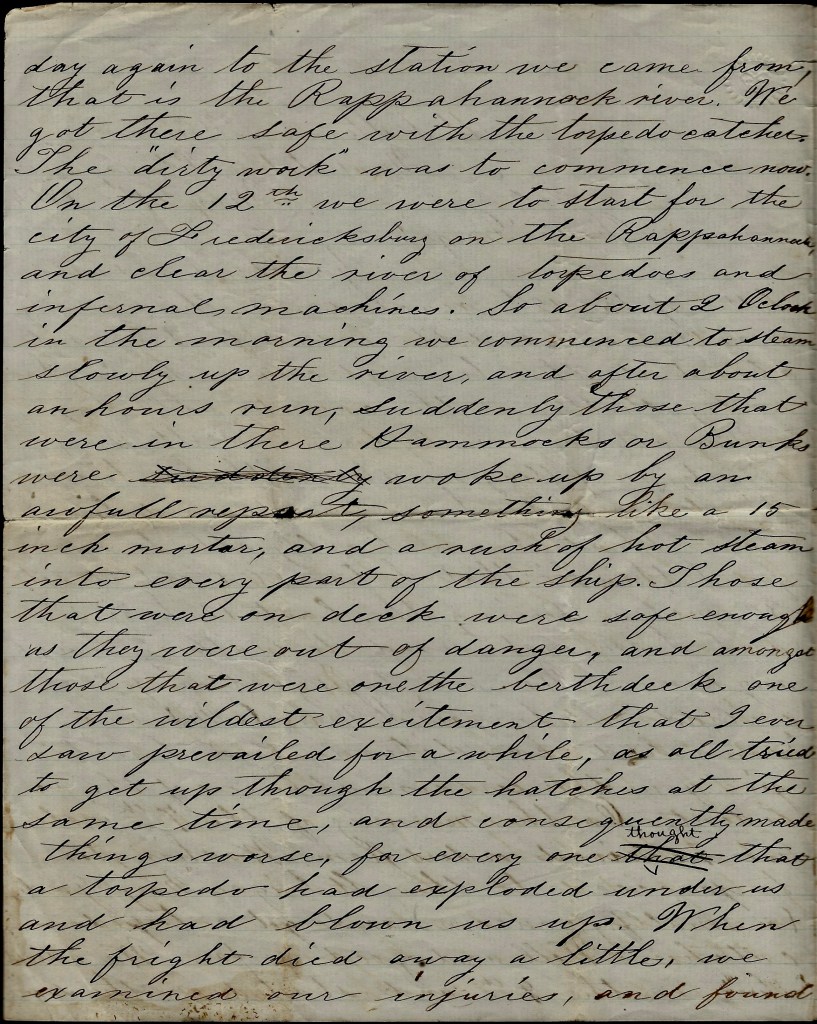
On the 12th we were to start for the City of Fredericksburg on the Rappahannock and clear the river of torpedos and infernal machines. So about two o’clock in the morning we commemced to steam slowly up the river and after about an hour’s run, suddenly those that were in their hammocks or bunks were woke up by an awful report—something like a 15-inch mortar—and a rush of hot steam into every part of the ship. Those that were on deck were safe enough as they were out of danger, and amongst those that were on the berth deck one of the wildest excitement that I ever saw prevailed for awhile as all tried to get up through the hatches at the same time and consequently made things worse for everyone thought that a torpedo had exploded under us and had blown us up.
When the fright died away a little, we examined our injuries and found that our cylinder had blown to pieces from some unknown cause. The cylinder is 52 inches diameter and 11 feet stroke and you can imagine the thunder it made when it bursted. A few men were slightly scalded and no other damage was done.
Well, this put an end to the expedition and the next day we were towed up to the Potomac by a steam tug. It might have been all for the best for we might have been blown up otherwise if we would have tried to get up the river. We are having a big thing of it now, but lose all sight of the fight that is going on now which we might have otherwise joined in.
Well, George, you asked me my opinion about Grant and the army. Well I think he is the best man in the army and has some chance of taking Richmond but I think he will have a hard job of it. As far as I am individually concerned, I don’t care a damned whether “school keeps or no,” for I am disgusted with the war, and I pray to God that it will end soon. If I don’t see any prospect of it ending this summer, I am going to resign for I think that I have done my share towards it, for a fellow is throwing his life away here. I am got the “blues” half of the time, and I believe a fellow might as well be in Hell as live discontented on board of a vessel. If I would try to get off now, I would most likely be sent to the Charleston fleet which would be like jumping from the frying pan into the fire so I will have to wait until the present campaign is over when I will stand a better chance of having my resignation accepted.
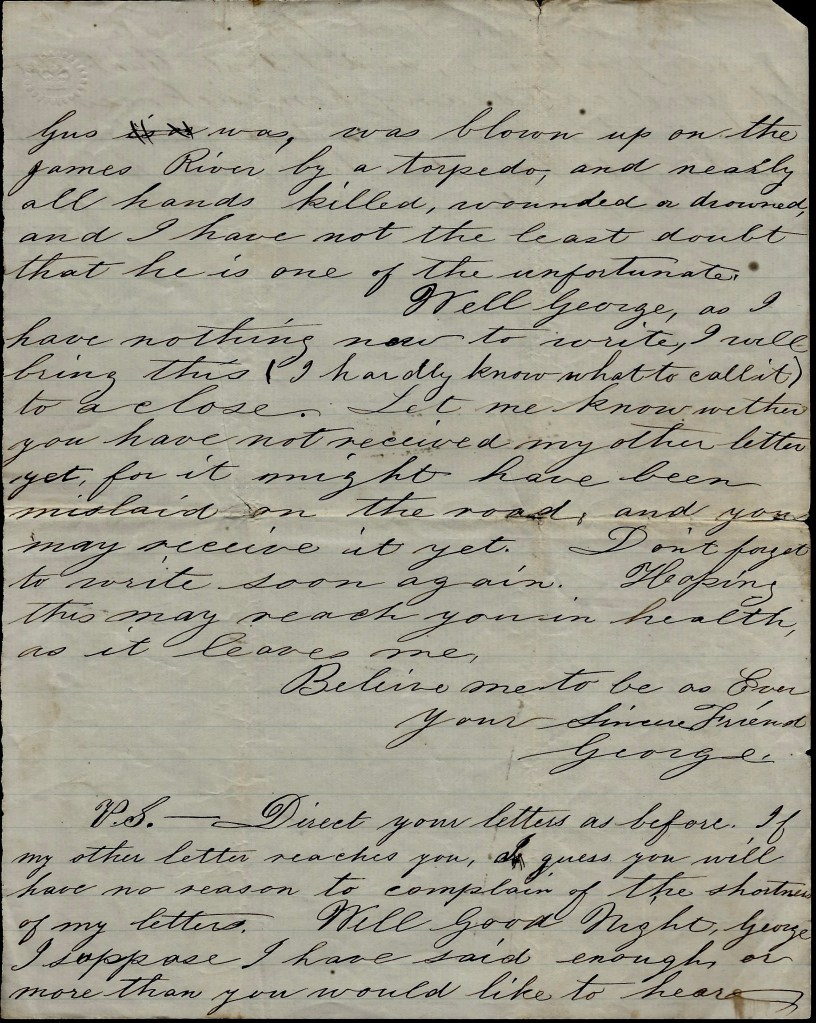
I received a letter from Punch about 15 days ago and he is well. I have not heard from Baltimore during the present month as some of my “correspondents” are getting pretty damned slack about writing, so I don’t hear much more from there than you do. I am very anxious to hear from home anyhow, as the Gunboat Commodore Jones 1 on which my brother Gus was, was blown up on the James river by a torpedo and nearly all hands killed, wounded, or drowned, and I have not the least doubt that he is one of the unfortunates.
Well, George, as I have nothing new to write, I will bring this (I hardly know what to call it) to a close. Let me know whether you have not received my other letter yet, for it might have been mislaid on the road, and you may receive it yet. Don’t forget to write soon again. Hoping this may reach you in health as it leaves me. Believe me to be as ever your sincere friend, — George
P. S. Direct your letter as before. If my other letter reaches you, I guess you will have no reason to complain of the shortness of my letters. Well good night, George. I suppose I have said enough, or more than you would like to hear. I think you look first rate in your picture ad I don’t think that it indicates any homesickness. I hardly think it is worth apologizing for bad writing as I might have done better and have no excuse for it. Yours, — George
1 The USS Commodore Jones was a side-wheel ferryboat acquired by the Union Navy, valued for its flat bottom and shallow draft that could navigate up rivers in the South. She performed picket and patrol duty, dragged for torpedoes (mines), skirmished with enemy cavalry, shelled shore installations, and captured contraband goods with her shore parties. She patrolled the James River frequently in the course of her service, and there on 6 May 1864, she was destroyed by an electrically fired, 2,000-pound torpedo. The explosion claimed 40 lives.




 Spared & Shared 23