
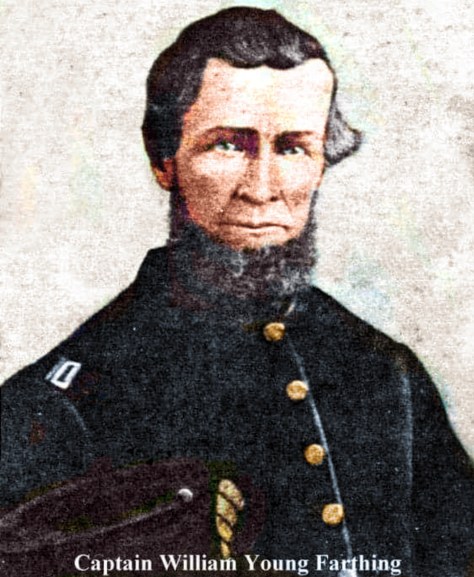
The following letter was penned by Paul Farthing (1821-1865), the son of Rev. William Watkins Farthing (1782-1827) and Polly Halliburton (1784-1844) hailing from Watauga County, North Carolina. At the age of 40, Paul was a farmer who enlisted in the 37th North Carolina Infantry on September 18, 1861. Just two months later, he received a commission as 1st Lieutenant of Company E—known as the “Watauga Minute Men”—under the command of his relative, Captain William Young Farthing. He was discharged on April 16, 1862, approximately a month after this letter was composed. Subsequently, he served as a sergeant in Company A of the 11th North Carolina Home Guard, ultimately being captured in North Carolina in mid-February 1865. As a prisoner of war, he was transported west to Chattanooga, then north to Louisville, and finally further north to Camp Chase, where he met his death in April 1865.
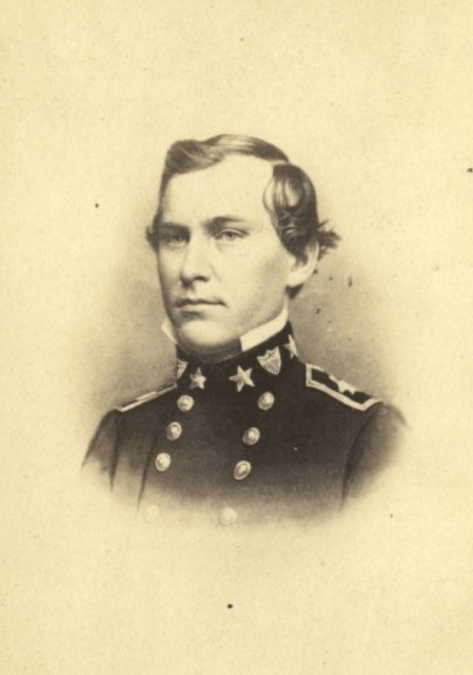
Due to the absence of the captain, 1st Lieutenant Paul Farthing assumed command of Company E during the Battle of New Bern, which occurred on 14 March 1862. In his correspondence, Farthing recounts the events of the battle, revealing that Brigadier General Lawrence O’Bryan Branch sought to reinforce a weakened segment of the Confederate line by deploying part of the 37th North Carolina. Farthing’s reflections on the discussions and his profound hesitation to comply with Branch’s directive to essentially sacrifice this small contingent of three companies (approximately 100 men) in order to stem the Confederate retreat illuminate his internal conflict and apprehensions. Paul’s protest, and Branch’s reply, “if we had the hearts of men, show it,” left little doubt about the tense crisis of the moment. Branch was killed by a sharpshooter later in the year at Sharpsburg.

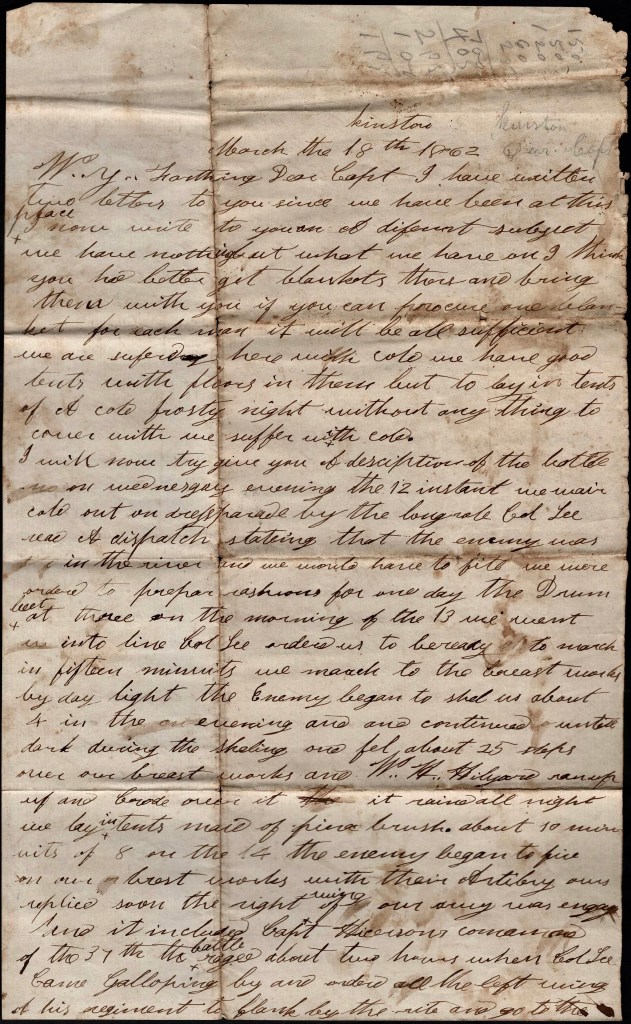
Transcription
Kinston, [North Carolina]
March the 18th 1862
W. Y. Farthing. Dear Captain,
I have written two letters to you since we have been at this place. Now [I] write to you on a different subject. We have nothing but what we have on. I think you had better get blankets there and bring them with you. If you can procure one blanket for each man, it will be sufficient. We are suffering. here with cold. We have good tents with floors in them, but to lay in tents of a cold, frosty night without anything to cover with—we suffer with cold.
I will now try [to] give you [a] description of the battle. On Wednesday evening, the 12th instant, we were called out on dress parade by the Brigade Col. [Charles Cochrane] Lee [who] read a dispatch stating that the enemy was [present] in the [Neuse] River, and we would have to fight. We were ordered to prepare rations for one day. The drum beat at three on the morning of the 13th. We went into line. Col. Lee ordered us to be ready to march in fifteen minutes. We marched to the breastworks by daylight. The enemy [gunboats] began to shell us about 4 in the evening, and continued until dark. During the shelling, one fell about 25 steps over our breastworks, and W. H. Hilliard ran up and crowed over it. It rained all night. We lay in tents made of pine brush.
About 10 minutes of eight on the 14th, the enemy began to fire on our breastworks with their artillery. Ours replied. Soon the right wing of our army was engaged and it included Capt. [Charles N.] Hickerson’s command [Co. F] of the 37th. The battle raged about two hours when Col. Lee came galloping by and ordered all the left wing of his regiment to flank by the right and go to the railroad. We struck [on] the double quick and soon came to Grimes’ [Latham’s Battery] Artillery. I inquired for Col. [Reuben P.] Campbell [7th N.C. Inf., k.i.a. Gaines’ Mill 6-27-1862].
I should have stated that [Lt.] Col. [William M.] Barbour ordered us to report to Col. Campbell. They told us to go on—he was ahead (the balls were flying as thick as hailstones—our boys were glanced by several of them, but nobody was hurt). We went on and Col. Campbell’s adjutant came running [up] and said Col. Campbell was behind [us]—we had passed him. We faced about and marched off in the new direction when we received an order to go on to the railroad. We faced about and marched to that place. There we met [Brigadier] General [Lawrence O’Bryan] Branch. He ordered us to face about and meet our forces who were retreating before the enemy. He said that we had men enough to fight a good battle of ourselves (we had the commands of Captains [Jackson Lafayette] Bost [Co. D], [James M.] Potts [Co. F], and your own; not more than 100 men in all).
I protested against going back [but] his orders were to go, saying if we had the hearts of men, [then] show it. We faced about. The order was given to march. They went—but slow. We had not gone far before we saw Col. Barber. He told us to make our escape for we were defeated. We made our escape to the [railroad] cars, and all of your company got in but myself and [Pvt. William] Strickland. We made our way to New Berne, [and] from there we walked 9 miles and got on the [cars] and came here. — P. Farthing

 Spared & Shared 23