
The following letter was written by Cpl. Ovando M. Messer (1842-1938) of Co. C, 19th Ohio Infantry. Ovando was the son of Loren Sanborn Messer (1816-1890) and Chestina Waterbury Cook (1815-1892) of Warren, Ohio.
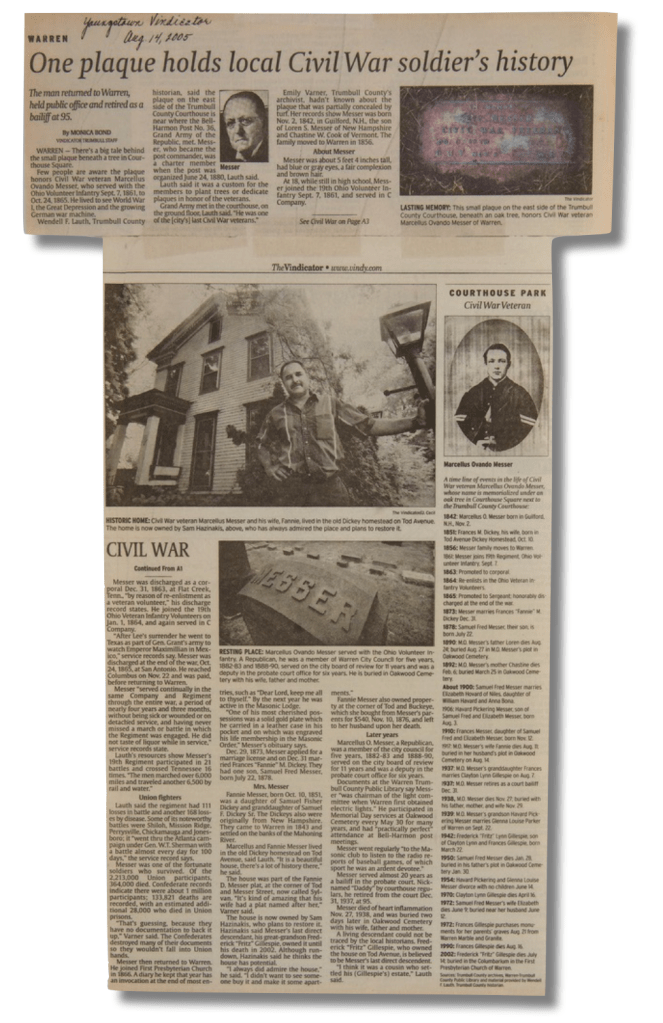
Marcellus Ovando Messer (who variously signed his letters Ovando Messer, Ovando M. Messer, or M. Ovando Messer) was born on 2 November 1842 in Guilford, Belknap County, New Hampshire. In 1856 he moved with his family to Warren, Trumbull County, Ohio, and in September 1861 was mustered in to Company C, 19th Ohio Volunteer Infantry. He would remain with Co. C of the 19th Ohio to the end of the war (and beyond), serving in the Army of the Ohio (to November1862), the Army of the Cumberland (to October 1863), IV Corps (to August 1865), and the Department of Texas (to October 1865), reenlisting on January 1, 1864.
Messer served in many of the major campaigns of the war’s western theater, mainly in Tennessee and Georgia. He was present at a number of significant engagements, including the battles of Shiloh, Murfreesboro, Chickamauga, and Nashville. He served in Sherman’s Atlanta campaign. In the summer of 1865 he and the 19th Ohio were among the troops sent to Texas to keep an eye on Emperor Maximilian I in Mexico. He was mustered out in San Antonio on 21 October 1865. Though Messer’s letters report a number of close calls, he concluded his four years of service without serious injury or illness. He married Frances M. “Fannie” Dickey in 1873 and remained in Warren, Ohio until his death on 27 November 1938.
See also—1864: Marcellus Ovando Messer to Parents on Spared & Shared 19, published in 2019.
Transcription
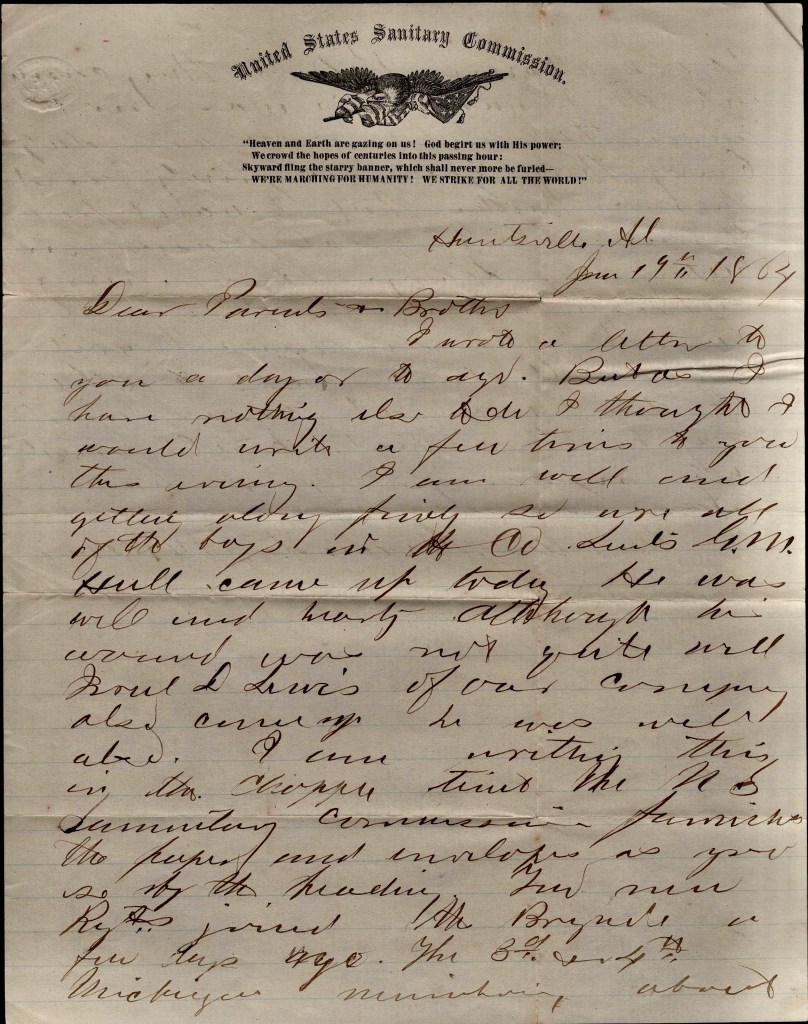
Huntsville, Alabama
January 19, 1864
Dear Parents & Brothers,
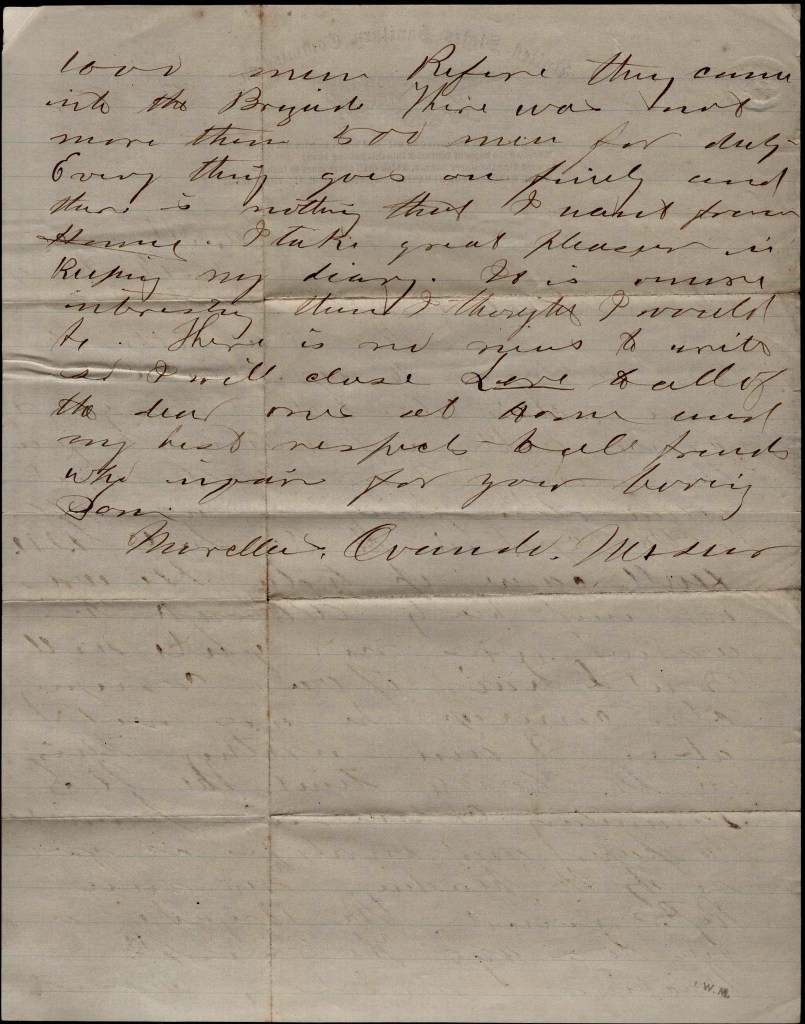
I wrote a letter to you a day or two ago, but as I have nothing else to do, I thought I would write a few lines to you this evening. I am well and getting along finely. So are all the boys in the company. Lieut. G. M. Hull came up today. He was well and hearty although his wound was not quite well. Israel D. Lewis of our company also came up. He was well also. I am writing this in the chapel [ ]. The U.S. Sanitary Commission furnishes the paper and envelopes as you see by the heading. Two new regiments joined the Brigade a few days ago—the 3rd & 4th Michigan—numbering about 1,000 men. Before they came into the Brigade, there was not more than 500 men [fit] for duty. Everything goes on finely and there is nothing that I want from home.
I take great pleasure in keeping my diary. It is more interesting than I thought it would be. There is no news to write so I will close.
Love to all of the dear ones at home and my best respects to all friends who enquire for your boring son. — Marcella Ovando Masur
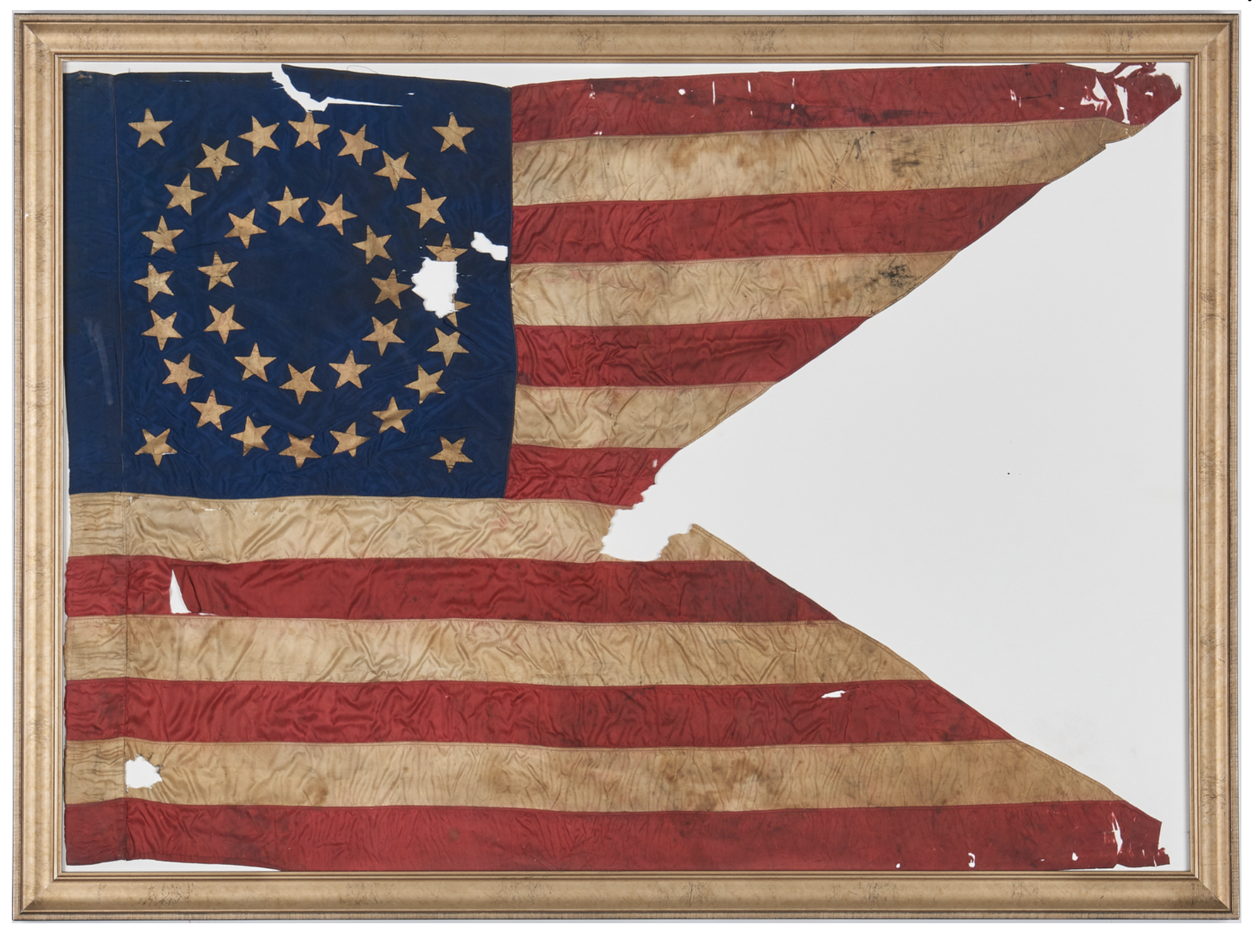
Civil War Union Cavalry Swallowtail Guidon Flag belonging to Corporal Marcellus Ovando Messer (1842-1938), 19th Regt., Ohio Volunteer Infantry, Company C. The silk flag has a double wreath of 35 gilt-painted stars, indicating use between the admission of West Virginia as a state in 1863, and the admission of Nevada in 1865; canton and stripes are pieced and treadle-sewn. 26 14″ x 36 3/4″ sight, 30″ x 40″ framed. Note: according to flag historian Greg Biggs, the U.S. contracted for more of these guidons than the cavalry could use, so standards like this one were issued to infantry regiments as guide flags, which were placed on the left and right flanks of the regiment to help form their line of battle. The battles in which the 19th Ohio engaged were among the war’s most infamous and included Shiloh, Missionary Ridge, and Chickamauga. They also participated in the Atlanta campaign, under General William Tecumseh Sherman. In all, the 19th regiment participated in 21 battles and crossed Tennessee 16 times, marching over 6,000 miles and traveling another 6,500 by rail and water. Cpl. Messer was born Nov. 2, 1842 in Guilford, New Hampshire. His family moved to Warren, Ohio when he was 14. When the Civil War broke out, Messer joined the 19th Ohio Volunteer Infantry, Company C., on Sept. 7, 1861 and was promoted to Corporal in 1863. According to his discharge record, he was discharged as a corporal on Dec. 31, 1863 at Flat Creek, Tennessee “by reason of re-enlistment as a veteran volunteer” and again served in C Company.
After Lee’s surrender, he went to Texas as part of General Grant’s army to monitor Mexican Emperor Maximillian. He was discharged Oct. 24, 1865 at San Antonio. According to his records, he “served continually in the same Company and Regiment through the entire war… without being sick or wounded or on detached service, and having never missed a battle in which the regiment was engaged. He did not taste of liquor while in the service.”
After the war, Messer returned to Warren, Ohio, and married Frances “Frannie” M. Dickey. They had one son and lived in the old Dickey homestead. Messer, a Republican, went on to serve as a member of the city council for five years in the 1880s and on other municipal boards. He also served as a bailiff in the Probate Court for more than 20 years.
Note: Some of this biographical information comes from a newspaper article on Messer in the Youngstown OH Vindicator newspaper, August 14, 2005. A copy of the article is included with this lot. Provenance: by descent in the Messer family to present consignor. Note: remnants of a box formerly used to store the flag bore this inscription: “A regimental flag of the 19 O.V.I. carried during Nov. 1861-65.” CONDITION: 4 1/4″ tear upper center canton, with two holes – 2″ diameter and 1 1/2″ L – at center right edge of canton. Two 1″ to 1 1/2″ L holes to stripes along sleeve. Center with 3″ hole/loss; each tip with losses and fraying. Several other small holes and slits; light fading, staining, discoloration and creasing throughout. Flag has been mounted (not glued down) atop white matting, under acrylic, and framed in a molded giltwood frame.
 Spared & Shared 23