
The following letter was written by Samuel Hall (1836-1863) of Marshall, Marshall county, Iowa. Samuel was married in Fulton county, Indiana to Mary Elizabeth Meredith (1831-1899) in 1855 and in the 1860 US Census he was enumerated in Jefferson township of Marshall county with his wife Mary and two sons, Isaac (age 2) and Leonard (age 7 months). He was a farmer. Samuel enlisted in 13 August 1862 and was mustered in as a private in Co. K, 23rd Iowa Infantry on 1 September 1862. He became ill in the service and in an attempt to see his wife and children before he died, he battled his way home and, according to family tradition, knocked on the door and died on the threshold. His date of death was recorded as 27 August 1863. He was 27 years old.

The 23rd Iowa was organized at Des Moines and ordered to St. Louis, Missouri, where they were attached to the Department of Missouri. Their duty was at Camp Patterson when this letter was written in November 1862. In his letter, Samuel describes the march from Camp Patterson to Pitman’s Ferry on the Current River, the skirmish there with Confederates, and the march to Pocahontas before marching back to Camp. Patterson. The Skirmish at Pitman’s Ferry is described below from official reports:
On October 27, 1862, Union Colonel William Dewey surprised Confederate Colonel John Q. Burbridge’s Brigade at Pitman’s Ferry (Randolph County). Dewey’s rapid combined-arms attack temporarily won control of the ferry and allowed for the reconnoitering of the Pocahontas (Randolph County) area.
“Near 8:00 a.m. October 27, the Confederate force reported to be Burbridge’s Brigade aligned for battle on the Arkansas side of the river. Dewey formed his line straddling the road about 100 yards from the ferry in Missouri. Deploying his artillery in the center, Federal troops began firing on the Confederate artillery deploying over the river, effectively scattering it and weakening the determination of the defenders. The Twenty-third Iowa positioned itself on the bank to deliver cover fire for the Twenty-fifth Missouri, which crossed the river and lightly skirmished with the Confederates, forcing them to retreat.
In possession of the ferry, Dewey ordered his exhausted men into camp, as they had covered sixty-five miles in two and a half days. On October 29, Dewey linked with Lazear at Bollinger’s Mill, about fifteen miles inside Randolph County, before sending reconnoitering parties toward Pocahontas. On October 30, Dewey began his return to Camp Patterson, reaching the site on November 2.” [Source: Skirmish at Pitman’s Ferry, October 27, 1862, Encyclopedia Arkansas]
Transcription
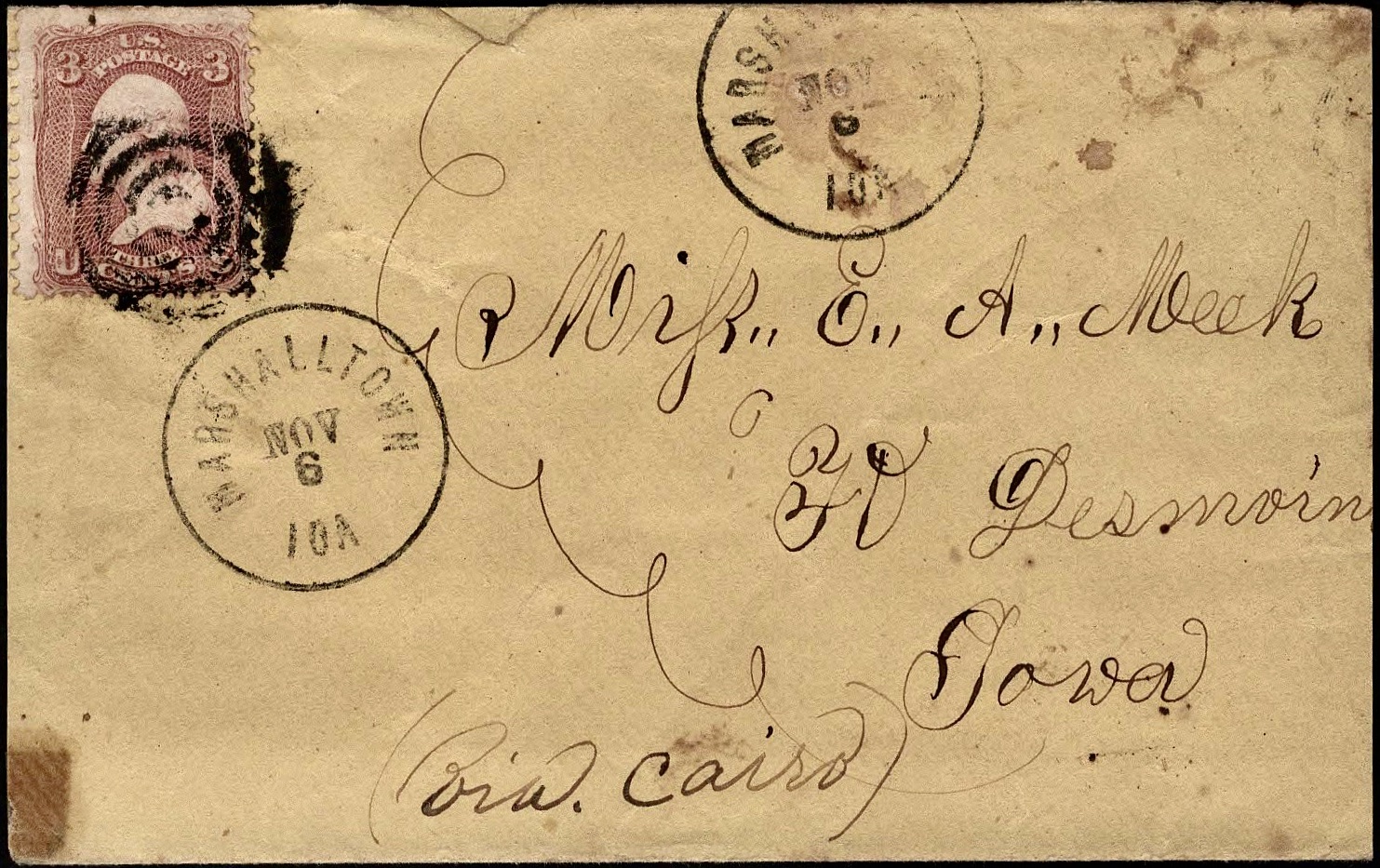
Camp Patterson
November 4, 1862
I once more sit down to let you know that I am well at present and I hope this letter will find you the same.
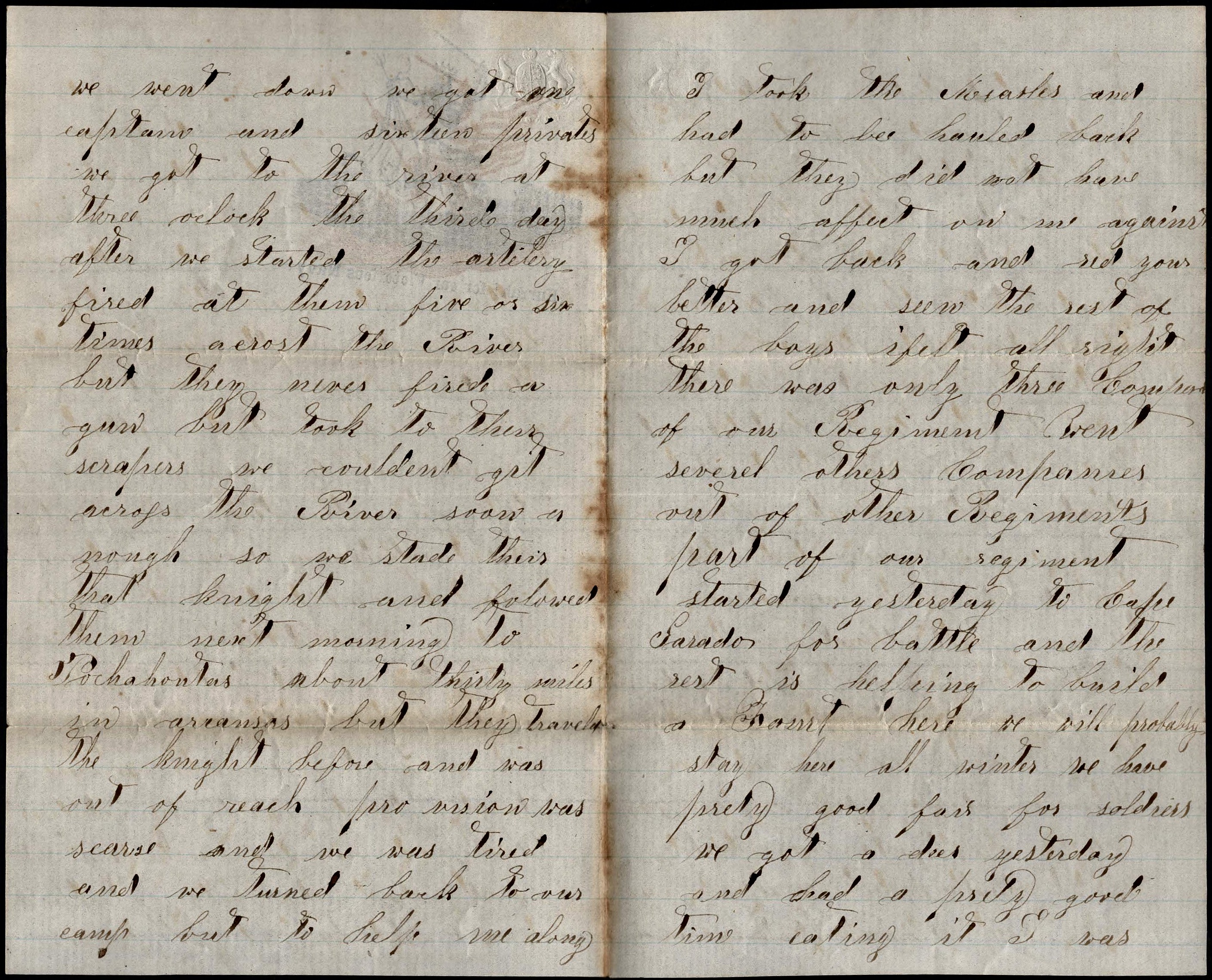
We left this camp the 25th of October for Pitman’s Ferry on Current River 80 miles from camp. We was called up in the night about twelve o’clock and they told us to fix for eight days march to rout four thousand Rebels. We marched night and day till we got there. We took their pickets as we went down. We got one Captain and sixteen privates. We got to the river at three o’clock the third day after we started. The artillery fired at them five or six times across the river but they never fired a gun but took to their scrapers. We couldn’t get across the river soon enough so we stayed there that night and followed them next morning to Pocahontas about thirty miles in Arkansas, but they traveled the night before and was out of reach. Provision was scarce and we was tired and we turned back to our camp. But to help me along, I took the measles adn had to be hauled back. But they did not have much effect on me against I got back and read your letter and seen the rest of the boys. I felt alright. There was only three companies of our regiment went.
Several other companies out of other regiments [with] part of our regiment started yesterday to Cape Girardeau for battle and the rest is helping to build a fort here. We will probably stay here all winter. We have pretty good fare for soldiers. We got a deer yesterday and had a pretty good time eating it. I was weighed today and I weighed 150 pounds. My weight is 150 for common. I wrote to William and you not long ago. I am going to write to George Randle this evening if I can. I would like to see the folks and would like to have been at that little bust up at our house. How I would [have] made them [funnybeans?] fly. But that [is] nothing.
The Colonel had a dance and I was there and the girls was all over in a minute and back again. Who wouldn’t be a soldier? But that isn’t half. Write soon. — Samuel H. to Miss Meeks

 Spared & Shared 23