
The following letter was written by James S. Simmons (1823-1870) who first enlisted in late September 1862 as a private in Co. C, 43rd Massachusetts Infantry. He mustered out of that regiment in late July 1863 and later mustered into the 16th Independent Battery, Massachusetts Light Artillery.
The Battery moved from Washington D. C. to Fairfax Court House, Virginia, on 6 December 1864 and was on duty there and at Vienna till 17 June 1865 when they were ordered to Massachusetts and mustered out 13 July 1865. They never saw any active combat.
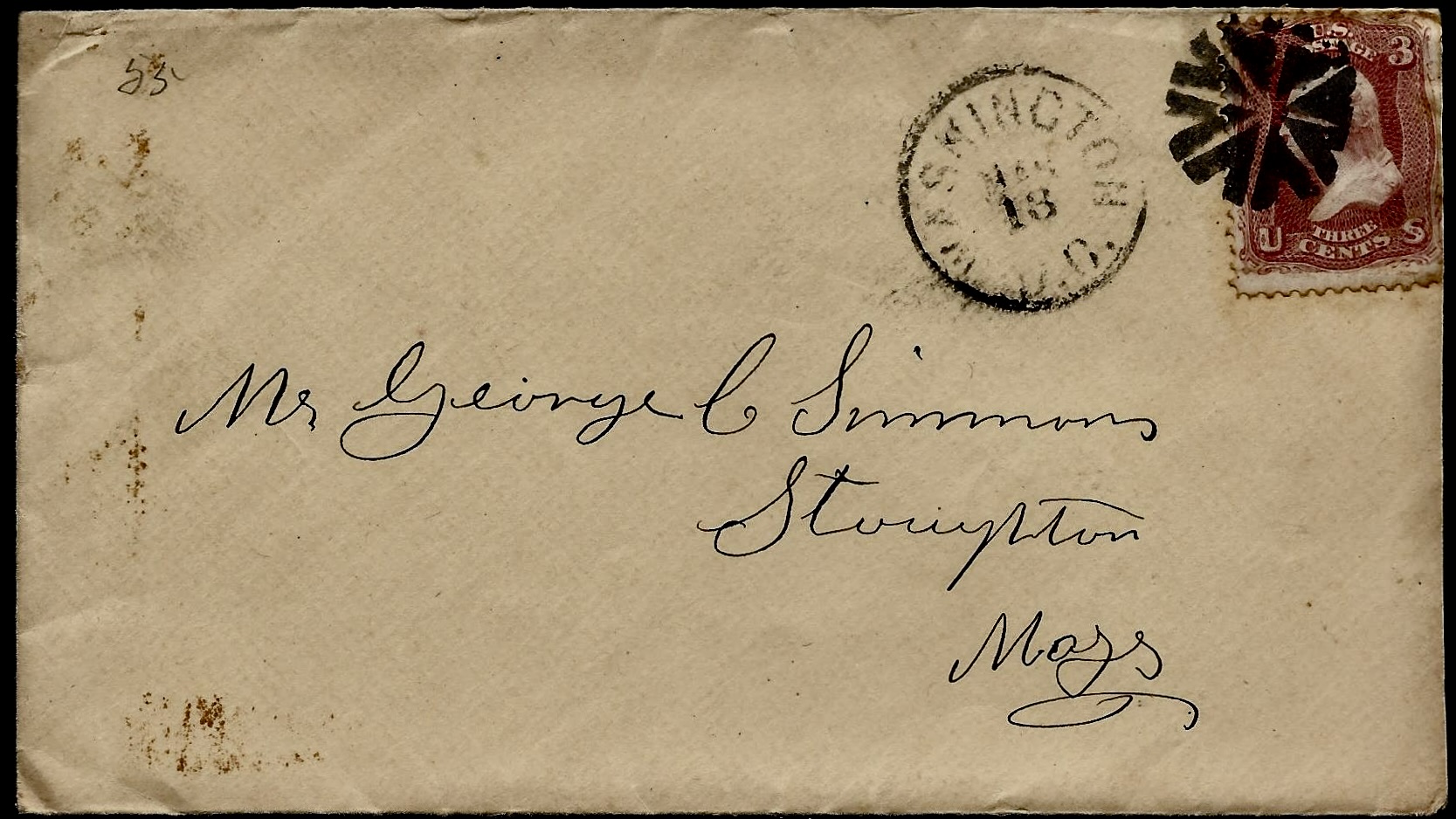
James wrote the letter to his brother, George C. Simmons (1824-1889) of Stoughton, Norfolk county, Massachusetts where he worked in a boot manufactory.
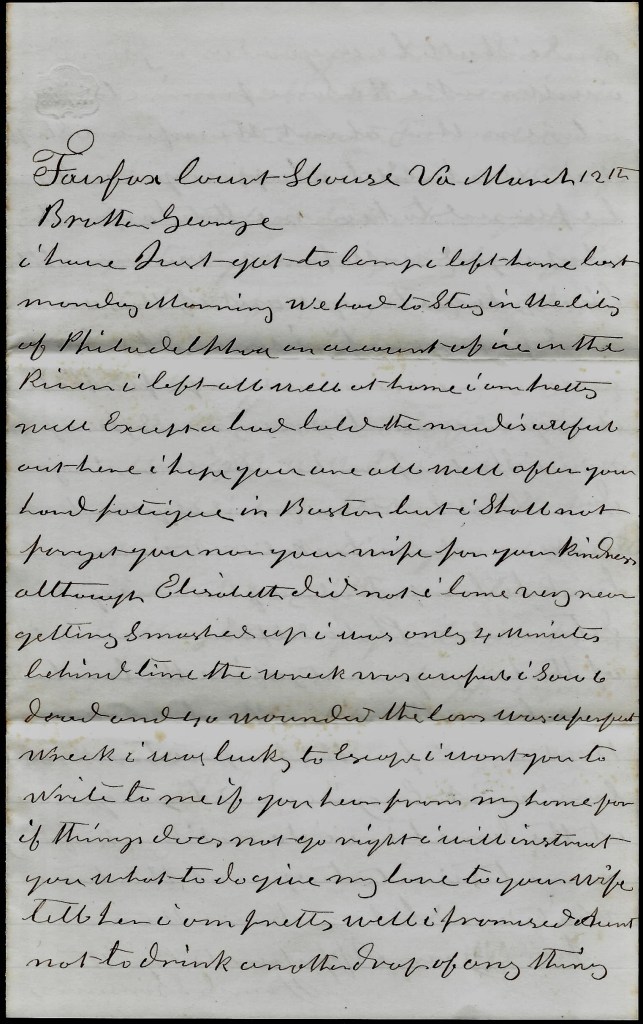
Transcription
Fairfax Court House, Va.
March 25, [1865]
Brother George,
I have just got to camp. I left home last Monday morning. We had to stay in the City of Philadelphia on account of ice in the river. I left all well at home. I am pretty well except a bad cold. The mud is awful out here. I hope you are all well after your hard fatigue in Boston but I shall not forget you nor your wife for your kindness although Elizabeth did not. I come very near getting smashed up. I was only 4 minutes behind time. The wreck was awful. I saw six dead and 40 wounded. The loss was a perfect wreck. I was lucky to escape.
I want you to write me if you hear from my home for if things does not go right, I will instruct you what to do. Give my love to your wife. Tell her I am pretty well. I promised Aunt not to drink another drop of anything and I shall be as good as my word. I will make the same promise to you. I love nothing about the infernal stuff—it is all a habit. So I suppose you will be pleased to hear me state to you this.
I hope God will prosper our arms this spring so we can get out of this army and rejoin our families and kindred once more. We must hope for the best. It is good weather but very muddy here just now. I started from here just now to go down street but was afraid of getting lost in tyhe mud so I backed out.
I arrived back to camp Friday afternoon. I got detained in Philadelphia on account of the large quantity of ice. The cars could not cross the river. They cross on a boat made for the purpose. Tracks are laid on it. Engine and train goes over at the same time. 1
I do not think of any more to write to you at this time. Write and let me know the news. From your affectionate brother, — James S. Simmons
The boys were all glad to see me back. They came and shook hands with me. They had two horses die with Farcy 2 while I was gone. They had no one to doctor them if they had all been sick. I have got to get things straightened up. They can’t get a man to look after everything as I do. The Captain is glad to see me in my old place, I tell you. He is very friendly to me and sociable. I do just as I please. It is alright with him what I do. He asks me about the stable and the horses my opinion. It is all right what I tell him. That’s what no other man can do in the Battery. If you could be i nmy house and see my big fire, you would laugh, it looks bully I tell you. Well, I must stop so goodnight. — J. S. S.
1 Philadelphia relied on ferries, including those operated by companies like the Camden and Atlantic (C&A) Railroad and the Pennsylvania Railroad (PRR), to transport train cars and passengers across the Delaware River between Philadelphia and Camden, as no bridge crossed the width of the river until 1926.
2 The horse disease sometimes called “farcy” is actually glanders. Its skin form is known as farcy. It’s a serious, contagious, and often fatal disease caused by the bacterium Burkholderia mallei.

 Spared & Shared 23