
The following letter was probably written by Sgt. John A. Buchanan (1826-1885) of Co. A, 100th Indiana Infantry. John was 35 years old and married to Emily (“Em”) Burns when he enlisted with his younger brother George in August 1862. John survived the war, mustering out on 8 June 1865. His brother George was not so lucky. He was wounded severely in November 1864 at the Battle of Griswoldville, Georgia, though he survived and was able to return to farming after the war. They were both listed as being residents of Corunna, a little farming village in DeKalb county—roughly 30 miles north of Fort Wayne, Indiana. I don’t have a picture of either of them but I’ve posted two members of the 100th Indiana wearing their Zouave jacket with the distinctive “100th” badge sewn on their breast, the arabic numeral 100 surrounded by an oval.
Co. A was raised in DeKalb county, Indiana, and after training in Fort Wayne and Indianapolis, they were sent to Carrollton, Kentucky, for a brief time and then were ordered to Memphis by way of Cairo and the Mississippi river in November 1862. They were stationed at Fort Pickering and assigned to a brigade that consisted of the 100th Indiana, 40th Illinois, 46th Ohio, 6th Iowa, and the 13th US Infantry. 1st Battalion. In late November 1862, the Brigade advanced under the command of Maj. Gen. James B. McPherson until they reached the Tallahatchie River where the Confederates under Price and Van Dorn put up some resistance. By December 18th, the command had reached Yocna Patufna Creek. At this point the command was recalled to Holly Springs, Grant’s supply depot, which had been raided and ransacked by Van Dorn on 20 December 1862—essentially foiling Grant’s overland campaign against Vicksburg. The 100th Indiana only remained a few days in Holly Springs before moving on to Grand Junction where they went into winter quarters and were detailed as guards on the Memphis and Charleston Railroad.


Transcription
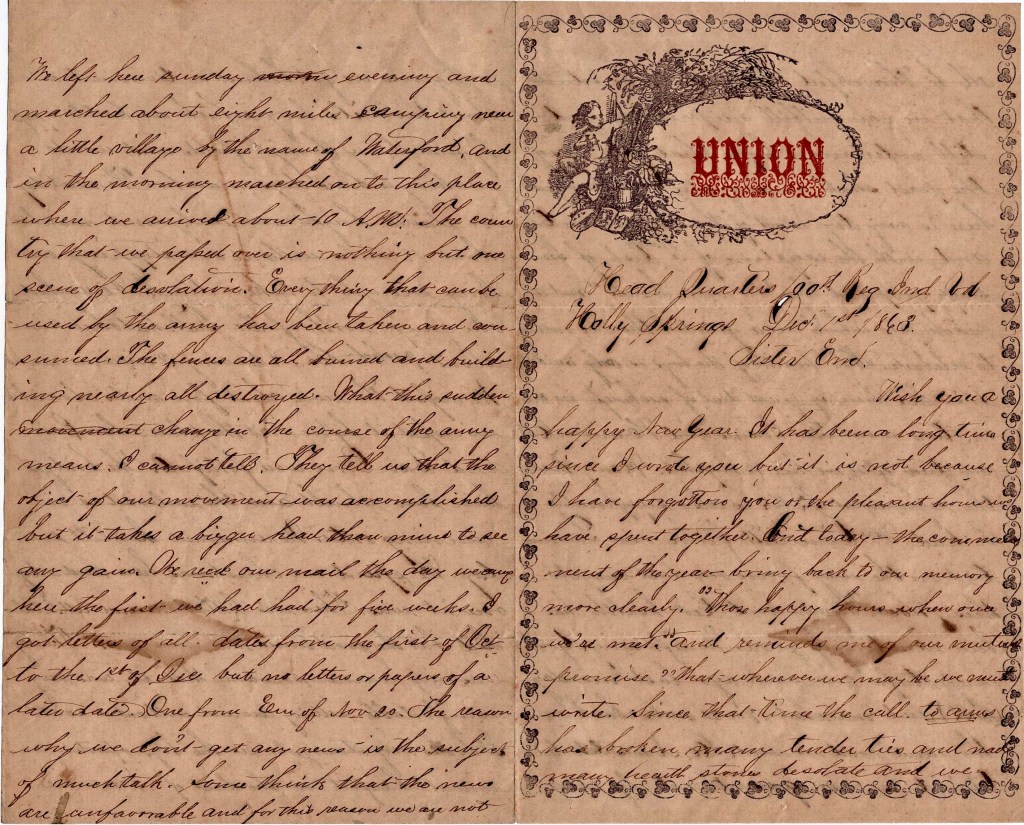
Headquarters 100th Reg. Indiana Volunteers
Holly Springs [Mississippi]December [January] 1st 1863
Sister Em.
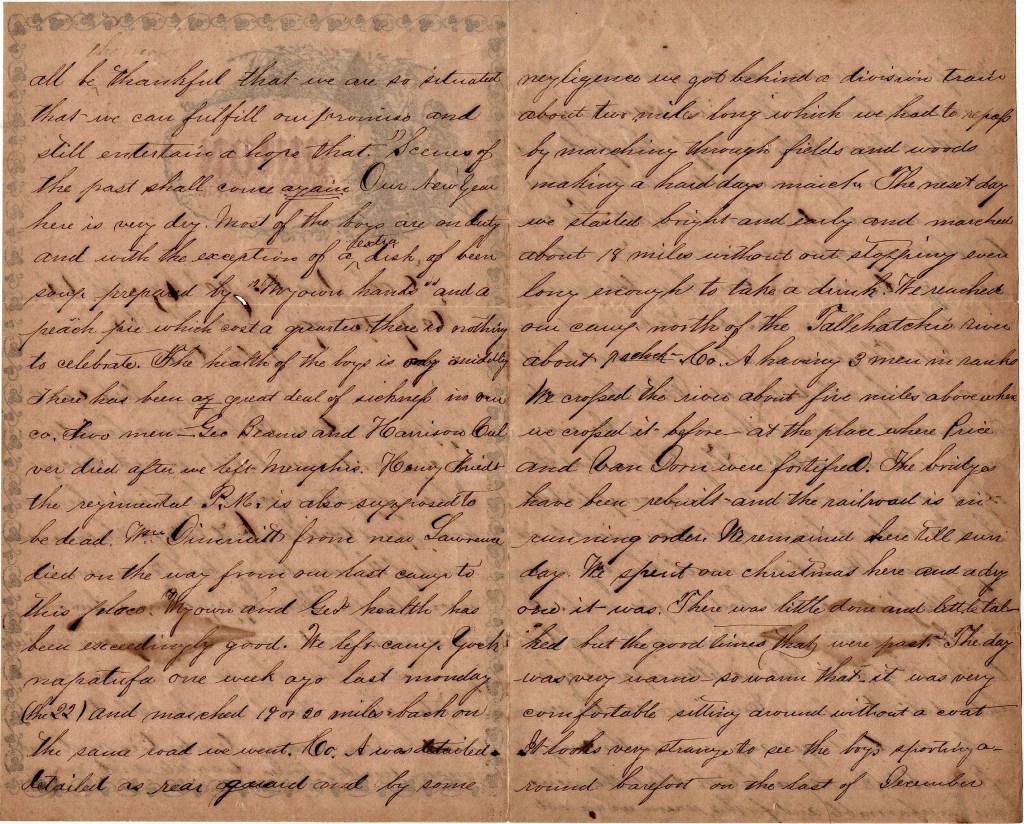
Wish you a Happy New Year. It has been a long time since I wrote you but it is not because I have forgotten you or the pleasant hours we have spent together. But today—the commencement of the year—bring back to our memory more clearly those happy hours when our were met” and reminds me of our meeting promise that wherever we may be, we must write. Since that time the call to arms has broken many tender ties and made man’s hearth stones desolate and we all be thankful that we are so situated that we can fulfill our promise and still entertain hope that “scenes of the past shall come again.”
Our New Year here is very dry. Most of the boys are on duty and with the exception of a extra dish of bean soup prepared by “my own hands” and a peach pie which cost a quarter, there is nothing to celebrate. The health of the boys is only middling. There has been a great deal of sickness in our company. Two men—George Beams 1 and Harrison Culver 2 died after we left Memphis. Henry Friedt 3 the regimental post master, is also supposed to be dead. William [H.] Dimmitt 4 from near Lawrence died on the way from our last camp to this place. My own and [brother] George’s health has been exceedingly good.
We left camp Yocknaptufa one week ago last Monday (the 22nd) and marched 19 or 20 miles back on the same road we went. Co. A was detailed as rear guard and by some negligence we got behind a division train about two miles long which we had to pass by marching through fields and woods making a hard days march. The next day we started bright and early and marched about 18 miles without any stopping even long enough to take a drink. We reached our camp north of the Tallhatchie river about 7 o’clock., Co. A having 3 men in ranks. We crossed the river about five miles above where we crossed it before—at the place where Price and Van Dorn were fortified. The bridges have ben rebuilt and the railroad is in running order. We remained here till Sunday.
We spent our Christmas here and a dry one it was. There was little done and little talked but the good times that were past. The day was very warm—so warm that it was very comfortable sitting around without a coat. It looks very strange to see the boys sporting around barefoot on the last of December. We left here Sunday evening and marched about eight miles, camping near a little village by the name of Waterford and in the morning marched on to this place where we arrived about 10 a.m.
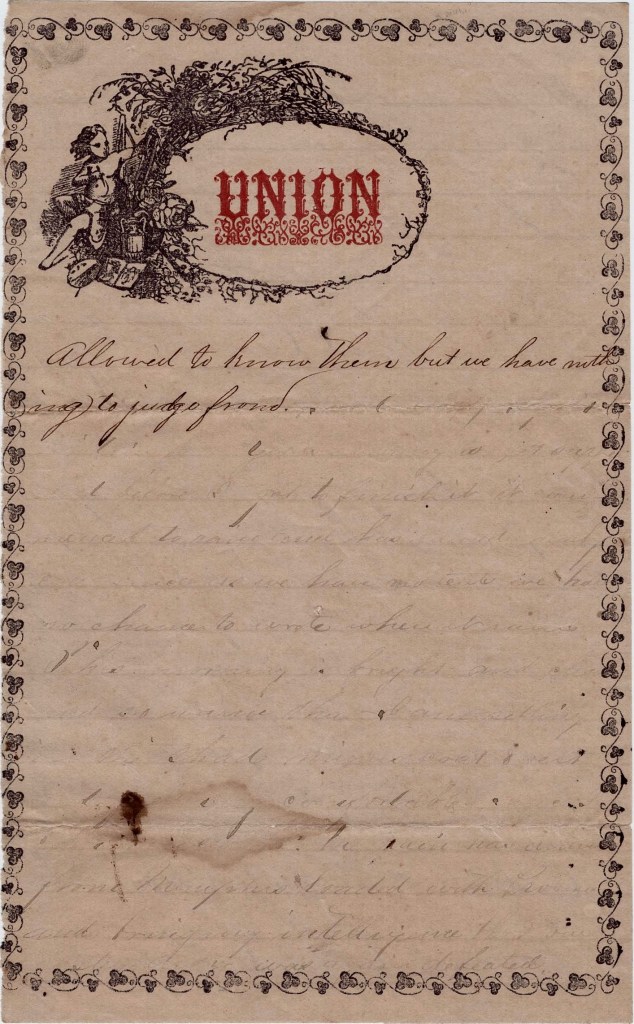
The country that we passed over is nothing but one scene of desolation. Everything that can be used by the army has been taken and consumed. The fences are all burned and buildings nearly all destroyed. What this sudden change in the course of the army means, I cannot tell. They tell us that the object of our movement was accomplished but it takes a bigger head than mine to see any gain. We received our mail the day we came here—the first we had had for five weeks. I got letters of all dates from the first of October to the 1st of December, but no letters or papers of a later date. One from [my wife] Em of November 20. The reason why we don’t get any news is the subject of much talk. Some think that the news are unfavorable and for this reason we are not allowed to know them but we have nothing to judge from.
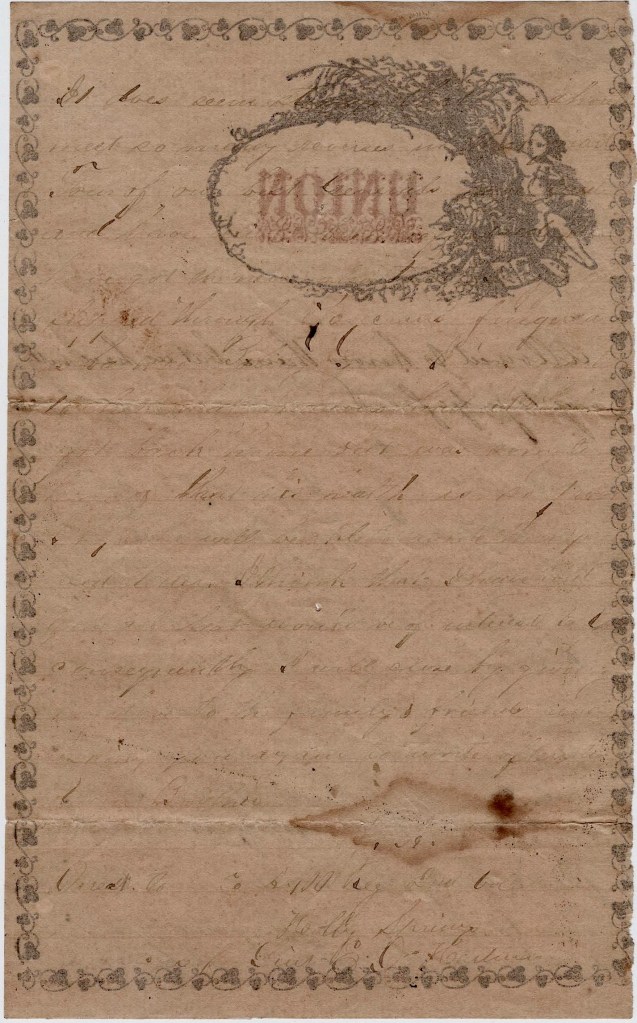
[Remainder of letter written with very faint ink and nearly illegible though I can make out “direct to Company A, 100th Reg. Indiana Volunteers, Holly Springs, in care of Lieut. E. O. Hartman]
1 George Beams of Spencerville, Indiana, died at Memphis, Tennessee, on 24 November 1862.
2 Harrison Culver of Auburn, Indiana, died at Memphis, Tennessee, on 24 December 1862.
3 Henry Friedt of Spencerville, Indiana, was discharged on 30 January 1863.
4 William H. Dimmitt died at Abbyville, Tennessee on 24 December 1862.
 Spared & Shared 23