

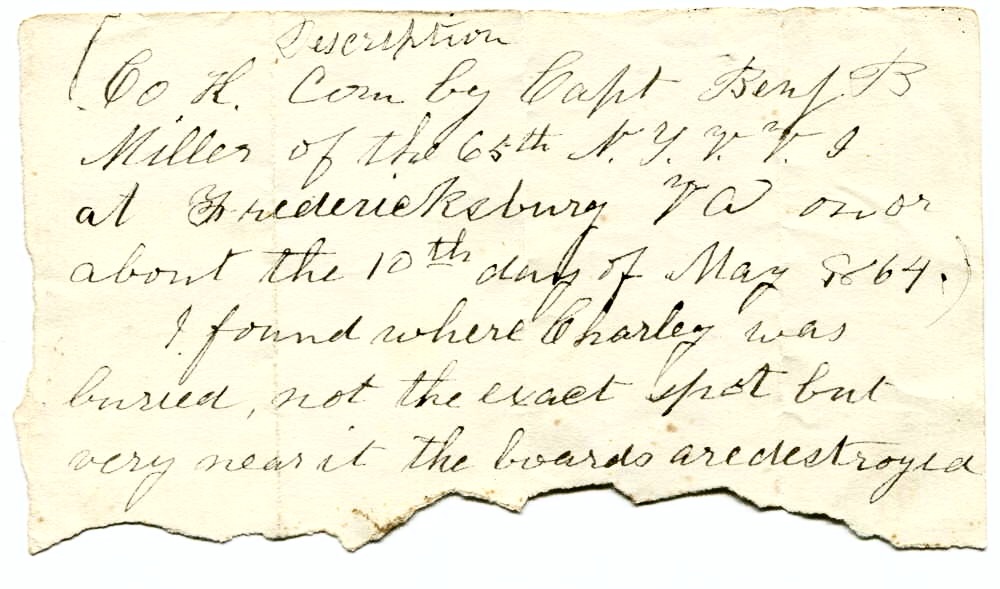
These letter was written by Pvt. Charles S. Crockett (1838-1864) of Co. K, 65th New York Infantry (a.k.a. the 1st U.S. Chasseurs). The regiment was primarily raised in New York City, but also recruited in Connecticut; Seneca, Ohio; and Providence, Rhode Island. Crockett of Company K was from Adams township, Seneca county, Ohio. He was the son of James Crockett (1798-1874) and Mary Parsons Haskell (1801-1874). When he enlisted, he was described as 6 foot 1 inches tall, with blue eyes and dark hair—a farmer. He reenlisted in the regiment in December 1863 but did not survive the war. He died at Fredericksburg from wounds received in the Battle of the Wilderness on 6 May 1864. His death occurred on 10 May 1864.
Crockett’s 2nd letter alludes to the losses of the regiment at Gettysburg and of the more recent action at Wapping Heights (Manassas Gap) where they participated in the attack by the Excelsior Brigade led by Gen. Spinola in the evening of July 23, 1863. See “Too Good to be True: At Manassas Gap,” by Rick Barram (2018).


Letter 1
Camp near Harrison’s Landing
On James River, Va.
July 22, 1862
John Gifford, Esq., Laurens, N. H.
Friend John,
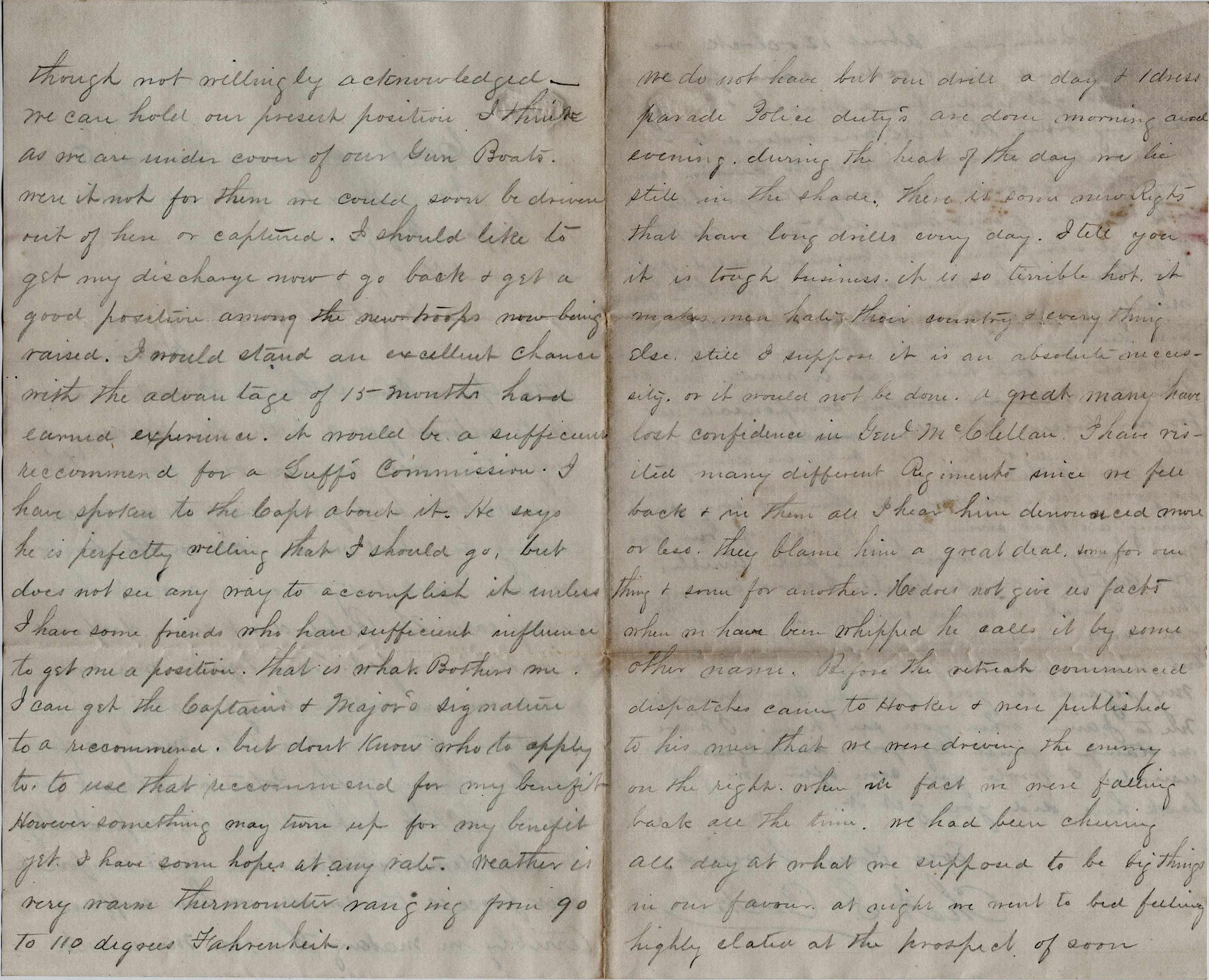
Having a little spare time I thought I would devote it to interest you a little. The heading of my letter will tell you our present location. We have had quite easy times since coming here but we are still on the front. We have picket duty once in a week, but it is very easy. The Rebels don’t seem disposed to molest us yet. Their pickets are very quiet. We are entrenching & making our position strong as possible. Many a farm has this Army of the Potomac almost ruined by the pick and shovel. We shall probably make no demonstration here until reinforced, Our force is too small, We have suffered terribly in making this rear movement though not willingly acknowledged. We can hold our present position I think as we are under cover of our gunboats. Were it not for them, we could soon be driven out of here or captured.
I should like to get my discharge now & go back & get a good position among the new troops now being raised. I would stand an excellent chance with the advantage of 15 months hard earned experience. It would be a sufficient recommend for a Lieutenant’s commission. I have spoken to the Captain about it. He says he is perfectly willing that I should go, but does not see any way to accomplish it unless I have some friends who have sufficient influence to get me a position. That is what bothers me. I can get the Captain and Major’s signature to a recommend but don’t know who to apply to to use that recommend for my benefit. However, something may turn up for my benefit yet. I have some hopes at any rate.
Weather is very warm—thermometer ranging from 90 to 110 degrees Fahrenheit. We do not have but one drill a day & 1 dress parade. Police duty’s are done morning and evening. During the heat of the day, we lie still in the shade. There is some new regiments that have long drills every day. I tell you, it is tough business. It is so terrible hot, it makes men hate their country & everything else. Still I suppose it is an absolute necessity or it would not be done.
A great many have lost confidence in General McClellan. I have visited many different regiments since we fell back & in them all I hear him denounced more or less. They blame him a great deal, some for one thing & some for another. He does not give us facts when we have been whipped. He calls it by some other name. Before the retreat commenced, dispatches came to Hooker & were published to his men that we were driving the enemy on the right when in fact we were falling back all the time. We had been cheering all day at what we supposed to be big things in our favor. At night we went to bed feeling highly elated at the prospect of soon being in Richmond. About 12 o’clock we were all called up & orders came for every man to get ready for a march & in light marching order. The sick ones were ordered to start immediately & we were ordered to destroy everything that we could not carry—knapsacks, tents, & even guns were destroyed, clothing of every description were burned instead of giving them to the men when half of them were nearly naked. Ammunition & subsistence were destroyed all along the lines the amount of which no one has dared to make an estimate. Millions wouldn’t compensate us for our losses. These stores did not fall into the hands of the rebels but were destroyed—that is, the most of them.

The retreat, however, was made in good order. We whipped them at every point during all that seven days fighting. If our loss was heavy, there must have been terrible. Our artillery made terrible havoc among them. I wish I could explain to you so that you could understand it as I have seen it but it is impossible. But I must close, My regards to your family. Also remember me to James when you see him. I have no stamp & must beg your indulgence as usual. I wrote you soon after we got back here. Did you. get it? Ever your friend, — Charles S. Crockett

Letter 2
Note: This letter is from the private collection of Greg Herr and was made available for transcription and publication on Spared & Shared by express consent.
Wagon Park of 1st Regt., Ex[celsior] Brigade
Near Warrenton, Va.
July 29th 1863
Jno. Gifford, Laurens, New York
Friend John, after so long a time I have again got a moment’s time to write to you. I assure you I could not well do it sooner. We arrived here on the afternoon of July 26th & are here yet. Everything goes to show, however, that today will be our last day here. We have had quite a rest. Have got new clothes for the most needy. Have got our wounded taken care of. Have got harnesses & wagons repaired & are in pretty good condition to go on again. Which way through, I cannot tell.
Our Colonel—Major—Adjutant with one sergeant and six privates have gone to New York after drafts to fill up our ranks. Each regiment of the Brigade & Division have sent in the same manner & I expect we will soon have our Division as large as ever. We had come down to our last hard tack when we arrived here. It seems that the Rebel guerrilla parties annoyed our trains so much between Upperville and Harper’s Ferry that communication was stopped. The consequence was I had a half day’s ration to issue to get from Piedmont Station to Warrenton. The Rebs held Warrenton until the day before we came here.
I assure you, we have done some tall marching since we left Falmouth, Virginia, the 10th day of June last. I never had so hard a time in my life to my end up. It has been night and day, rain and shine, day after day, week after week. Nothing we have ever been called on to do could begin [to compare] with the last campaign. We have all suffered severely in wear and tear, in loss of men, and everything belonging to war. But I think the campaign is about over until we get the drafts in proper order & our ranks filled.
Our regiment lost in the Gettysburg battle 108 men in killed, wounded, and missing. And in a charge made on the 25th [23rd] of July at Manassas Gap we lost 38 men in killed & wounded. Besides [this], we have lost a great many by sickness, &c., consequently in making such long fatiguing marches. I am astounded that men can stand as much as they have done. I have had a good horse to ride during all the marching & yet I have been so worn and tired many a time that I have fallen asleep in the saddle & it seemed as though I must give up. Still I have made out to stand it so far.
I have not time to write more as I have just got an order to go to the regiment. Excuse briefness & do not think amiss if I fail to write you often. In friendship yours, — Charles Crockett


 Spared & Shared 23