
The following letters is signed “David” and so I can’t be 100% certain it was written by David Evans Moore, Jr. (1840-1920) but I consider him the one most likely to have penned the letter while serving in the Rockbridge Artillery in mid-April 1864. David was the son of David E. Moore (1797-1875) and Elizabeth M. Harvey (1809-1888). He was just concluding his junior year at Washington College in Lexington, Rockbridge county, Virginia, when he joined the battery in late April 1861. He enlisted as a private but had worked his way up in rank to 3rd Sergeant by the time this letter was written. He was with the Battery at the surrender at Appomattox Court House where the members tore up their flags and distributed the remnants as mementoes rather than turn them over to the Union army. After the war, he returned to Lexington where he was employed as a school teacher and a lawyer.
David wrote this letter on the eve of Grant’s Overland Campaign. The Rockbridge Artillery participated in the Battle of Spotsylvania Court House in May 1864 but was only lightly engaged during the remainder of the campaign, Once the fighting reached Petersburg, the Rockbridge Artillery deployed near Drewry’s Bluff and New Market Heights. On July 27, while harassing Union gunboats on the James River during the First Battle of Deep Bottom, the battery lost four cannon when Union infantry drove off the battery’s supports. Four replacement tubes were quickly issued, and they continued to harass ship traffic on the James River for the remainder of the summer. During the autumn, the Rockbridge Artillery manned entrenchments at Fort Harrison and Fort Gilmore along the Richmond line. On September 29, 1864, Union troops overran Fort Gilmore and then Fort Harrison; the Rockbridge Artillery withdrew from both positions without a loss. It went into winter quarters at Fort Alexander until the fall of Petersburg and Richmond on April 2, 1865. [Source: First Rockbridge Artillery.]

T R A N S C R I P T I O N
Artillery Camp near Frederick’s Hall
Louisa County, Virginia
April 18, 1864
Friend William,
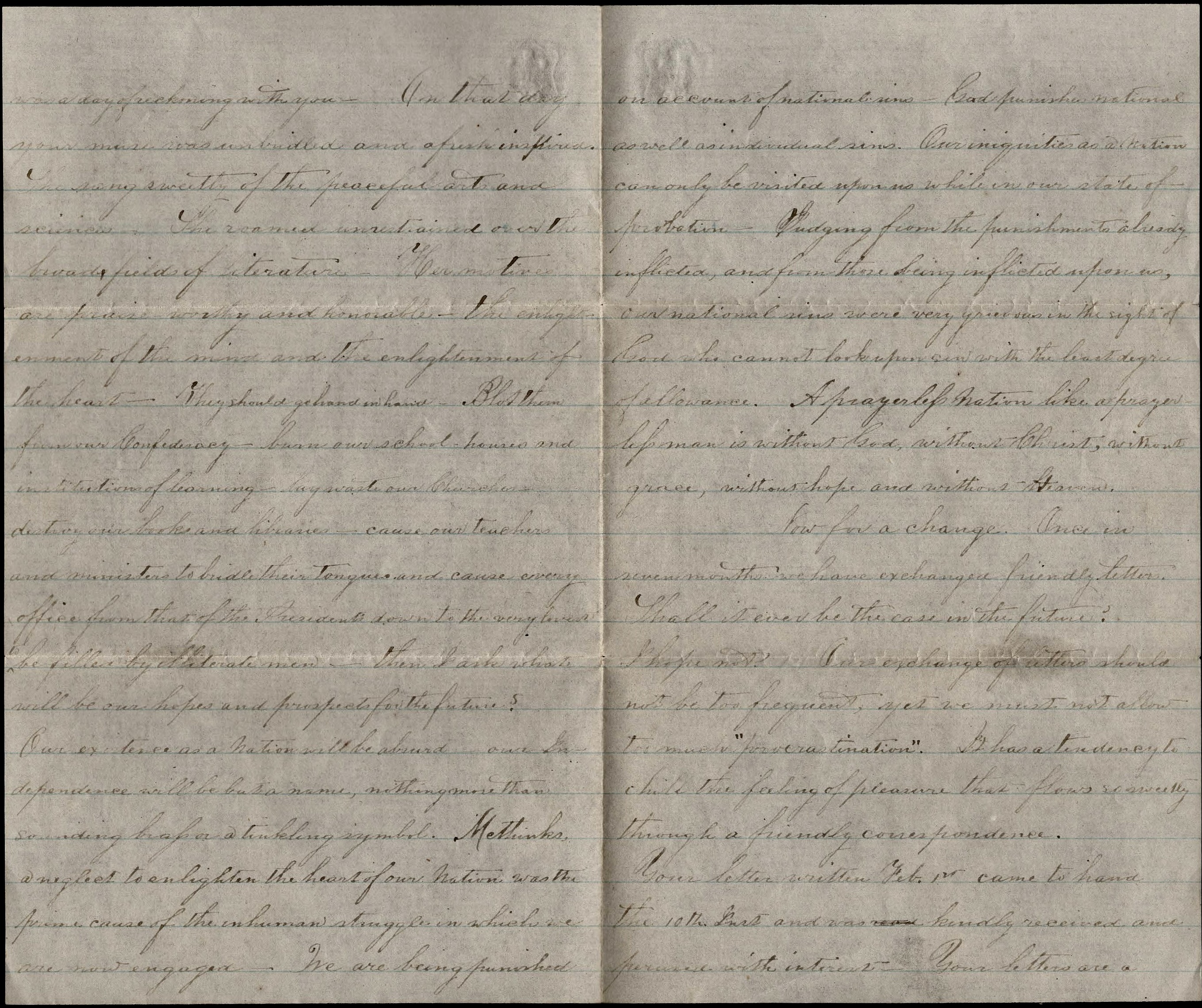
My muse sang so much about the horrors of war and so long that you did not recover from the effects for five months, It is a source of regret to me that your muse was silent so long. I had almost concluded that you had hung your hoop so high upon the willow that you never would be able to reach it. Had I not remembered your procrastination habit, I mist certainly should have given up every hope of receiving a letter from you. I looked long and anxiously for a kind missive penned by thine own hand and not in vain. A new year or month often reminds of resolutions already made and not strictly kept. While thinking about forming new plans and new resolutions, we are forcibly reminded of those sadly neglected and shamefully broken.
The 1st of February perhaps was a day of reckoning with you. On that day your muse was unbridled and afresh inspired. She song sweetly of the peaceful arts and sciences. She roamed unrestrained over the broad fields of literature. Her motives are praiseworthy and honorable—the enlightenments of the mind and the enlightenment of the heart. They should go hand in hand. Blot them from our Confederacy. Burn our school-houses and institutions of learning. Lay waste our churches. Destroy our books and libraries. Cause our teachers and ministers to bridle their tongues and cause every office from that of the President’s down to the very lowest to be filled by illiterate men. Then I ask what will be our hopes and prospects for the future?
Our existence as a Nation will be absurd. Our independence will be but a name—nothing more than sounding brass or a tinkling cymbal. Methinks a neglect to enlighten the heart of our Nation was the prime cause of the inhuman struggle in which we are now engaged. We are being punished on account of our national sins. God punishes national as well as individual sins. Our iniquities as a Nation can only be visited upon us while in our state of probation. Judging from the punishments already inflicted, and from those being inflicted upon us, our national sins were very grievous in the sight of God who cannot look upon sin with the least degree of allowance. A prayerless Nation like a prayerless man is without God, without Christ, without grace, without hope and without Heaven.
Now for a change, Once in seven months we have exchanged friendly letters. Shall it ever be the case in the future? I hope not. Our exchange of letters should not be too frequent, yet we must now allow to much “procrastination.” It has a tendency to chill the feeling of pleasure that flows so sweetly through a friendly correspondence. Your letter written February 1st came to hand the 10th inst. and was kindly received and perused with interest. Your letters are a great treat to me. Mr. Lowry brought the letter to the regiment. I was absent on furlough at the time. The letter was then sent to Rockbridge. From some defect in the mail arrangement, it did not come while I was at home. Finally, however, it found its way to the “old homestead.” After a long time, it came to me. The gentleman of my company who sent it to Rockbridge told me that it was from my sweetheart on my return to the company. He could not tell me what gentleman of Captain G’s company gave it to him but told me it was from Salem as I inspected at once that it was from you. Sometime afterwards I saw Mr. Lowry. He told me that you sent it. I have a slight acquaintance with Mr. Lowry and Mr. Hubbert. I saw Mr. Hubbert on yesterday. He is quite well. I understood from him that you are a candidate for the clerkship of the county. I wish you all success on election day. If I had a vote, you should have it.
From the best information I can obtain, we shall leave here the first of next week. We shall go either in the neighborhood of Gordonsville or Orange Court House. We are too far from the front in case the Yanks should make a sudden dash. In a couple of weeks, there will be fine grazing for our horses at the front. This is not a grass country. It will be with reluctance that I shall leave my comfortable quarters, yet I think it perfectly right to do so. I prepared on yesterday for an active campaign by sending my extra baggage home. There are many pleasant associations connected with this encampment and neighborhood. I have formed some very pleasant acquaintances with the fair sex since I have been here. Two of my friends and myself went into the country on a visit yesterday evening. We met with three young ladies whose acquaintance we had previously formed. They conversed fluently, performed well upon the piano and sang so sweetly for us, The time passed away very pleasantly indeed and too rapidly for me. We did not get to camp till 12 o’clock. We intended to leave at 9 p.m. It was not our fault we remained so late. There are some nice young ladies in this section of country.
Rev. Mr. H. White, who has been with our regiment as missionary during the winter, left on yesterday for the purpose of preaching about three weeks to the congregations of which he is pastor. He then expect to be with us again. The Spirit of God has been in our midst and I think He is still with us. I received a letter from brother John not long since. He is still in Mississippi. He is well. Father’s family was well as usual when I heard last. I received a letter on the 10th. I received to excellent and interesting letters from your sisters last week. I shall answer them soon. I send my love to all the family. Please write soon. — David

 Spared & Shared 23