
The following letter was written by Vernon Obadiah Wilcox (1836-1919), the son of John William Wilcox (1811-1904) and Sally E. Stowell (1810-1865). Vernon was 24 years old and still working on his father’s farm with his younger brother Allen in Plato, Kane county, Illinois when the census taker came knocking on the door in July 1860.
Vernon began his military service on 23 September 1861 when he enlisted as a sergeant in Smith’s Independent Cavalry. Dyer’s Unit History claims this unit was organized at Aurora as Co. B Cavalry, 36th Illinois Infantry. They were sent into Missouri in November 1861 and joined in Curtis’ Campaign against Price in Missouri and Arkansas in February and March 1862, including the Battle of Pea Ridge. He later transferred to the 15th Illinois Cavalry but was discharged from that regiment in July 1862 for disability. Muster rolls record his height as 5′ 7″ and claimed his hair was dark and eyes hazel.
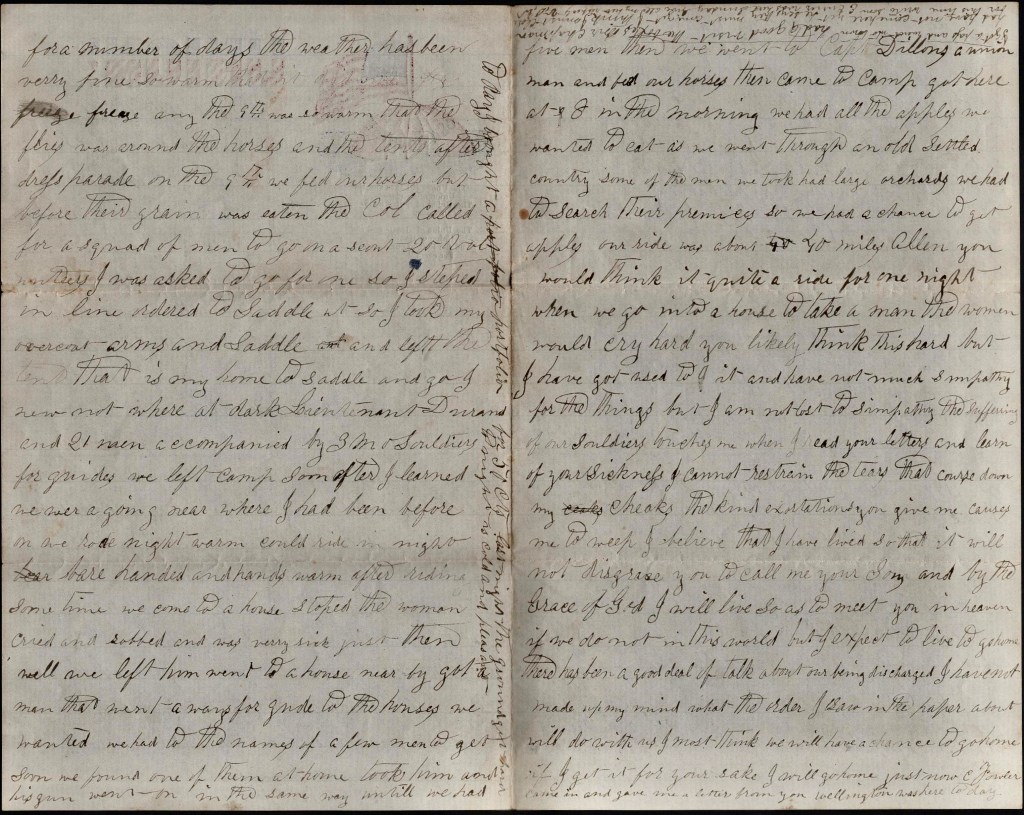
T R A N S C R I P T I O N
December 11th 1861
Dear Parents, Brother & Sisters,
This opportunity I embrace to write you a few lines. Yours written the first and mailed the 5th came to me yesterday the 10th. It camp in camp the night before but I was out on a scout. Was glad to hear again from you. Would be glad if your healths were better but know that what you say about its being better to be sick at home than here but those from this regiment takes a good care as any of any sick as they could be expected to. For my part, my health is good. I wish you could see my face now and see how healthy I look. My weight today is 139 in light clothes—no overcoat or arms. In the summer before I enlisted, my weight was 126 or 127. This is doing well for Vernon. Allen, how much do you weigh?
Well, the watch came all right. I wish you to know how much it cost. This was answered in the last. Now I will tell you about the last scout and the weather, The latter first.
For a number of days the weather has been very fine—so warm that at night it did not freeze any. The 9th was so warm that the flies was around the horses and the tents after dress parade. On the 9th we fed our horses but before their grain was eaten, the Colonel called for a squad of men to go on a scout—twenty volunteers. I was asked to go for one so I stepped in line, ordered to saddle up, so I took my overcoat, arms and saddle and left the tent—that is, my home, to saddle and go. I knew not where, At dark, Lieutenant Durand and 21 men accompanied by 3 Missouri soldiers for guides. We left camp. Soon after I learned we were a going near where I had ben before. On we rode—night warm—could rife in night bare handed and hands warm. After riding some time we came to a house—stopped—the woman cried and sobbed and was very sick just then. Well we left him, went to a house nearby, got a man that went a ways for guide to the houses we wanted. We had the names of a few men to get. Soon we found one of them at home, took him and his gun. Went on in the same way until we had five men. Then we went to Capt. Dillon’s—a Union man—and fed our horses. Then came to camp. Got here at 8 in the morning. We had all the apples we wanted to eat as we went through an old settled country. Some of the men we took had large orchards. We had to search their premises so we had a chance to get apples. Our ride was about 40 miles.
Allen, you would think it quite a ride for one night. When we go into a house to take a man, the women would cry hard. You likely think this hard but I have got used to it and have not much sympathy for the things. But I am not lost to sympathy. The suffering of our soldiers touches me. When I read your letters and learn of your sickness, I cannot restrain the tears that course down my cheeks. The kind exhortations you give me causes me to weep, I believe that I have lived so that it will not disgrace you to call me your son, and by the grace of God, I will. live so as to meet you in heaven if we do not in this world. But I expect to live to go home.
There has been a good deal of talk about our being discharged. I have not made up my mind what the order I saw in the paper about will do with us. I most think we will have a chance to go home. If I get it, for your sake, I will go home. Just now C. Fowler came in and gave me a letter from you. Wellington was here today.
A joke for me. I thought I had written the paper over and was crossing in a few words to you but when I looked here was more to write. Maybe you cannot read the fine so I will write it over. C. Fowler brought me a letter. Wellington came here this morning. I got a pass, went out into town, had a good visit with him, came back. The company was preparing to accompany the regiment to C. The 13th Illinois went with them, maneuvered around there a while, then came back. I enjoy myself very well or should if it were not for home. I love home dearly. I wish that I could see you. If we stay here and you think best, and if I can get a furlough, I will go. Julius Pratt went home unwell. He will tell you all about me if you see him. G. Campbell has come here to his tent having been discharged from the hospital. There is none of our company there now. Well, the next news is about Smith, He does not succeed in gaining the command of the company. Neither will he. And if he is smart, he will let Co. B alone. A rascal must keep clear when once started. What the army ought to have is to be purged from such men. I wrote W. H. Morehouse a letter, Have you heard from it? Ask him if he has got it. Tell all the folks to write me.
E. Currier was here Sunday. He looks well—a little darker complexion than when he was at home. Excuse bad writing for the pen is worn out. I must buy another. From your son and brother, — V. O. Wilcox
Today bought a portfolio for 50 cts. Last night the ground got hard. Tonight is cold and pleasant.

 Spared & Shared 23