

The following letter was written by Harrison Guiles (1841-1896) who was born at at Charleston, Montgomery County, New York, on 17 January 1841, the son of William Guiles (1810-1877) and Margaret Rulison (1822-1916) of Conklin, Broome county, New York. At the age of twenty he enlisted (May 1861) in Co. F (the “Broom County Volunteers”), 27th New York Infantry and served two years when he was honorably discharged in 1863. This incredible letter was written on 6 August 1861, a couple weeks after the Battle of Manassas or 1st Bull Run in which the 27th New York Infantry participated, led by their Colonel Henry W. Slocum who was wounded in the day’s action. The regiment’s losses included 1 officer and 25 men killed; two officers and 42 enlisted men wounded. There were 60 reported missing.
Returning home after his term of service had ended, Harrison was married on the 12th of March 1864 to Miss Emma Jane Darling.
I can’t be certain but suspect the letter was written to Annis Dillon (1844-1926), the 15 year-old daughter of Hamlet Dillon (1812-1890) and Adelia Chapman (1817-1889) who lived in the same village as Harrison, Conklin, New York. She later married William Alexander Bowman (1829-1898)
T R A N S C R I P T I O N
Washington [D. C.]
August 6, 1861
My friend,
I now take my pen in hand to tell you about those friends but I am sorry that I have bad news for you. The report that I received when I wrote before is all false—a [ ] rumor. Our friend [Frank] Gunther I think is a prisoner and for all that I know, it not in the land of the living now but I hope he is. He has not been heard from since he was seen at Fairfax and the probability is that he is now in their doctor’s hands and the others. [Sidney A.] McKune has not been heard from since the battle. Tybe [?] is here but not very well at present. And Spencer Whipple I heard that he is wounded but how true it is is more than I can tell. And myself, I am well and hope these [lines] will find you the same.
I received your letter yesterday and you may be assured that it come welcome too. And so they all will be that you write. I am having a very good time now, not having to drill much since we returned from the battlefield. My friend, that was a hard time. We was almost tired out and then marched clear back to Washington. I traveled 60 miles and never tasted food and fought four hours besides. It was enough to make one think of home. We expect to leave here before long. I hope so.
Annis, you must excuse my poor writing for I have been on duty the last twenty-four hours and you must know how one feels after being out all night. I think you do it. It’s very warm here and what is worse, the flies is very troublesome here. I am eating here in our old shanty and have nothing but a rough board to write on at that. I would like to be home to go to camp meeting this fall but I hardly think I will sometimes. I have had no [ ] and the time we had the fourth I feel like flying. But never mind. It will come out all right by and by. I wish that you could be here just to see the cavalry and soldiers perform. They have great old times. But it is no sport for me to settle from them.
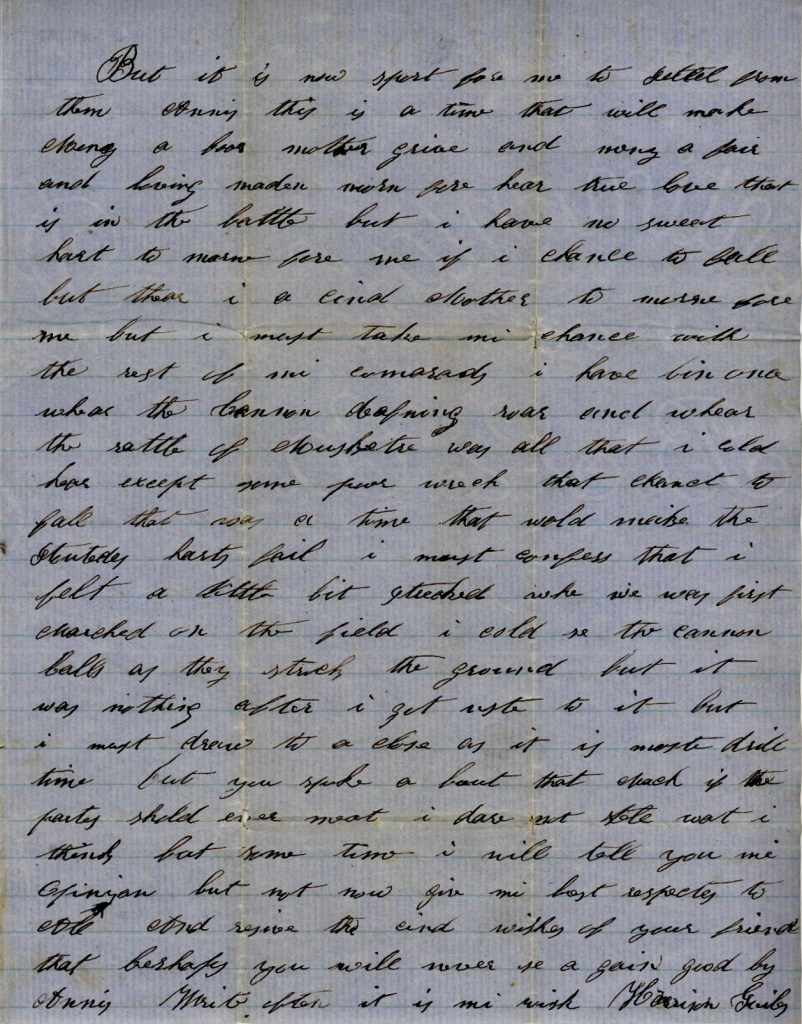
Annis, this is a time that will make many a poor mother grieve and many a fair and loving maiden mourn for her true love that is in the battle. But I have no sweetheart to mourn for me if I chance to fall. But there is a kind mother to mourn for me but I must take my chance with the rest of my comrades. I have been once where the cannon’s deafening roar and where the rattle of musketry was all that I could hear except some poor wretch that chanced to fall. That was a time that would make the sturdy hearts fail. I must confess that I felt a little bit wretched when we first marched on the field. I could see the cannon balls as they struck the ground but it was nothing after I got used to it.
But I must draw to a close as it is most drill time. But you spoke about that speech. If the party should ever meet, I dare not state what I think. But some time I will tell you my opinion. But now give my best respects to [ ] and receive the kind wishes of your friend that perhaps you will never see again. Goodbye Annis. Write Often. It is my wish. — Harrison Guiles


 Spared & Shared 23