
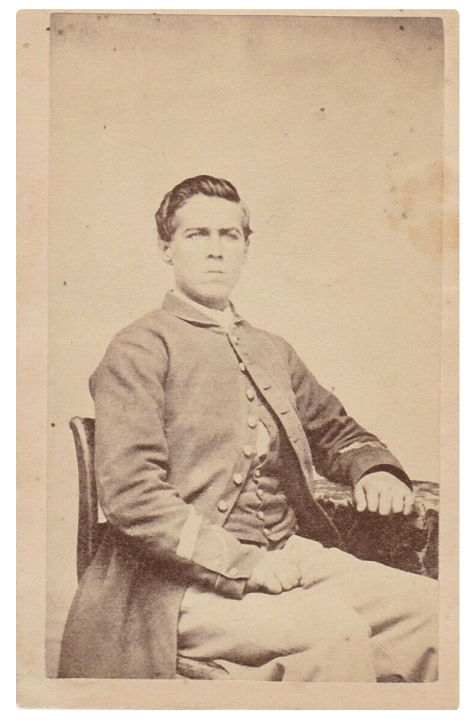
The following letter was written by John Wells Sanborn (1843-1930) of Co. D, 4th New Hampshire Infantry. An obituary, published in the Palm Beach Post of 29 July 1930, reports that John was born in Sanbornton, Belknap county, New Hampshire on 7 May 1843. “He saw three years active service and during the capture of Morris Island was wounded and spent the remainder of the war in hospitals, being honorably discharged in September 1864.” After the war, John left New Hampshire to drive a bull team from Kansas City to Denver and enjoy life in Colorado. In 1874 he started a sheep ranch and eventually settled in Greeley, Colorado in 1884 where he lived until 1912. He then relocated to Lake City, Florida where he died in 1930. Census records reveal that John was the son of Christopher Sanborn (1803-1902) and his second wife, Mehitable Philbrick (1809-1883)
In this letter, John. gives a good description of Ferandina, Jacksonville and St. Augustine as the 4th New Hampshire made its way to Fort Marion where they would remain in garrison until October 1862.
T R A N S C R I P T I O N
Fort Marion
St. Augustine, Florida
May 3, 1862
Friend Luther,
I received your letter yesterday and was mighty glad to hear from you. I reckon there was no one in Co. D that felt any better than I did when I got your letter and papers and the same from home. I had been looking for news from you for some time and well I know I should get something worth reading.
Well about Governor [Nathaniel S.] Berry’s paying us our state pay, I guess if you could hear the tall swearing some of the soldiers get off about him you would think he had not payed us nor has he yet. Nor is there any prospect of his doing so very soon. So for once the Democrats don’t blow for nothing.
Ruth Smith’s marriage was news to me. What does King David think to have his boys leaving him so in his old age? I delivered the tobacco you sent to Horace who I guess thought it was a curious present. He had some bad spells of bleeding at the nose a few days ago but is now doing well.
When we went to Fernandina, we were all well pleased for although it is not so large or wealthy a place as this place, or Jacksonville, yet there is something about it that seems more like our pleasant hills in New Hampshire. The buildings and land look much more like those at home. The streets are of good width, well laid out, and a little sandy with many fine shade trees. In going up the river to Jacksonville, interesting sights presented themselves all of the way. Most of the way the banks are thickly wooded. Now and then you see cleared spots with a few negro huts here. You always see the occupants with flags of some kinds raised and waving handkerchiefs and showing every demonstrations of joy. On a little farther you see a good building looking out from some remote spot among the trees—also the negro shanties scattered around it. At these places you generally see white women, but not a man, if any there be dare show their heads. Corn was just large enough to be plainly seen. All these things with the expectation of being saluted with a ball or shell kept up quite an excitement.
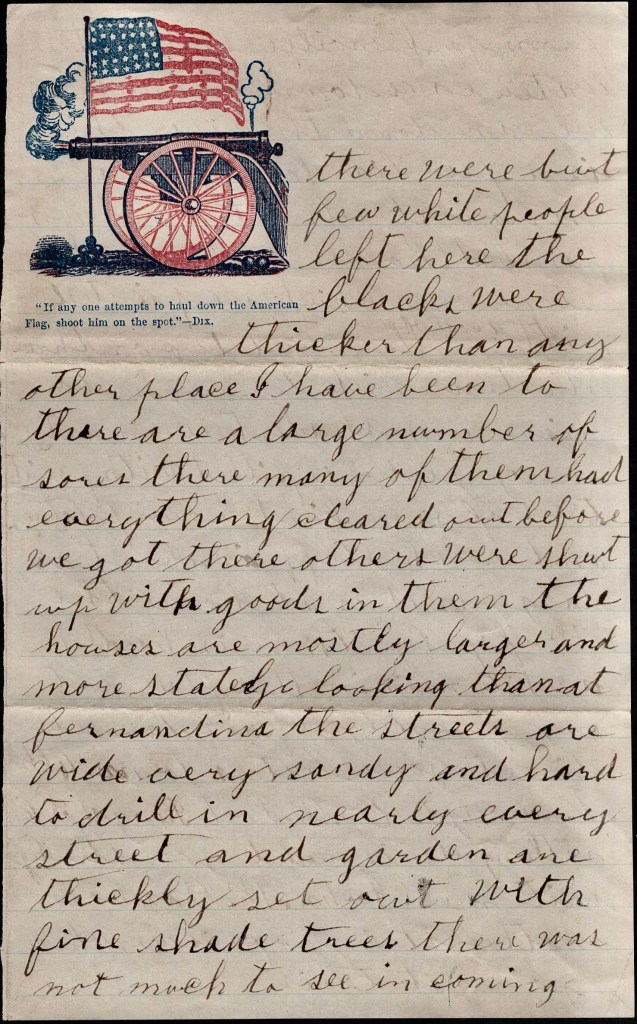
Nearing Jacksonville, clouds of smoke could be seen rising on both sides of the river. This was the rebels last work before leaving. They burned a lot of sawmills, foundries, machine shops and a large hotel. Nearly everything on shore seemed to be on fire. There were but few white people left here. The Blacks were thicker than any other place I have been to. There are a large number of stores there [but] many of them had everything cleared out before we got there. Others were shut up with goods in them. The houses were mostly larger and more stately looking than at Fernandina. The streets are wide, very sandy, and hard to drill in. Nearly every street and garden are thivkly set out with fine shade trees.
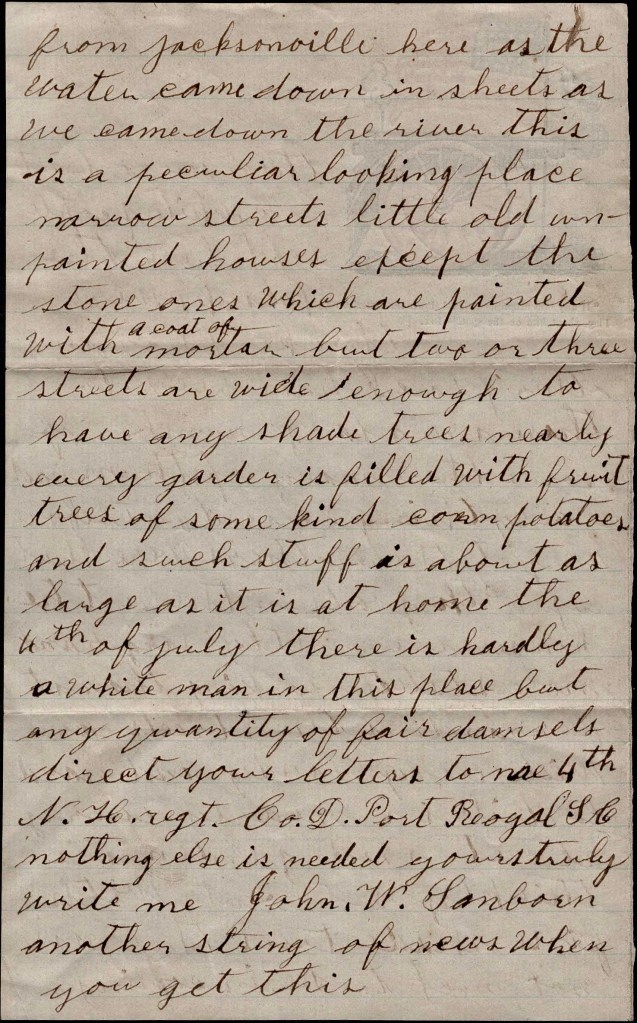
There was no much to see in coming from Jacksonville here as the water came down in sheets as we came down the river. This is a peculiar looking place—narrow streets, little old unpainted houses except the stone ones which are painted with a coat of mortar. But two or three streets are wide enough to have any shade trees. Nearly every garden is filled with fruit trees of some kind, corn, potatoes, and such stuff is about as large as it is at home [by] the 4th of July. There is hardly a white man in this place but any quantity of fair damsels. 1
Direct your letters to me, 4th N. H. Regt., Co. D, Port Royal, S. C. Nothing else is needed. Yours truly, — John W. Sanborn
Write me another string of news when you get this.
1 To the annoyance of the soldiers of the 4th New Hampshire, the young damsels would often gather at the Plaza in St. Augustine, visibly chipping off pieces from the flagpole stump as souvenirs. This was from the flagpole that once waved the Confederate standard before they cut down the pole to prevent Union troops from flying the Stars and Stripes from it. [Source: St. August During the Civil War by Omega G. East, Florida Historical Quarterly, 1952.]


 Spared & Shared 23