

The following letters were written by Pvt. George W. Roe (1831-1864) of Co. A, 109th New York Infantry. That company was recruited principally at Newfield, Caroline and Danby in Tompkins county. I was able to find him buried in Roe Cemetery which is located in Caroline. His parents were Phillips Roe (1801-1885) and Mary Jones (1804-1873). George was married to Sarah Adeline (“Ada”) McPherson (1838-1915). George’s headstone is smashed but it is possible to see the 109th Regiment on it and the cemetery register gives his death date as 27 June 1864.
The regiment was transported from Binghamton to Annapolis Junction, Md., where it was placed on guard duty along the line of railroad to Washington, a few of the companies being stationed at Laurel, Md. It remained there the rest of the year and during all of 1863. In the spring of 1864, the regiment was ordered to join the 9th corps, then assembling at Annapolis, and participated in the Overland Campaign. During the final eleven months of service, the regiment lost 614 men in killed and wounded, aside from the missing or prisoners. Its loss by death during service was 5 officers and 160 men; by disease and other causes, 164 men—total deaths, 329. The percentage of killed, 165 to the total enrollment, 1.353. was 12.1. It was mustered out of service June 4, 1865, at Delaney house, D. C.
Annapolis Junction was located about midway between Baltimore and Washington cities, on the Washington Branch of the Baltimore and Ohio Railroad. It is about equidistant, say nineteen miles from each of the cities of Baltimore, Washington and Annapolis.

Letter 1
Headquarters 109th N. Y. V.
Annapolis Junction, Maryland
September 5th 1863
Dear Ada,
Your kind & affectionate letter of August 30th came to hand last night and as I had been to Washington I did not feel much like writing last night & now this will not go out of the office until Monday morning. I have nearly recovered from my sickness but do not feel much like laboring. I have not done any duty since I have been here & shall not until I get entirely over the sickness.
Harrison & I went to Washington Thursday night & returned yesterday. I got my bounty but shall not be able to send as much to you at present as I expected to as we bought quite a lot of things to sell out in camp and it has run me rather short. I will send ten dollars now and after payday I can send more or & fetch it maybe.
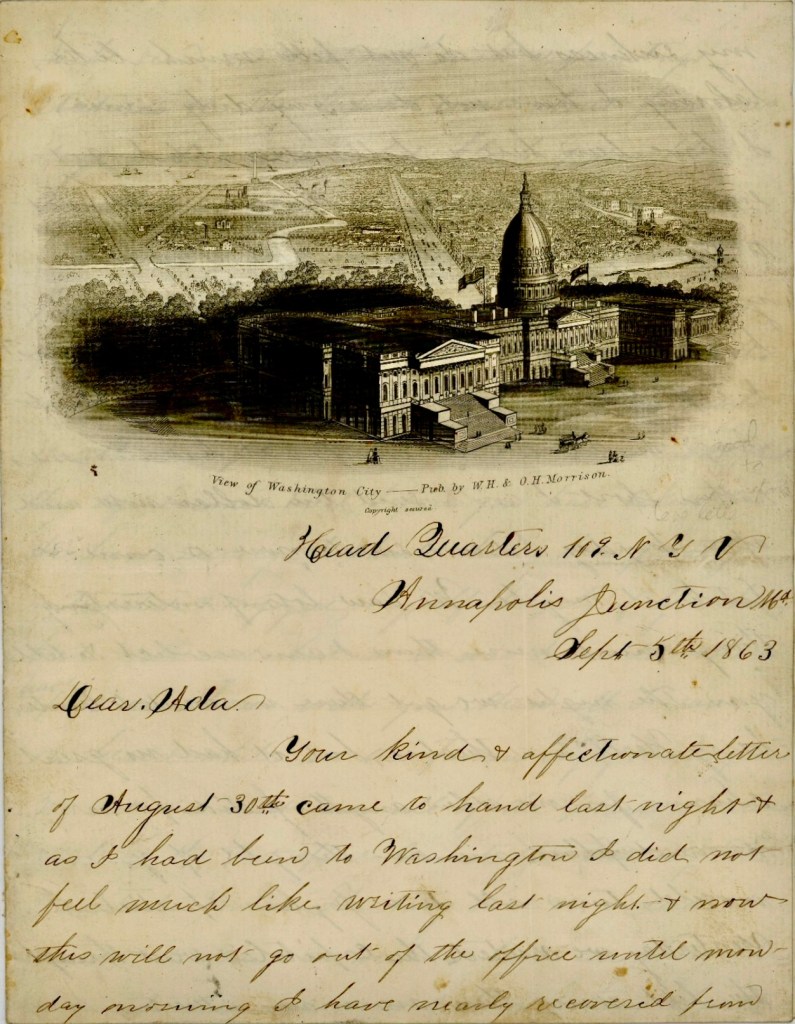
We saw lots of interesting things—much more than I can recollect to tell you. The night we got there we went to Canterberry Hall to a theatre but it had no great charms for me. When anything did for a moment please me, one thought of you would turn all to a joyless spectacle. Yesterday we visited the Capitol and went through the left wing. There are many interesting things to be seen in and about it such as paintings, statues, &c. the Capitol covers about four acres of ground and is a solid block of marble. We then went to the Smithsonian Institute which is filled with curiosities gathered from all parts of the world—birds and beasts of every description are to be seen & look as natural as if they were alive. Stones & minerals of all descriptions & curiosities so numerous that the eye becomes tired before you have taken the first survey. I should have been greatly interested & enjoyed myself hugely if you had been with me but as it was, I would rather have spent one hour with you than all I saw or heard while in the famous City of Washington.
We did not visit all of the places on interest such as the Post Office General, the Treasury, the President’s House, the Navy Yard, &c. Indeed, it needs at least a week to take everything like a comprehensive view of the interesting objects and places that are to be found at the Capitol of our country.
Now dearest, I will proceed to answer your letter as briefly as possible for fear I shall not have room. I know full well that you have suffered a great deal of anxiety on my account & as you say as much probably as I did from bodily pain. I am very sorry that you have to suffer so much, Indeed, I pity you from the bottom of my heart & were it within my power, gladly would I relieve you from every pang that you suffer—both bodily and mentally—even if it required my life to accomplish the object. Believe me, dearest, there is no sacrifice so great that I would not gladly submit to could I thereby secure your happiness. I will try hereafter to not give you any unnecssary pain in consequence of not writing often when I am sick if I am so unfortunate as to be sick again.
But in regard to Harrison [Tompkins] writing, that was not possible as he cannot get a pass to go out & in when he pleases. Indeed, he could not get a pass to come to the hospital for ten days after I was taken there & he said he tried to get one every day. But as I am well now, do not let us borrow any trouble but look on the pleasant side of the picture. You say that you are or at least think you look two or three years older than when I left. I hope that is not so for if you grow old so fast I fear I shall not find you at all when I come home if I should have to stay three years. You must not worry so much or I fear you will destroy your health & sink into a premature grave. So do not, dearest, for my sake, for in case of your decease, I should pray that some friendly bullet would put an end to my existence. I never want to return & find a seat vacated by your own dear self. I hope that the war will not last long & then our troubles will be at an end. Let us hope and not despair.
In regard to furloughs, if I got one it will not be longer than a ten day furlough and I think I shall get one of that length. I am going to see Captain about it & then I will write and let you know what he thinks about it. But rest assured I shall come if possible. In the meantime, do not give yourself any uneasiness. With many wishes for your welfare, I remain your ever faithful husband, — George W. Roe

Letter 2

Annapolis Junction, Maryland
September 9th 1863
Dear Ada,
Yours of September 6th I received about four o’clock and hasten to reply. I did not expect that my presence would be required at home quite so soon. But as you think it best I shall try & get a furlough immediately. I went and saw the Colonel this forenoon & he said that he would try to & get me a furlough for fifteen days & Captain said that he would have an application made out tomorrow & Lieut. Meed promised me some days ago that he would go to Washington and put it through if I wanted him to. I expect Meed will be in camp tomorrow morning & I shall try and have him go down tomorrow if possible. If nothing happens to delay & everything works well, I think I shall get started this week & will be home by Monday or Tuesday. But do not look for me until I come as there is nothing certain in military matters.
You say that John Maltly is there and that he is drafted. Give him my best respects & tell him to come and enlist in the 109th Regiment. If he gets here & gets mustered in, there is no earthly power that can hurt him for it & he will get $75 bounty from the State. If he is not already examined and mustered into the service, I should like very much to have him come & join our company. He can come here and be examined & mustered in & the authorities of Pennsylvania will not affect him unless he has already been examined.
On the first page of this sheet, you will see is a picture of the Smithsonian Institution which I told you contains a collection of curiosities from all parts of the world. I mean if it ever happens so that I can have you go with me & visit that as well as many other places of interest in the City of Washington.
Reuben Youngs 1 got his face severely burned this afternoon. It happened in this way. William Debell 2—-one of our tent mates—got a cannon cartridge while on patrol down to Savage & brought it to camp & hung it up in the tent. While he was out, Harrison [Tompkins] 3 and Reuben thought they would come a joke on Bill so Rube took the powder & some matches & went out back to explode it. He placed a piece of paper on the powder & placed fire at the other end. He thought it was not going & so he moved the paper so that the wind would blow it towards the powder [and] at that instant, sparks blew into the powder & it exploded & burned his face quite badly. I think, however, he will get along without much trouble as it is not burned very deep.
There is nothing of importance transpiring here but the same hum drum routine of camp life is all that comes under our observation. I do not think of anything more at present. You can answer this in a day or two after you get it if I do not come by that time. With many wishes for your welfare & remain as ever your affectionate husband, — Geo. W. Roe
To his beloved wife Ada Roe
1 Reuben Youngs of Caroline was 21 years old when he enlisted in Co. A on 12 August 1862. He died of disease on 5 September 1864 at City Point, Va.
2 William H. Debell of Danby was 18 years old when he enlisted as a private in Co. A on 12 August 1862. He was killed in action on 19 August 1864 at Weldon Railroad.
3 Harrison Tompkins of Newfield was 22 years old when he enlisted in Co. A on 12 August 1862. He mustered out with his company on 4 June 1865.


Letter 3
Annapolis Junction, Maryland
September 13th, 1863
Dear Ada,
Yours of September 9th I received last night & as no mail goes out until Monday morning, I thought I would wait until today to answer it. I am very sorry to learn that you are afflicted with such poor health. I have felt better for a few days back than I have since I went to the hospital. Indeed, I feel about as well as ever except that I am rather weak. I told you in my last that I should be home Monday or Tuesday which I should have done if I could have got a furlough without any difficulty but everything has worked against me. I have at last, however, got a furlough made out & tomorrow I shall take it over to the Colonel & he will send it to Washington & if approved there, I shall start as soon as it is returned. I cannot tell how soon that will be. Sometimes it will come back in a day or two and at others, it will be a week or more before it gets around. I think however I shall get it as soon as to start by the 20th if not before unless it is disapproved at headquarters. In such a case, I do not know what I should do for it seems to me that I must come at some rate if they shoot me for it.
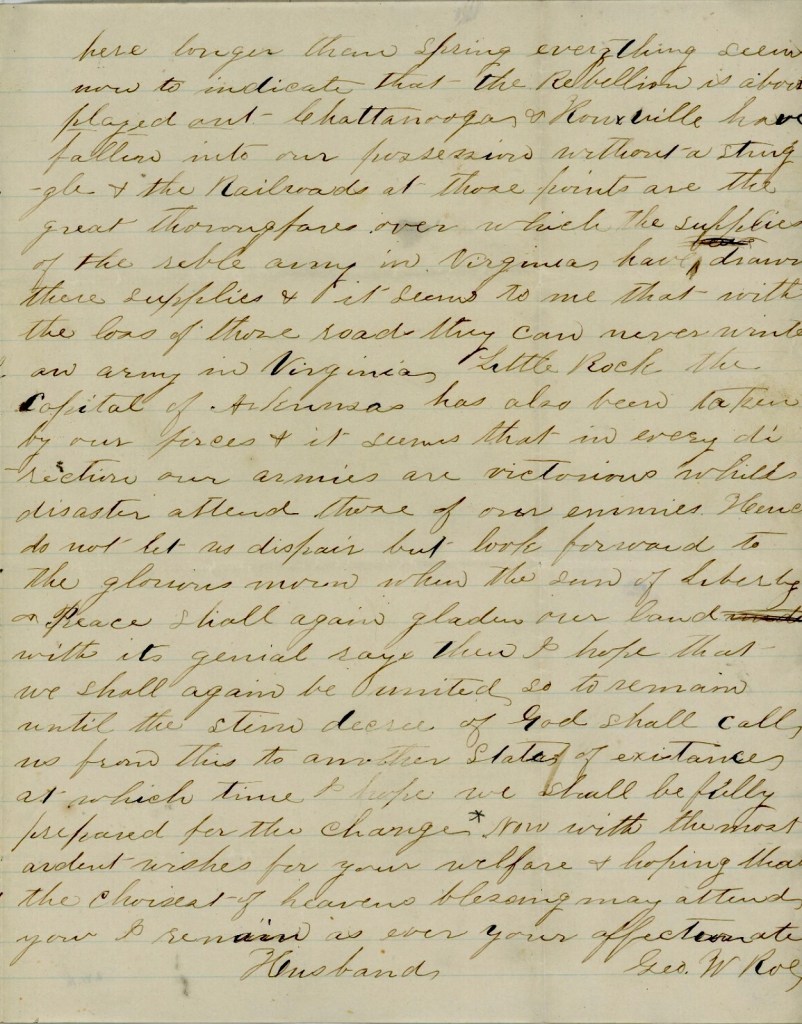
In regard to money, I sent you ten dollars as week ago & I presume you have received it before this time. You say that you are about discouraged. You must not give way to such feelings but hope for the best. I shall be home in a week or so now & then I will try to have things fixed more comfortable for you & we will also discuss the question about you coming down here. I hope that I shall not have to stay here longer than spring. Everything seems to indicate the Rebellion is about played out. Chattanooga & Knoxville have fallen into our possessions without a struggle and the railroads at those points are the great thoroughfares over which the supplies of the rebel army in Virginia have drawn their supplies & it seems to me that with the loss of those roads, they can never winter an army in Virginia.
Little Rock, the Capitol of Arkansas, has also been taken by our forces & it seems that in every direction our armies are victorious while disaster attends those of our enemies. Hence, do not despair but look forward to the glorious morn when the sun of Liberty & Peace shall again gladden our land with its genial rays. Then I hope that we shall again be united so to remain until the stern decree of God shall call us from this to another state of existence at which time I hope we shall be fully prepared for the change.
Now, with the utmost ardent wishes for your welfare and hoping that the choicest of heaven’s blessing mat attend you, I remain as ever your affectionate husband, — Geo. W. Roe


 Spared & Shared 23