

This letter was composed by Oliver M. Able (1820-1883), the progeny of William Abel (1796-1880) and Alma Sager (1805-1861). In October 1842, Oliver entered into matrimony with Sally L. Ferris (1822-1900). The couple engaged in agriculture in Perry, Shiawassee County, Michigan, and by the time Oliver, then 42 years old, enlisted on 13 August 1862 as a private in Company H, 23rd Michigan Infantry, they had borne as many as eight children. In his letter, written three months into his three-year term of service, he conveyed his struggles with rheumatism, which compelled him to seek a disability discharge, ultimately granted on 20 February 1863 in Bowling Green, Kentucky.
The 23rd Michigan left Saginaw on the 18th of September 1862, under the command of Colonel Chapin, proceeding at once to Kentucky, its muster rolls showing a force of 983 officers and men. Soon after its arrival, it was assigned to the Tenth Division of General Rosecrans’ Army, then pushed forward to Bowling Green. While there a detachment of the Regiment was attacked by a superior force of Confederate guerrillas, but were repulsed. The 23rd remained at Bowling Green until May 29,1863, employed in guarding the trains.
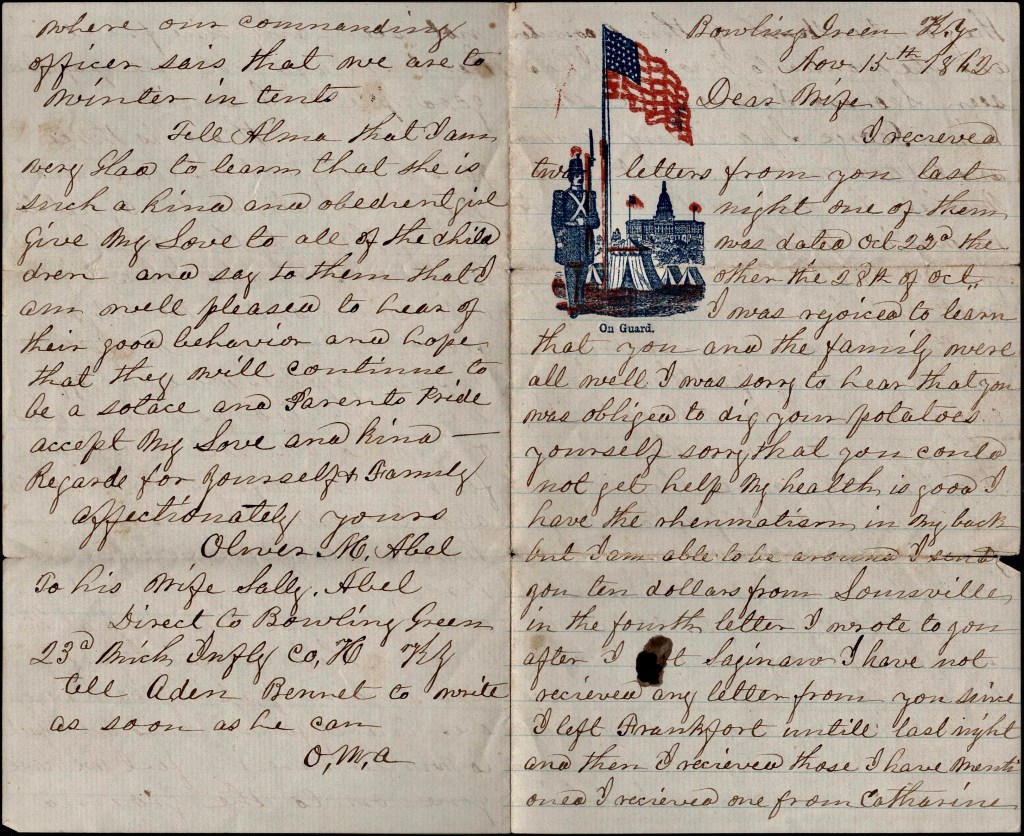
T R A N S C R I P T I O N

Bowling Green. Kentucky
November 15th 1862
Dear Wife,
I received two letters from you last night. One of them was dated October 22nd. The other the 28th of October. I was rejoiced to learn that you and the family were all well. I was sorry to hear that you was obliged to dig your potatoes yourself. Sorry that you could not get help.
My health is good. I have the rheumatism in my back but I am able to be around. I sentr you ten dollars from Louisville in the fourth letter I wrote to you after I left Saginaw. I have not received any letter from you since I left Frankfort until last night and then I received those I have mentioned. I received one from Catharine the fourteenth of this November and she wanted to know if I had seen Leonard. I have not seen him. George Spaulding saw him and talked with him at New Market. He was well and hearty. He was in Michigan 2nd Cavalry.
You ask me how I like soldiering. Well only I do not like this lying in the dirt and being so dirty and smutty looking. If Father is going East and wants to sell you his things and you want them, why buy them of course. They are second hand things. Don’t pay too much for them. Keep in good courage as I am in the firm believe that I shall get to return to my family.
Bowling Green is quite a place for a Kentucky town. There is some very nice churches and dwellings and some splendid orchards here—that is, the trees grow very large and thrifty but I have not seen any nice fruit in Kentucky and not one passable good pie or biscuit.
There is three fort or fortifications commanding. the place—all built by Rebels. One of them by the Rebel General [Simon] Buckner situated on a high hill commanding the city and all of its surroundings. 1 But his supplies were cut off by the Union troops and he was obliged to evacuate it too soon for his own safety as he was killed about eighteen miles from here. There is a railroad passing through here doing a large and extensive business at this time. There are certainly as many as six trains passing each way every twenty-four hours.
We expect to winter here. In fact, we have gone on to the ground where our commanding officer says that we are to winter in tents.
Tell Alma that I am very glad to learn that she is such a kind and obedient girl. Give my love to all of the children and say to them that I am well pleased to hear of their good behavior and hope that they will continue to be a solace and parents’ pride. Accept my love and kind regards for yourself & family. Affectionately yours, — Oliver M. Abel
To his wife Sally Abel.
Direct to Bowling Green, Kentucky, 23rd Michigan Infantry, Co. H
Tell Aden Bennett to write as soon as he can. — O. M. A.
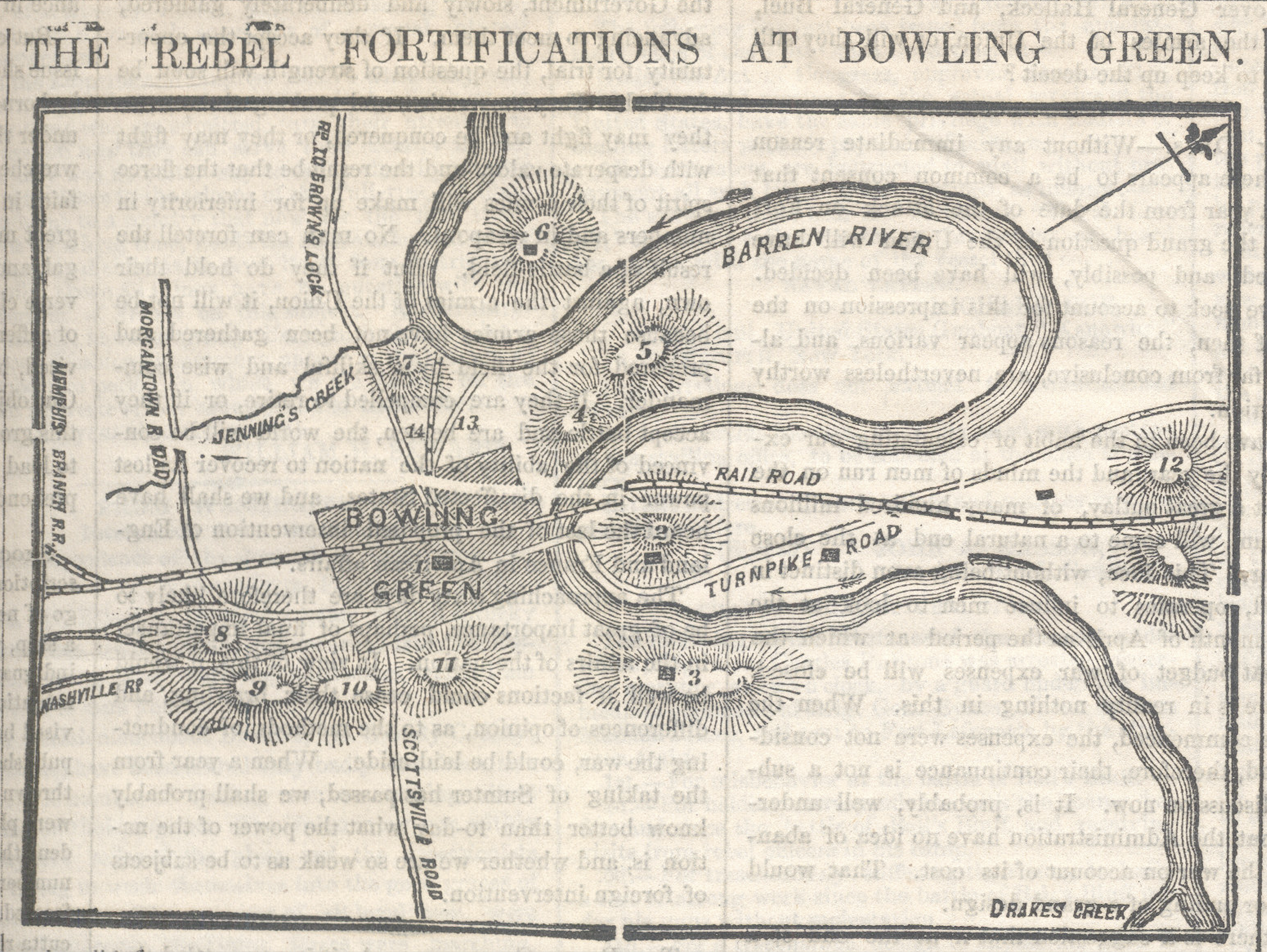
1 The two largest fortifications built by the Confederates were Fort C. F. Smith and Fort Baker. The former was built on Reservoir Hill south of town. The latter was built on a hill north of the city on the Barren River.

 Spared & Shared 23